Best Stock Scoring Approaches Compared (2026): Ziggma vs. Zacks, Seeking Alpha, and Morningstar

September 30, 2025

Key Takeaways

  • Stock scoring systems help investors quickly identify high-quality companies
  • Each system reflects a different philosophy: momentum, valuation, or multi-factor analysis
  • Ziggma offers a transparent, fundamentals-first 0–100 score designed for long-term investors
  • The best choice depends on your time horizon and investing style

Why Stock Scoring Systems Matter

Choosing the right stocks is hard. Thousands of companies, endless metrics, conflicting opinions.

Stock scoring systems cut through the noise by turning complex data into a single, comparable signal.

They act like a compass:

  • Highlight strong companies
  • Surface hidden risks
  • Save time in research

But not all scores are created equal. Some chase short-term momentum. Others focus on valuation. A few take a broader, multi-factor view.

The Main Approaches at a Glance

Ziggma Stock Score

A multi-factor, fundamentals-driven score (0–100) built for medium- to long-term investors.
It evaluates profitability, growth, valuation, and financial strength across a multi-year horizon — and ranks stocks relative to peers.

Zacks Rank

A momentum-focused model based on earnings estimate revisions.
It ranks stocks from 1 (Strong Buy) to 5 (Strong Sell) and is widely used for short-term trading signals.

Seeking Alpha Quant Rating

A factor-based “report card” grading stocks A–F across:

  • Valuation
  • Growth
  • Profitability
  • Momentum
  • EPS revisions

Scores are relative to sector peers and combine into an overall rating.

Morningstar Rating

A valuation-driven system based on discounted cash flow (DCF) models.
Stocks receive 1–5 stars depending on how their price compares to estimated fair value.
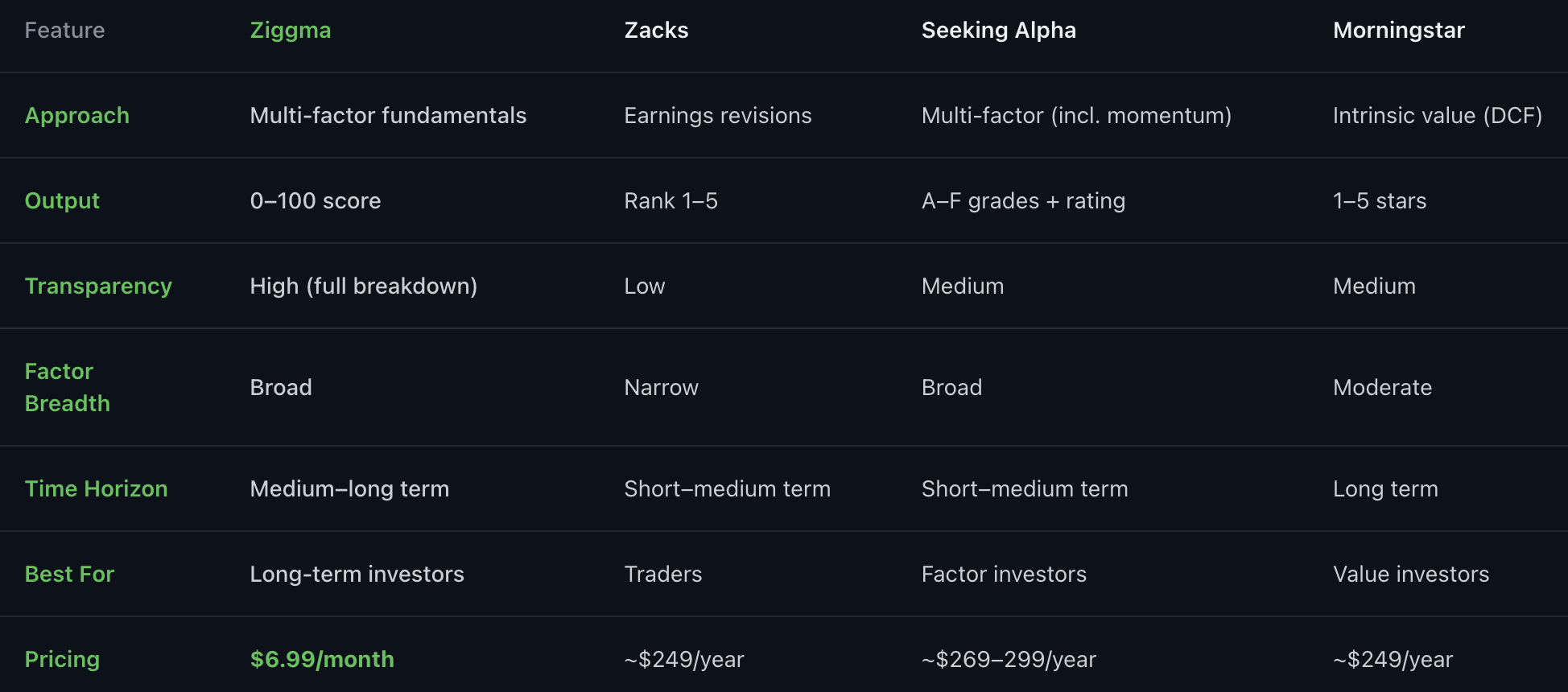
Overview table for different stock scoring approaches

What Really Drives the Differences

1. Time Horizon

  • Zacks → short-term earnings momentum
  • Seeking Alpha → mixed, momentum-sensitive
  • Morningstar → long-term valuation
  • Ziggma → balanced long-term fundamentals

2. What Gets Rewarded

  • Zacks → estimate revisions
  • Seeking Alpha → momentum + revisions + fundamentals
  • Morningstar → undervaluation
  • Ziggma → business quality + financial strength + growth + valuation

3. Transparency

  • Ziggma → clear factor breakdown
  • Seeking Alpha → visible grades, hidden weights
  • Morningstar → visible fair value, hidden assumptions
  • Zacks → largely a black box

Which System Fits You?

  • Short-term trader → Zacks
  • Factor-driven investor → Seeking Alpha
  • Value investor → Morningstar
  • Long-term, fundamentals-first investor → Ziggma

Why Many Investors Move Toward Multi-Factor Models

Single-factor systems (like earnings revisions or valuation) can work — but they’re narrow.

Multi-factor approaches:

  • Reduce blind spots
  • Capture more dimensions of quality
  • Provide more stable signals over time

That’s why institutional investors rely heavily on them — and why tools like Ziggma bring that approach to self-directed investors.

The Bottom Line

Stock scoring systems aren’t just tools — they shape how you invest.

  • Zacks helps you trade
  • Morningstar helps you value
  • Seeking Alpha helps you compare factors
  • Ziggma helps you understand the full picture

If you care about long-term performance, clarity, and independence, a transparent, fundamentals-first score is hard to beat.

See Your Own Portfolio Score

Most investors don’t realize what’s actually driving their returns.

  • Are you overexposed?
  • Holding weak companies?
  • Missing better alternatives?

Run your portfolio through Ziggma and find out in minutes.