GoodStocks Research: Why GEV stock gains from AI power demand
November 3, 2026
On April 2, 2024, GE Vernova rang the New York Stock Exchange opening bell alongside GE Aerospace, as General Electric completed its breakup. Wall Street could not agree on what the energy business was worth. Jefferies valued GE Vernova at $100 a share. BofA Securities said $116. GEV closed its first day of trading at $131.25.
Two and a half years later, GE Vernova (GEV) closed at $918.20 on November 3, 2026, about seven times that first close. The reason is electricity. GE Vernova booked $29.3B of orders in the third quarter of 2026, up 96% from a year earlier on an organic basis. AI data centers are buying its gas turbines to stay online around the clock. Utilities are buying its grid equipment and wind turbines to cut emissions.
That overlap is why GE Vernova is part of Ziggma’s GoodStocks research, which features companies where strong shareholder returns and real-world positive impact converge. The impact story has a catch, though. GE Vernova runs on 85% renewable energy, yet its global warming potential has risen from 1.4°C to 2.3°C since May.
Ziggma Stock Score, Impact Score, price and analyst data are as of the November 3, 2026 close. Backlog, revenue and dividend figures come from GE Vernova’s third quarter 2026 results, published October 28, 2026. Net margin and the 2027 revenue projection are from May 2026.
The return case
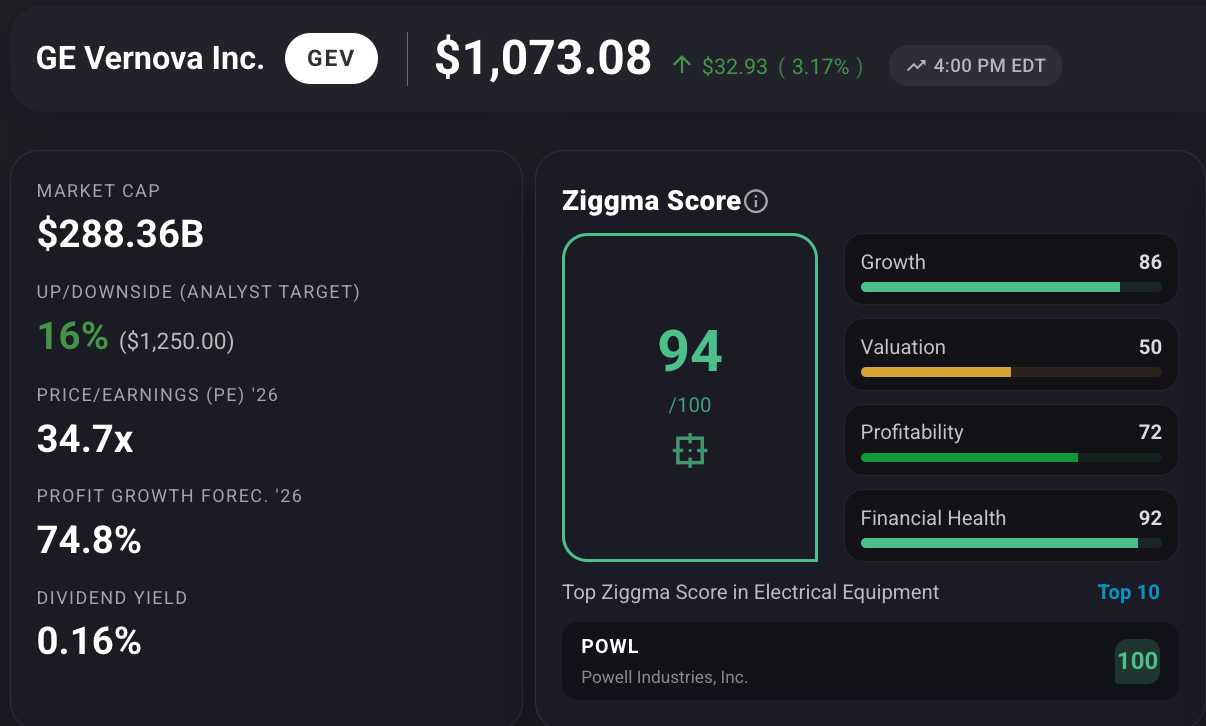
AI data centers, electrification and grid upgrades are lifting power demand. GE Vernova’s backlog reached $197B at September 30, 2026. GEV’s Ziggma Stock Score is 89/100, and analysts see 36% upside to a $1,250 target.
The impact case
GE Vernova’s wind turbines, grid equipment and efficient gas turbines help utilities add cleaner, reliable power. Its Impact Score is 72, rated Positive. GE Vernova gets 85% of its own energy from renewables.
Key takeaways
GE Vernova makes gas turbines, wind turbines and grid equipment, which puts it at the center of AI-driven power demand.
GE Vernova, Siemens Energy and Mitsubishi Heavy Industries lead the global market for large, high-efficiency gas turbines.
GE Vernova’s backlog reached $197B at September 30, 2026, and CEO Scott Strazik expects it to exceed $200B in the fourth quarter.
GEV’s Ziggma Stock Score is 89/100, led by Growth (83). Valuation (57) is its weakest pillar.
GE Vernova’s Impact Score is 72, rated Positive, led by Resource Use (81). Its 2.3°C global warming potential is its weakest impact metric.
Source: Ziggma, GE Vernova (GEV) stock profile
Why AI power demand is lifting GEV stock
AI power demand is lifting GEV stock because AI data centers need far more electricity than utilities planned for. GE Vernova’s equipment generates, transmits and stabilizes electricity across gas, wind and grid markets. That exposes GE Vernova to three trends at once:
the AI infrastructure boom
electrification of the economy
the global expansion of renewable energy
GEV stock closed at $918.20 on November 3, 2026, giving GE Vernova a market value of $243B. Analysts’ $1,250 price target implies 36% upside. The bigger question for GEV stock is how long the current power investment cycle lasts.
What does GE Vernova do?
GE Vernova is a power equipment and services company that General Electric spun off on April 2, 2024. GE Vernova trades on the New York Stock Exchange under the ticker GEV.
GE Vernova reports three segments:
Power
Electrification
Wind
GE Vernova makes gas turbines, wind turbines, grid equipment, transmission systems and software. Its customers are utilities and industrial companies worldwide.
GE Vernova’s strongest position is in gas turbines. GE Vernova, Siemens Energy and Mitsubishi Heavy Industries lead the global market for large, high-efficiency gas turbines. Utilities need these turbines to back up wind and solar and to serve new AI data centers. With only three major suppliers, GE Vernova has pricing power.
Advanced gas turbines take decades of engineering and large capital investment to build. Utilities cannot easily switch suppliers once the equipment is installed.
GE Vernova financial analysis: AI is pulling forward power demand
GE Vernova benefits from a change in electricity demand. For years, demand in developed markets grew slowly. AI data centers, electric vehicles and electrifying factories have changed that. Utilities now need far more generation capacity than they planned for.
GE Vernova’s backlog shows the scale of that demand. The backlog reached $197B at September 30, 2026, up $20B in the third quarter alone, according to GE Vernova’s third quarter 2026 results. It spans gas turbines, grid equipment, wind projects and long-term service agreements.
Service agreements matter for GEV stock because service revenue tends to be recurring and highly profitable.
How fast are GE Vernova’s revenue and earnings growing?
GE Vernova’s revenue and profit are rising quickly. In the third quarter of 2026, GE Vernova’s revenue rose about 27% to $12.6B. Analysts expect GE Vernova’s profit to grow 78.8% in 2026.
GE Vernova’s revenue was roughly $33B in 2023. In May 2026, analysts projected more than $50B by 2027. GE Vernova lost money in 2023. Earnings per share then rose sharply over the twelve months to May 2026.
GE Vernova’s net profit margin was negative in 2023 and roughly 24% over the twelve months to May 2026. Return on assets also rose sharply. Both point to operating leverage as volumes grow.
GE Vernova’s Ziggma Stock Score is 89/100 as of November 3, 2026, down from 94 in May 2026. Its four pillar scores are:
Growth: 83
Valuation: 57
Profitability: 71
Financial Health: 74
GEV trades at 29.0x expected 2026 earnings, against 78.8% expected profit growth in 2026. That puts the PEG (price/earnings-to-growth) ratio well below 1. A PEG below 1 suggests earnings growth may exceed what the share price reflects.
Why do gas turbines matter for AI data centers?
Gas turbines matter for AI data centers because data centers need reliable power 24 hours a day. Wind and solar output varies with the weather. Utilities therefore need flexible generation that can stabilize the grid as more renewables come online.
GE Vernova’s combined-cycle gas turbines are among the most efficient large-scale power plants available. Demand for them is rising fast. GE Vernova’s gas power equipment backlog and slot reservations reached 122 GW in the third quarter of 2026.
Gas turbines still burn fossil fuel. Replacing coal plants with gas plants does cut emissions, though. In 2019, US coal plants emitted 2,257 pounds of CO2 per megawatt-hour and gas plants emitted 976, according to the US Energy Information Administration (EIA).
Is GEV stock overvalued?
GEV stock is not cheap, but its growth offsets much of the premium. GEV trades at 29.0x expected 2026 earnings. Valuation, at 57, is the weakest of its four Ziggma Stock Score pillars.
Analysts see 36% upside to a $1,250 price target. Expected profit growth of 78.8% in 2026 keeps the PEG ratio well below 1. GE Vernova may also be early in a multi-year infrastructure cycle driven by AI and electrification.
What are the risks of GE Vernova stock?
Execution is the main risk for GE Vernova, because large infrastructure projects often run late or over budget. Wind markets are cyclical and politically sensitive. Gas turbine orders may slow if the economy weakens or utilities delay spending. GEV stock’s sharp rise also means investors should expect volatility.
Bottom line on GEV stock returns
GE Vernova is a picks-and-shovels play on AI. GE Vernova doesn’t build chips. It builds the power infrastructure those chips need.
GE Vernova impact analysis: enabling the energy transition
Source: Ziggma, GE Vernova (GEV) impact profile
GE Vernova’s impact comes from helping power systems grow while emissions fall. The world needs far more electricity as it moves away from coal and oil. The energy transition requires:
grid modernization
renewable integration
efficient power generation
transmission infrastructure
GE Vernova supplies all four. Its wind turbines, transmission equipment, grid-balancing technology and efficient gas turbines help utilities add renewables without losing reliability. That makes GE Vernova an enabler of the energy transition in Ziggma’s GoodStocks research.
Is GE Vernova a sustainable stock?
GE Vernova is a sustainable stock by Ziggma’s measure. Its Impact Score is 72, rated Positive, based on ACA Ethos data as of November 3, 2026. The four Impact Score areas break down as follows:
Resource Use scores 81, GE Vernova’s strongest area. GE Vernova gets 85% of its own energy from renewables.
Fair Labor scores 62. Gender equality scores 76, while a CEO-to-median worker pay ratio of 176:1 scores 42.
Climate Action scores 57. Carbon intensity scores 62 and is down 2.2%.
Accountability scores 51. Privacy and data management scores 91, while fines and violations score 16.
GE Vernova’s 2.3°C global warming potential is below the S&P 500’s 4.0°C.
Where is GE Vernova’s impact profile weaker?
GE Vernova’s weakest impact metric is its global warming potential. At 2.3°C, up from 1.4°C in May 2026, it sits above the Paris Agreement goal of well below 2°C and scores 0 out of 100. A Climate Action score of 57 stands out for a company that enables the energy transition. Waste recycling, at 46%, scores 40. Fines and violations score 16. Investors who own GEV should watch these areas.
See GE Vernova’s full Ziggma Stock Score and Impact Score
Compare GEV’s fundamentals and climate data with every stock you own.
Conclusion: GE Vernova is a GoodStock where returns and impact converge
GE Vernova is a GoodStock because AI demand and the energy transition both run through its products. The AI boom is creating demand for electricity infrastructure as well as chips and software. That demand flows to the few companies that can generate, transmit and stabilize power at global scale.
GE Vernova is one of them. Its backlog reached $197B in September 2026. Its gas turbine position is hard to replicate. Its technology supports both electrification and cleaner power.
GEV meets the GoodStocks criteria. GE Vernova helps solve one of the world’s largest infrastructure problems while creating substantial shareholder value. Compare GEV with Ziggma’s best sustainable stocks.
GE Vernova stock FAQ
What does GE Vernova do?
GE Vernova makes equipment and services that generate, transmit and convert electricity. Its three segments are Power, Electrification and Wind. At its April 2024 spin-off, GE Vernova said its installed base helped generate about 30% of the world’s electricity. See how GEV compares with Ziggma’s best renewable energy stocks.
When did GE Vernova spin off from General Electric?
GE Vernova spun off from General Electric on April 2, 2024. GE shareholders received one GEV share for every four GE shares. GEV trades on the New York Stock Exchange. You can follow GEV in the Ziggma free portfolio tracker.
Who are GE Vernova’s main competitors?
GE Vernova’s main competitors in large gas turbines are Siemens Energy and Mitsubishi Heavy Industries. The three companies lead the global market for large, high-efficiency gas turbines. You can compare GEV with peers in the Ziggma impact stock screener.
Does GEV stock pay a dividend?
Yes. GE Vernova pays a quarterly dividend of $0.50 per share. GE Vernova doubled the dividend from $0.25 in December 2025. The latest dividend is payable on November 24, 2026. Ziggma Portfolio Checkup shows how a stock like GEV fits your portfolio.
What is GE Vernova’s Ziggma Stock Score?
GE Vernova’s Ziggma Stock Score is 89/100 as of November 3, 2026, down from 94 in May 2026. Its pillar scores are Growth 83, Valuation 57, Profitability 71 and Financial Health 74. The Ziggma Stock Score rates fundamental quality from 0 to 100. Learn how the Ziggma Stock Score works.
What is GE Vernova’s global warming potential?
GE Vernova’s global warming potential is 2.3°C as of November 3, 2026, up from 1.4°C in May 2026. Global warming potential shows the level of warming a company’s emissions path is aligned with. The S&P 500’s global warming potential is 4.0°C, based on September 2026 data. Read more about portfolio temperature alignment.
Is GE Vernova a sustainable stock?
Yes, by Ziggma’s measure. GE Vernova’s Impact Score is 72, rated Positive, as of November 3, 2026. Resource Use scores 81, Fair Labor 62, Climate Action 57 and Accountability 51. Its 2.3°C global warming potential is its weakest metric. Ziggma Impact X-Ray shows these scores for every stock you own.
Do gas turbines fit a climate-focused portfolio?
Gas turbines can fit a climate-focused portfolio when they replace coal. US gas plants emitted less than half the CO2 per megawatt-hour of coal plants in 2019, according to the US Energy Information Administration. Gas turbines still burn fossil fuel, so they are a bridge technology. Learn how to reduce your portfolio’s climate impact.
How big is GE Vernova’s backlog?
GE Vernova’s backlog was $197B at September 30, 2026. The backlog grew $20B in the third quarter of 2026. CEO Scott Strazik expects it to exceed $200B in the fourth quarter. Find companies with similar growth in the Ziggma free stock screener.
Which Ziggma lists include GE Vernova?
GE Vernova is on Ziggma’s best climate tech stocks list for 2026. GE Vernova is also a GoodStock in Ziggma’s GoodStocks research series.
Disclaimer and risk disclosures
Disclaimer This information is provided solely for general information and educational use. It is not intended as, and should not be construed to be, financial, investment, tax, legal, or other professional advice. Data used in the analysis is derived from third-party sources and applicable at the time of publication of the analysis. No representation or warranty is made as to the accuracy or completeness of the information or any analysis herein. Ziggma is not registered or licensed as a financial advisor, broker-dealer, or tax professional. Readers should perform their own independent research and seek advice from appropriately qualified professionals before making any financial, investment, or legal decisions. You should presume that, as of the date this report is published or any related communication referencing publicly traded securities or assets, Ziggma team members may hold positions in the securities or assets discussed and could benefit financially from price movements. Positions may be changed without notice. There is no duty to revise or update the content after publication. Neither Ziggma nor any affiliated parties accept responsibility for market changes, economic developments, or subsequent events that could affect the relevance or accuracy of the information.
Forward-Looking Statements This report may include forward-looking statements, such as forecasts, projections, estimates, or expectations regarding financial outcomes, market dynamics, or future corporate developments. These statements are based on assumptions that may not hold true, and actual results may vary materially. The author undertakes no obligation to update or revise any forward-looking statements as circumstances change.
Third-Party Data & External Sources Certain information is sourced from third parties. Nonetheless, the accuracy, completeness, and timeliness of such information cannot be assured. Ziggma disclaims any responsibility for errors or omissions in third-party data and does not endorse, verify, or assume accountability for the methodologies or conclusions of external sources.
AI-Generated Enhancements AI tools can be used to enhance clarity, structure, and brevity, and to assist with research organization, ideation, and analytical review.
Redistribution You may share this report for informational purposes. However, reproduction, distribution, republication, or modification of any portion of the content, in whole or in part, without prior written consent is prohibited.
Investment Risk Disclosure All investing carries risk of loss. Historical performance does not guarantee future outcomes. References to specific securities, companies, or strategies are for informational purposes only and do not constitute recommendations or endorsements. Any use of, or reliance on, the information in this report is entirely at the reader’s own risk. Neither Ziggma nor affiliated parties shall be liable for any direct or indirect losses or damages of any kind arising from the use of this report or reliance on its contents. By accessing this report, you agree to indemnify and hold harmless Ziggma and affiliated parties from any claims, liabilities, or damages resulting from your use of the material. You alone bear responsibility for your decisions. Use this information at your own discretion and risk.
Free Whitepaper
Your Complete Guide to Impact Investing
How to actually move the needle. Why public markets are where real impact happens, and how to act on it.
No spam. No newsletter — we'll only reach out for major updates.