The Greenwashing Files · Part 1 of 3
Here's something that might surprise you: by at least one measure, greenwashing is actually declining. A RepRisk study recorded a 12% drop in greenwashing incidents globally in 2024 — the first annual fall in six years. Regulators are paying attention. The days of a company slapping 'eco-friendly' on a product with zero evidence seem to be fading.
So why does it feel worse than ever?
Because the headline number hides what's really happening underneath it.
The old version was blunt — a fossil fuel company claiming carbon neutrality with nothing to back it up, a fund calling itself 'green' while holding the same stocks as everyone else. Those moves got companies into legal trouble, and rightly so.
But greenwashing learned from that. What's replaced it is harder to call out, harder to prove, and much easier to walk past without noticing.
Next: Part 2 of 3
Most investors who check are surprised by what they find. Get your free impact analysis — no credit card, no commitment, just clarity.
No credit card required. Takes 2 minutes.
Most of the conversation around greenwashing focuses on ethics — and fair enough. Being misled about what your money supports matters. But there's a harder-nosed case to make here too, and it doesn't get made often enough.
"When capital flows to companies with strong sustainability marketing rather than strong sustainability practice, it bypasses the businesses actually driving solutions — and the returns that come with them."
— Ziggma, Impact Investing Research
The evidence for genuine impact investing is actually compelling. Research by Schroders and Oxford Saïd Business School found that impact-driven equity portfolios outperformed the market by up to 9%, with less volatility. The companies solving real problems — clean energy, healthcare access, the circular economy — tend to deliver stronger, more resilient returns over time.
p>Greenwashing is the mechanism that redirects capital away from those companies and toward the imitators. Which means it doesn't just mislead your values. It may be quietly costing you returns too.
Funds marketed as sustainable may still hold fossil fuel producers, fast fashion manufacturers, and companies with poor labor records — because those companies have learned to manage their ESG scores even while continuing business as usual. Your values and your returns could both be exposed, and you'd have no way of knowing.
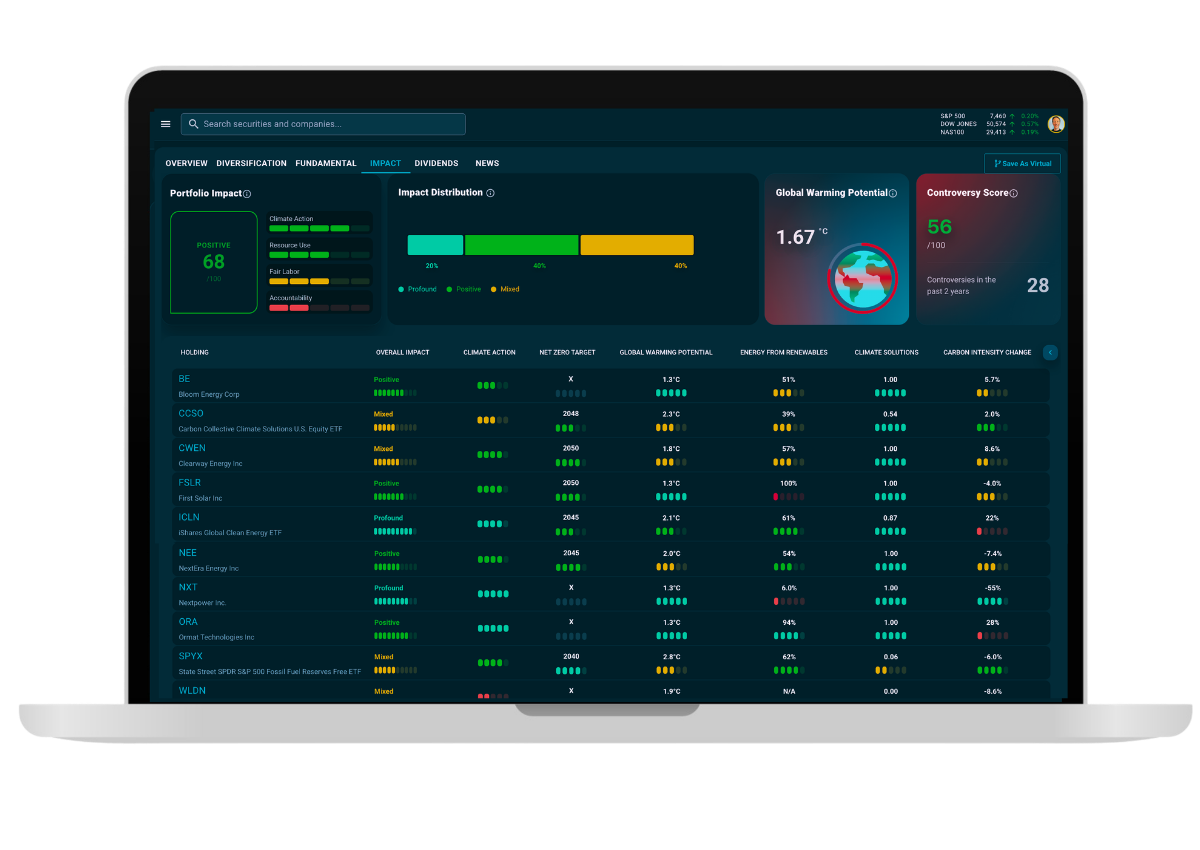
p>At Ziggma, we don't think the solution to misleading sustainability claims is more sustainability claims. It's transparency — the kind that can actually be checked.
That's why we partner with ACA Ethos, a leader in high-quality ESG and impact intelligence, to give you facts your broker won't show you.
p>How to actually move the needle. Why public markets are where real impact happens, and how to act on it.
No spam. No newsletter — we'll only reach out for major updates.