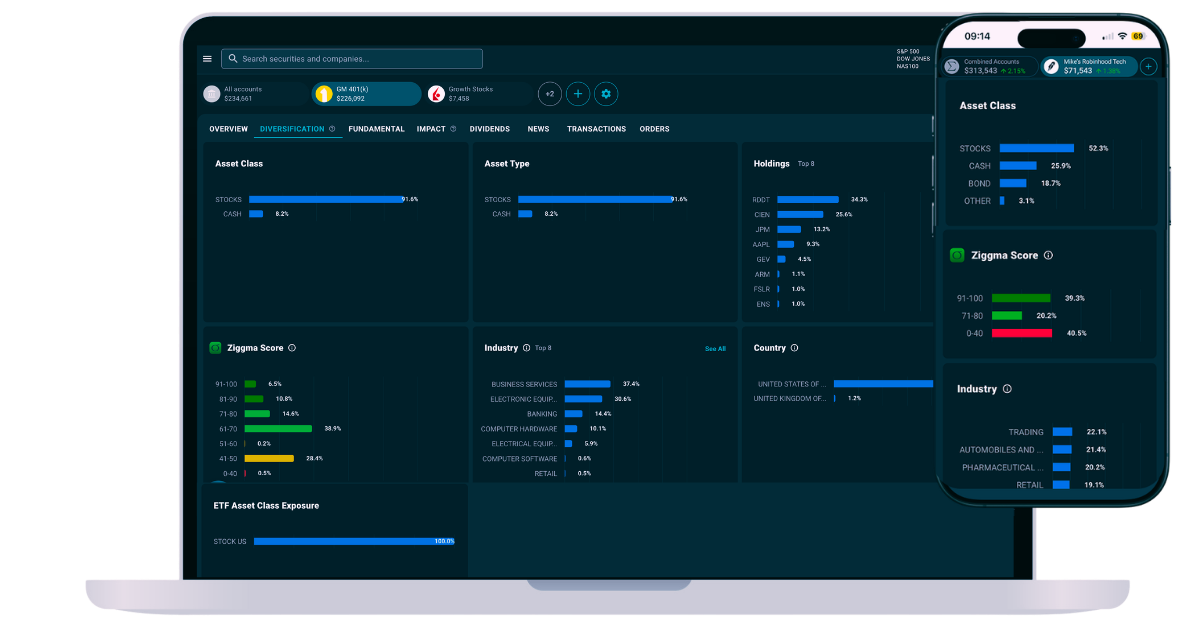
Discover where your portfolio is overly exposed. And how to build a more resilient portfolio over time.
Many investors believe they are diversified because they own several ETFs and dozens of stocks. Then they analyze their portfolio for the first time. That is often when an uncomfortable realization emerges: despite all those holdings, a surprisingly large share of the portfolio still depends on the same handful of companies.
This hidden concentration has become one of the defining risks of modern investing. Over the past decade, market leadership has narrowed dramatically. A relatively small group of companies has driven an outsized share of index performance, ETF returns and investor portfolios. As those companies continued outperforming, their weight inside portfolios quietly expanded.
The result is that many investors now carry far more concentration risk than they realize. And because concentration often builds gradually during strong markets, it typically remains invisible until volatility returns.
Concentration risk occurs when portfolio outcomes become too dependent on a limited number of companies, sectors, themes or economic drivers.
Importantly, concentration is not always obvious. A portfolio can look diversified on the surface while remaining highly exposed underneath. This is particularly common in portfolios built around multiple ETFs. Investors may own broad market funds, technology ETFs, AI-related strategies and individual growth stocks simultaneously, believing they are spreading risk widely across the market. In reality, many of those investments still revolve around the same underlying companies.
An investor holding the S&P 500, Nasdaq-focused ETFs and several technology funds may repeatedly own NVIDIA, Microsoft, Apple, Amazon and Meta across different products without fully realizing how concentrated overall exposure has become.
The portfolio feels diversified because there are many holdings. But economically, dependence may still be centered around the same market leadership.
One of the most widely used ways to measure concentration risk is the Herfindahl-Hirschman Index, often abbreviated as HHI. Originally developed in economics to measure market concentration, the HHI is also highly effective for evaluating how concentrated a portfolio has become.
The concept is straightforward: the index increases as portfolio weight becomes concentrated in fewer holdings. A portfolio evenly spread across many positions will have a low HHI, while a portfolio dominated by a small number of holdings will have a high HHI.
The calculation squares each portfolio weight and then adds the results together. Because larger positions are squared, the index penalizes concentration disproportionately. For example, a portfolio with one 20% position is considered significantly more concentrated than one with four separate 5% positions.

In practical terms:
Importantly, the HHI captures concentration more effectively than simply counting the number of stocks in a portfolio. A portfolio with 50 holdings can still have a high HHI if a few positions dominate overall exposure. That is why sophisticated portfolio analysis increasingly relies on concentration metrics such as the Herfindahl-Hirschman Index rather than headline holding counts alone.
👉 Measure your concentration risk with the Portfolio Checkup
Modern portfolios have become increasingly layered and complex. Investors frequently combine retirement accounts, multiple brokers, ETFs and individual stocks accumulated over many years. At the same time, passive investing has accelerated the concentration of capital into the largest index constituents. This creates a dynamic where portfolios often become more concentrated precisely when investors believe they are reducing risk.
Thematic investing can intensify the problem further. Portfolios built around AI, semiconductors, clean energy or electrification may appear diversified across numerous companies while still remaining highly dependent on the same economic forces, capital cycles and market narratives.
During favorable markets, concentration can amplify returns. But when leadership changes or market regimes shift, portfolios that seemed stable can suddenly become far more volatile than expected.
That is why concentration risk is not simply about owning large positions. It is about understanding how dependent a portfolio has become on a narrow set of outcomes.
.png)