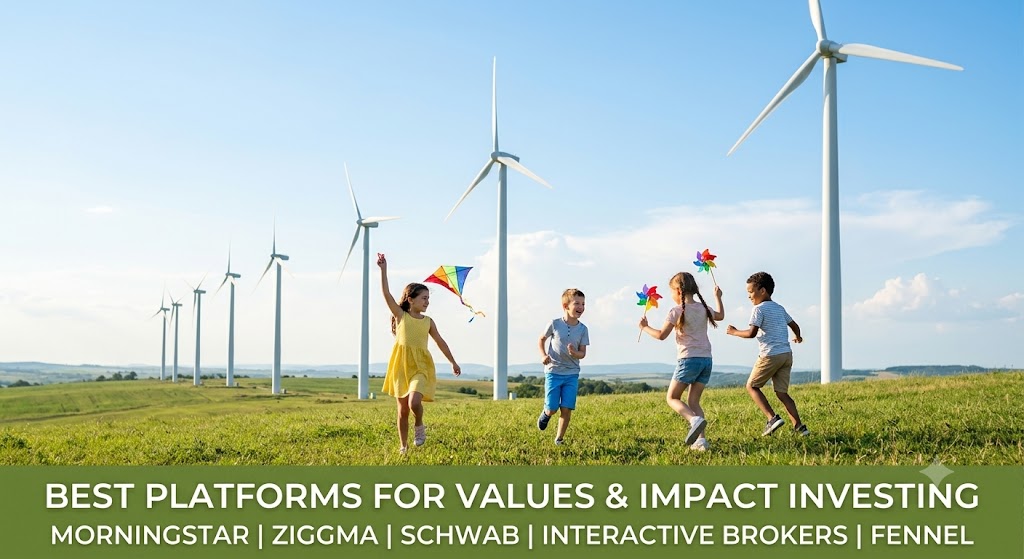
A practical comparison of five platforms self-directed investors actually use to bring their values into their portfolios — what each one is best at, and where each one falls short.
92% of individual investors say they're interested in sustainable investing, yet the average portfolio allocation to it is just 31% — and slipping. Morgan Stanley's 2026 Sustainable Signals survey points to a gap between sentiment and action, and the reasons are familiar: greenwashing concerns, fragmented data, and tools that don't make alignment easy. The five platforms below are the ones closing that gap for self-directed investors.
A note on framing."ESG" started as a risk-management framework — how exposed is acompany to environmental, social, or governance risks? — and most major platforms still use it that way. "Values-based" and"impact" investing ask a different question: what is this company actually doing in the world, and does that align with what I care about? The five platforms below sit at different points on that spectrum, and the right choice depends on what you're trying to do.
This page focuses on tools for self-directed investors, meaning you're managing your own portfolio, not handing it to a robo-advisor or human advisor.
Quick comparison
Morningstar is the long-standingauthority on fund analysis, and its sustainability tooling — the Morningstar Sustainability Rating (the familiar globe icons) — is built on Sustainalytics' ESG Risk Ratings. These ratings tell you how exposed a fund's holdings are to material ESG risks, on a relative scale within each fund category. For deeper analysis, the Morningstar Investor subscription gives access to portfolio-level sustainability scoring, climate risk metrics, and the broader research universe.
What's distinctive: unmatched depth of fund data and ratings, and the most widely cited sustainability rating system in the industry. The Climate Transition Toolkit (institutional-tier) adds forward-looking climate metrics.
Trade-offs: Morningstar is fundamentally a fund-research tool, not a portfolio management platform. Its ESG framework is risk-focused (how much ESG risk is this fund exposed to?) rather than values-aligned (does this portfolio match what I actually care about?). The full toolkit isn't cheap.
Pricing: free basic tier; Morningstar Investor from ~$34.95/month or $249/year. Verify current pricing on Morningstar's site.
What's distinctive: three things in combination. It's broker-agnostic (so it sees your entire portfolio regardless of where it's held). The Portfolio Optimizer actively suggests strong alternatives rather than just scoring what you have. And the screener lets you combine financial-quality filters — Ziggma Score, valuation, growth, profitability, financial health — with values-themed filters such as climate action, fair labor practices, accountable institutions, and resource use, as separate, named criteria in a single screen. Major brokerage and research screeners typically offer ESG-risk scores or exclusion lists; granular values themes you can dial in alongside fundamentals are less common.
Trade-offs: Ziggma is currently focused on the US market, with plans to expand beyond. If your portfolio is held primarily outside the US, the platform may not yet cover allyour accounts.
Pricing: Free plan available. Starter $6.99/mo (annual). Investor $10.49/mo (annual) — includes the Optimizer. 7-day free trial on paid plans.
For a closer look at how Ziggma's impact mechanism compares to Morningstar, As You Sow, and Carbon Collective, see the impact investing tools comparison.
Interactive Brokers' Impact Dashboard is one of the most thoughtful values-based tools built into abrokerage. It lets you select from 13 personal impact values — Clean Air, PureWater, Ocean Life, Land Health, Consumer Safety, Ethical Leadership, Gender Equality, Racial Equality, LGBTQ Inclusion, Company Transparency, Sustainable Product Lifecycle, Mindful Business Models, and Fair Labor & Thriving Communities — and 10 exclusion categories (animal testing, fossil fuels,weapons, tobacco, and so on). Based on what you pick, IBKR calculates an overall alignment score for your portfolio and flags each holding as align,conflict, or neutral.
What's distinctive: the breadth of value categories, and it's free for IBKR clients. Underlying data comes from Refinitiv and Truvalue Labs (SASB framework).
Trade-offs: the Impact Dashboard is built around the IBKR ecosystem — you need an IBKR account to useit, and while external brokerage accounts can be linked through PortfolioAnalyst, the experience is centered on holdings inside IBKR. The dashboard scores your portfolio but doesn't actively suggest reallocations.
Pricing: free with an IBKR account.
Fennel is a mobile-first brokerage that puts ESG data and shareholder voting visibility at the heart of its product. You see 200+ ESG indicators per company — carbon footprint, human rights, board composition, controversies — plus upcoming and historical shareholder votes in plain language, so you can actually participate in the governance of companies you own. Fennel doesn't accept payment for order flow and doesn't lend out your shares, which preserves your right to vote.
What's distinctive: the shareholder-voting experience is genuinely better than anything the major brokers offer. If proxy engagement is part of what "investing yourvalues" means to you, this is the strongest tool in the category.
Trade-offs: you have touse Fennel as your brokerage, which means consolidating to a newer, smaller platform. Fennel surfaces the ESG data and lets you judge — it doesn't compute a portfolio-level alignment score or suggest changes. App reviews show someusers have experienced service issues, so worth reading recent feedback beforecommitting.
Pricing: $4.99/month.
Charles Schwab takes a different approach: rather than scoring your existing portfolio, it makes it easy to find ESG-aligned funds and ETFs to invest in. The platform offers 300+ ESG mutual funds, 190+ ESG ETFs, and screening tools to filter by sustainability theme, exclusion preferences, or third-party ESG ratings. Schwab's ESG content explicitly groups "values-based investing," "impact investing," and "sustainable investing" under the ESG umbrella.
What's distinctive: the depth of ESG fund coverage is among the best in the industry, and Schwab's editorial content is genuinely useful for investors learning the space.
Trade-offs: Schwab's tools are about helping you choose funds, not about analyzing the portfolio you already have or optimizing it for impact. The framework is fund-discovery, not portfolio alignment.
Pricing: free with a Schwab account.
There isn't one right platformfor values-aligned investing — there's one that fits your situation. A quick recap:
• Shareholder voting is core to what"values" means for you? Fennel is the most thoughtful tool in the category.
• You hold accounts across multiple brokers and wantactive suggestions, not just scoring? Ziggma is the only platform on this list built for that case. You can try it free.
• All your investments are at Interactive Brokers? Their Impact Dashboard does a good job at no extra cost. However, you don’t get the independent insights you get from Ziggma and Morningstar.