A complete playbook for self-directed investors who want zero exposure to coal, oil, and gas — without giving up returns, diversification, or quality.
For the full sustainable investing strategy landscape — negative screening, positive screening, temperature alignment, and more — see the Ziggma Sustainable Investing Guide for 2026.
The first move isn't picking winners — it's deleting losers. Cut the entire fossil fuel complex from your investable universe before you do anything else. Ziggma's screener applies the same exclusion logic to both equities and funds, so an ETF that holds Exxon doesn't sneak back in through the back door.
Most "ESG" funds still hold integrated oil majors. The fix is to screen on what's inside the basket — not what's on the label. Use Ziggma's ESG and impact screener to apply the Fossil Fuel Free preset alongside financial quality filters.
Don't waste guessing fossil fuel industries. Ziggma maintains preset exclusion screeners that wipe entire industries from your universe instantly. Fossil Fuel is one of them. Stack it with other exclusions if you want.
Open the stock screener's panel, jump to the Impact - Exclusion tab, and set Fossil Fuel to EXCLUDE. You can layer additional exclusions in the same panel — Deforestation, No Vice Stocks, Conflict Minerals — and combine up to four presets at once.
Under the hood, the toggle slides a slider from Ignore to Exclude on the Fossil Fuel dimension in the filter rail. You can also set this manually for finer control.

A fossil-free portfolio sounds restrictive — and from a pure-numbers standpoint, it is. Roughly half of the global stock universe has direct fossil fuel exposure through extraction, refining, transport, or power generation. But the half that remains is still vast: more than 3,300 companies across technology, healthcare, consumer, financials, industrials, and renewables. The constraint is real, but it isn't crippling. The challenge isn't finding fossil-free names. It's finding the high-quality ones.
A clean energy startup that burns cash and dilutes shareholders is still a bad investment. After exclusion, filter the survivors by Ziggma Stock Score (≥75) and tune the sub-scores — Financial Health, Growth, Profitability, Valuation — to your strategy.
The Ziggma Score is a 0–100 composite that synthesizes the four sub-scores into a single quality read. Setting it to 75+ keeps the top-quartile names. From there, push individual sub-scores to match how you invest:
This is the move that separates a real fossil-free portfolio from a feel-good basket of meme renewables. Quality compounds; vibes don't.
A fossil-free portfolio isn't only about what you exclude — it's about what you select for. Filtering for companies with a published net zero target raises the floor of your portfolio's forward climate alignment.
Under the Impact filter tab, switch on the Net Zero Target (SBTi) requirement. Ziggma will limit candidates to companies that have publicly committed to a decarbonization pathway with a stated target year. This is also the filter that catches greenwashing from the other side: a renewables-adjacent business with no formal commitment gets cut.
But not all net zero targets are created equal. Three details separate a credible commitment from a press release:
The strongest test: combine the Net Zero filter with the Carbon Intensity Change metric in the portfolio tracking view. A company with a credible target should already be reducing emissions per unit of revenue. If the trend is flat or rising, the commitment is theoretical.
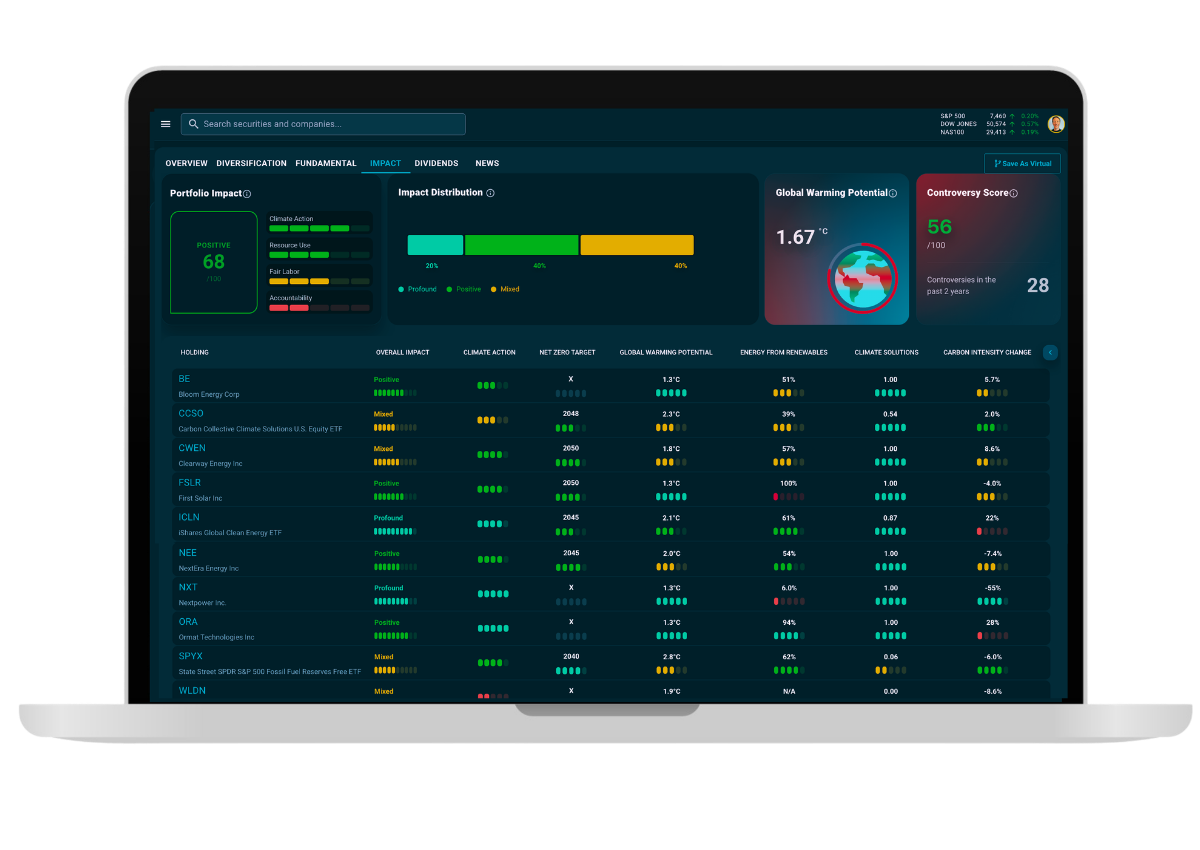
Global Warming Potential converts the implied emissions trajectory of every holding into a single number: the temperature rise (in °C) the world would experience if every company in your portfolio kept doing what it's doing. Paris-aligned reads near 1.5°C. A coal-heavy book reads 6.0°C+.
This metric sits on your portfolio's Impact dashboard alongside the Portfolio Impact score and Controversy Score. It updates with every position change, so you can see the climate consequence of a trade before you commit to it.
How it's calculated. Each holding has its own implied temperature — derived from its current emissions intensity, its stated decarbonization pathway, and the carbon budget remaining in a 1.5°C scenario. Your portfolio's GWP is the weighted average across holdings, with weights set by position size. Add Exxon at 5% of NAV and your number moves more than adding it at 0.5%.
What "good" looks like, benchmarked. Context matters more than the absolute number:
Where the metric has limits. GWP is a forward-looking estimate, not a measurement. It assumes companies execute on their stated trajectories — which many won't. Use it as a comparative tool (Portfolio A vs. Portfolio B, this trade vs. that trade) rather than an absolute truth. The number can also swing on methodology updates from the underlying data provider, so don't over-react to small month-to-month moves.

You cannot build an optimal portfolio if you add positions casually. Ziggma's Optimizer simulates the effect of any prospective buy or sell on the full portfolio — diversification, risk-adjusted return, and climate impact — before you place the trade.
Enter a transaction and the Portfolio Optimizer will show you how your portfolio evolves, if you were to make the trade. Does the trade improves portfolio quality? Does it improve portfolio impact? And what will happen to portfolio risk?
.png)
Run the Optimizer. Then run the trade. The Optimizer exists because portfolios get worse one well-intentioned decision at a time. Every position looks reasonable in isolation; the damage shows up in the aggregate. Ziggma evaluates each prospective trade against the full portfolio across diversification, risk-adjusted return, and climate impact of your investments— three dimensions that humans cannot weigh simultaneously without help. When the output is green, place the trade. When it isn't, the right move isn't to override; it's to find a different trade that does improve the portfolio. The Optimizer doesn't restrict you. It tells you where the better options actually are.
A fossil-free portfolio isn't a one-time setup. Companies change. Indices reconstitute. ETFs drift. The Portfolio Impact view gives you a continuously-updated read across the five climate KPIs that matter.
For every holding, Ziggma surfaces Climate Action, Net Zero Target year, Global Warming Potential, share of Energy from Renewables, Climate Solutions revenue, and Carbon Intensity Change. Sort by any of them. Set alerts on the ones you care most about.
Once you've mapped out your approach, see which companies make the cut in our list of the best fossil-free stocks for 2026 — each screened for both zero fossil-fuel exposure and top-tier financial quality.