Climate change is no longer a distant environmental concern. It is one of the defining economic and financial transformations of the 21st century.
Rising temperatures, resource stress, and accelerating electrification are reshaping industries, energy systems, and capital markets worldwide. The transition toward a lower-carbon global economy requires massive investment across renewable energy, electricity grids, semiconductors, industrial efficiency, transportation, and climate infrastructure.
The question for self-directed investors is no longer whether this transition matters. It is how to position a portfolio to benefit from it — while understanding what that portfolio actually supports.
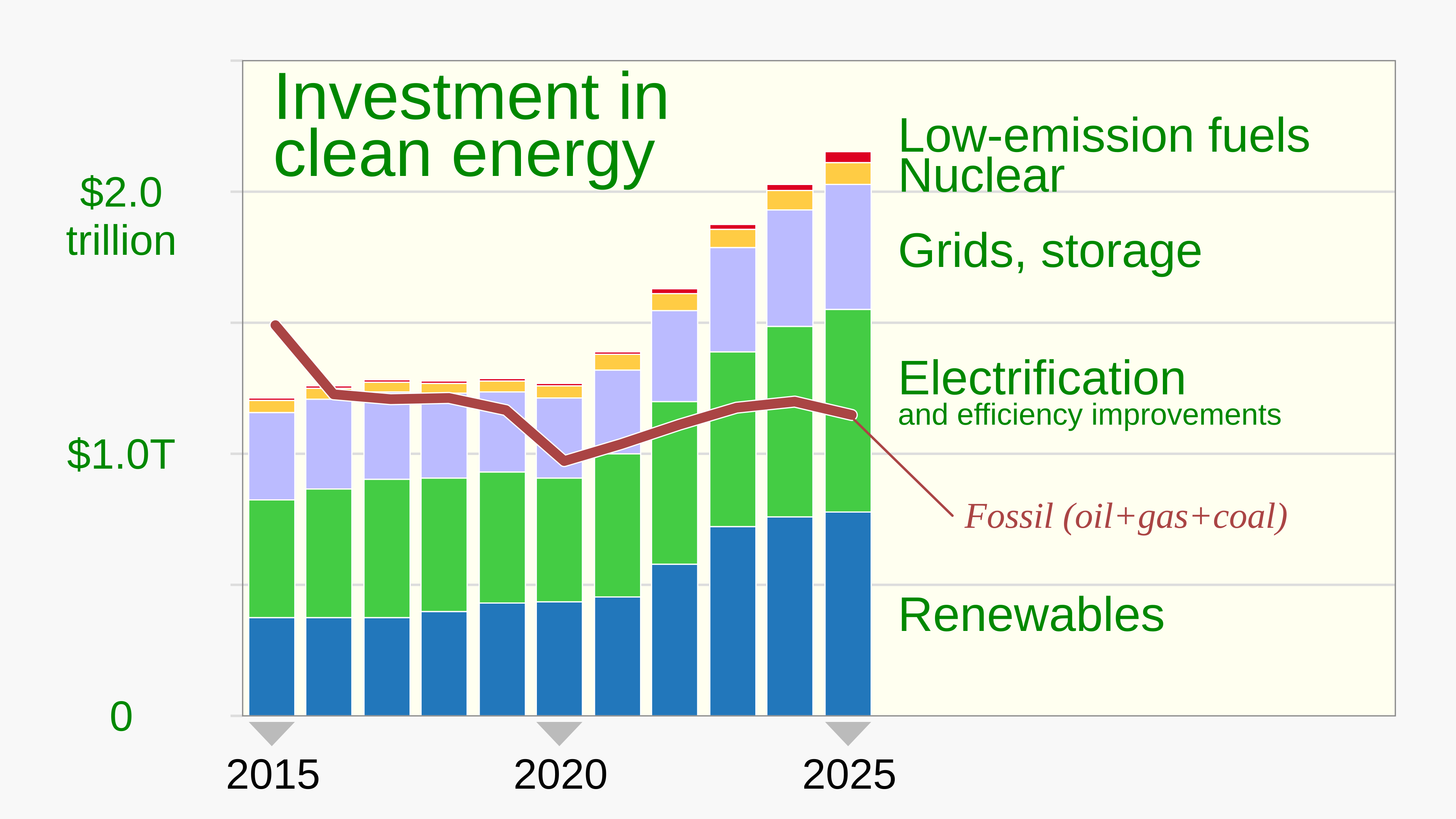
The clean energy transition cannot happen without private investors. According to the International Energy Agency, annual global clean energy investment may need to exceed $4 trillion by 2030 on a net-zero pathway. In 2025, actual investment barely surpassed $2 trillion — leaving a $2 trillion gap to close in five years.
Governments alone cannot finance a transformation of this scale. Most major economies carry historically high debt levels. Private capital will play a central role.
That reality is already changing how self-directed investors think about long-term portfolio construction.
Today's investors want to know what their money actually supports. Financial performance still matters. But a growing share of self-directed investors also want to understand whether their capital backs companies driving the climate transition forward — or companies facing long-term structural disruption as the global economy evolves.
At the same time, many investors have grown deeply skeptical of traditional ESG investing frameworks. ESG funds promised alignment. Too often, they delivered opacity. Many ESG-labelled funds continued holding fossil fuel companies, heavy polluters, or businesses with no meaningful positive climate contribution.
The result: a trust deficit that climate impact investing is now trying to fill. Understanding why impact investing is growing starts with understanding where ESG fell short.
Climate impact investing emerged to answer the questions ESG investing failed to ask. Rather than relying on ratings or exclusion lists, climate impact investing identifies companies positioned to benefit from — and contribute to — the transition toward a more resource-efficient, lower-carbon economy.
At Ziggma, we believe self-directed investors should not have to choose between strong long-term returns and understanding what their money supports. In many cases, the two may increasingly overlap — as trillions of dollars flow toward rebuilding energy systems, modernizing infrastructure, and improving global resource efficiency over coming decades.
This post explains:
Climate impact investing is an approach that seeks competitive long-term returns while supporting companies contributing to real climate solutions.
These solutions include:
Climate impact investing is not simply about avoiding "bad" companies. It is also about identifying businesses helping build the infrastructure, technologies, and systems likely to define the future global economy.
It can also apply to backing companies actively reducing their own carbon footprint — and making that reduction measurable. Ziggma's Impact Score tracks exactly this: real-world climate outcomes per company, not legacy ESG ratings.
The core problem with ESG investing is that it measures risk to the company — not the company's impact on the world.
Traditional ESG frameworks focus primarily on single materiality: how environmental and social issues could financially affect a business. For example:
These are valid questions. But they are incomplete. They do not measure whether a company contributes positively or negatively to climate outcomes or broader society.
As a result, companies with sophisticated reporting structures sometimes received high ESG scores despite limited positive real-world impact. Fossil fuel companies with strong governance disclosures still appear in ESG funds. This disconnect fueled growing accusations of greenwashing — and investor frustration.
Climate impact investing attempts to move beyond this limitation by asking a different question entirely: what is this company's actual effect on the world?
If you want to go further, Ziggma's guide on how to build a truly greenwashing-free portfolio walks through the practical steps.
Climate impact investing and ESG investing are not the same thing — despite being used interchangeably.
The shift is from single materiality to double materiality. Double materiality asks both how climate change affects a company — and how that company affects the climate. For long-term investors, that broader lens is increasingly relevant.
Ziggma's deeper comparison of ESG vs. impact investing covers the full distinction.
Climate-aligned investing does not require sacrificing returns — and may increasingly offer structural advantages.
The transition toward a lower-carbon economy is one of the largest industrial transformations in modern history. Capital is flowing toward:
Simultaneously, demand for electricity is rising sharply due to AI data centers, industrial reshoring, and electrification. This creates long-duration demand for companies improving energy efficiency, expanding power generation, and modernizing infrastructure.
Research from Morgan Stanley has repeatedly documented strong investor interest in sustainable and impact-aligned strategies — particularly among younger generations. Research from Oxford Saïd Business School and Schroders suggests sustainability-focused strategies can outperform while reducing portfolio volatility.
None of this guarantees returns. But it challenges the outdated assumption that impact and performance must inherently conflict. Ziggma's analysis of outperformance through impact investing examines this evidence in depth.
The climate transition touches far more sectors than most investors realize. When many investors hear "climate investing," they think solar panels or electric vehicles. But the universe is far wider.
Some of the most important climate-related businesses operate in sectors investors rarely associate with sustainability at first glance. Explore Ziggma's best climate stocks for 2026 for a curated, quality-screened list across all themes.
Renewable energy remains one of the most visible climate investment themes. Companies such as First Solar and Nextracker are helping expand solar deployment and improve energy generation efficiency. For a broader view, Ziggma tracks the best renewable energy stocks and best solar stocks — ranked by financial quality, not just narrative.
A modern electrified economy requires major upgrades to transmission systems, transformers, and power management infrastructure. Without grid modernization, neither renewable generation nor electrification can scale effectively.
Advanced semiconductors sit at the center of both AI infrastructure and energy efficiency improvements. Companies such as NVIDIA play a growing role in enabling AI-driven optimization, industrial automation, and computational efficiency — making chips a climate theme as much as a technology theme.
Efficiency itself is a climate investment thesis. Businesses improving industrial productivity, reducing waste, optimizing logistics, or lowering energy consumption contribute meaningfully to lower resource intensity across the economy.
Electric vehicles are only one part of the electrification trend. Industrial systems, heating, transportation, and infrastructure are all shifting toward electrified models — each requiring new technologies, components, and infrastructure investment.
Most portfolios contain climate exposures investors never consciously chose.
This is especially common with ETFs and retirement accounts. An investor may own several "sustainable" funds while unknowingly holding significant exposure to oil majors, utilities with heavy emissions, or companies misaligned with climate objectives.
Ziggma calls this the Portfolio Transparency Gap — the difference between what investors think they own and what their portfolio actually contains.
Common hidden issues include:
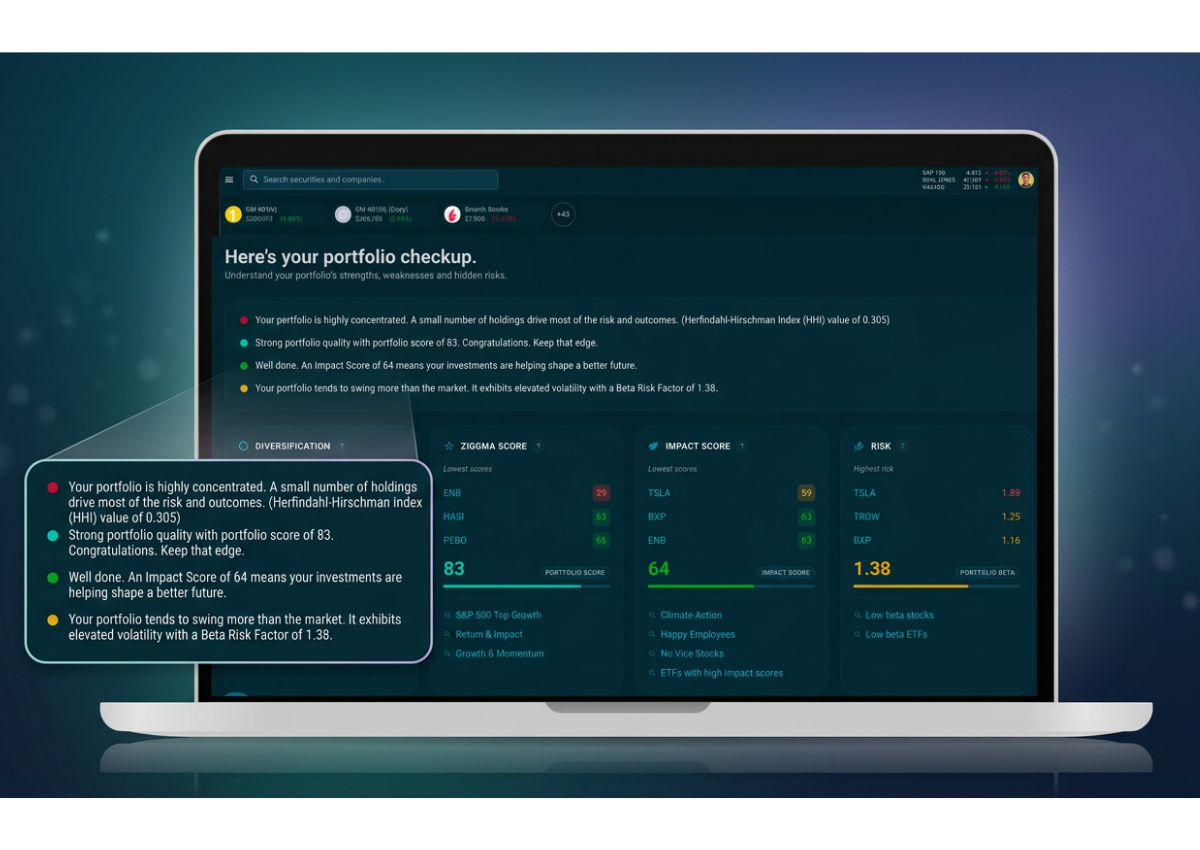
Measuring the climate impact of your investments is the first step toward closing that gap. Ziggma's Portfolio Checkup surfaces these hidden exposures automatically — including a full climate impact breakdown. If fossil fuel elimination is your goal, Ziggma also offers a dedicated guide on building a fossil-free portfolio.
Climate investing is not just about individual stocks. It is about understanding the portfolio as a whole.
Ziggma is built on four core principles: financial quality, real-world impact, portfolio construction, and full transparency.
Strong climate narratives alone are not enough. Long-term investing requires financially resilient businesses with durable economics, healthy balance sheets, and strong competitive positioning.
That is why Ziggma developed the Ziggma Stock Score — a multi-factor framework evaluating growth, profitability, valuation, and financial health in a single composite score. Climate conviction and financial discipline belong in the same portfolio.
Investors deserve visibility into how companies affect the world around them — not just how external risks affect corporate earnings.
That is why Ziggma integrates impact data powered by ACA Ethos, covering hundreds of underlying environmental, social, and governance metrics. The result is a portfolio-level Impact Score that reflects actual climate outcomes — not legacy ESG ratings.
[Insert Image 2: Impact tab desktop + mobile screenshot here]
Ziggma's Impact Score measures climate action, resource use, fair labor practices, and accountability — broken down to the individual holding. Global Warming Potential (GWP) temperature alignment shows whether a portfolio is on track for 1.5°C, 2°C, or far worse.
Even strong companies can create weak portfolios if risk becomes overly concentrated. Diversification, portfolio quality analysis, and risk management remain central to long-term investing success — especially in thematic portfolios exposed to volatile growth sectors.
Investors should be able to clearly understand what they own, why they own it, what risks they carry, and what their capital supports. That sounds obvious. Yet many financial platforms still make it surprisingly difficult.
Ziggma was built to close that gap.
Building a climate-aligned portfolio is a gradual process — not an overnight transformation.
Most investors improve their alignment one step at a time. Ziggma's guide on how to reduce the climate impact of your portfolio offers a practical walkthrough.
Before adding new investments, analyze sector exposures, concentration risks, overlapping holdings, and any fossil fuel exposure embedded in existing ETFs or fund positions.
Climate narratives alone are insufficient. Strong long-term investing still depends on fundamentals. Use the Ziggma Stock Score to screen for financial quality across holdings.
Not all ESG funds are climate-aligned. The label is not a guarantee of impact. Understanding underlying holdings — not just fund names — is what separates informed investors from label buyers.
Climate investing extends well beyond one industry. Diversifying across infrastructure, semiconductors, efficiency, electrification, and renewable energy creates more balanced exposure — and reduces concentration risk in any single narrative.
Portfolios evolve constantly. Regular reviews help ensure both risk exposure and impact alignment remain intentional — not accidental.
Investing is moving toward greater accountability — and the climate transition is accelerating that shift.
For decades, capital allocation largely ignored broader consequences. That era is changing. Today's investors increasingly expect to understand what their money supports.
At the same time, the transition toward a more resource-efficient global economy is creating structural shifts across industries, infrastructure, and technology. Trillions of dollars are expected to flow into energy systems, electrification, grid modernization, semiconductors, and industrial efficiency over coming decades.
Climate impact investing sits at the intersection of these trends. It is about finding where long-term value creation and real-world outcomes overlap — and positioning a portfolio accordingly.
Climate impact investing starts with transparency. Ziggma's Portfolio Checkup helps uncover hidden exposures, assess portfolio quality, and understand whether your investments align with your long-term financial and climate priorities.