Climate-Aligned Investing vs. ESG Investing: What's the Difference?
ESG investing and climate-aligned investing measure two different things. ESG ratings from MSCI and Sustainalytics measure how environmental, social, and governance risks could hurt a company's financial performance — not how the company affects the planet.
Climate-aligned investing flips that lens. It measures a company's climate footprint directly, using metrics like Global Warming Potential (GWP), overall carbon emissions, carbon intensity, and net-zero target dates.
Neutrality in finance is a myth. A portfolio's holdings finance specific companies, industries, and outcomes — chosen deliberately or not.
ESG risk ratings were never built to capture that. They protect the investor's returns under a single-materiality lens, even at the expense of the environment and society. That's why a fund can score well on an MSCI ESG scale while holding oil majors, coal-fired utilities, or companies with no net-zero target at all.
The AI data center buildout is proving this in real time. Microsoft and Alphabet both reported sharp emissions increases in their 2026 sustainability reports. Neither company's MSCI ESG Rating moved to reflect it.
Real-world example
Microsoft MSFT
FY24
FY25
+25%
emissions YoY
16M → 20M tons CO2e (net)
MSCI ESG Rating
CCC
B
BB
BBB
A
AA
AAA
Leader tier — unchanged
Emissions jumped a quarter in a year. The rating didn't move.
Alphabet GOOGL
2019
FY25
+81%
vs. 2019 baseline
+18% year-over-year alone
MSCI ESG Rating
CCC
B
BB
BBB
A
AA
AAA
Average tier — governance-driven
BBB reflects voting control and antitrust risk, not this trend.
Both ratings measure risk to the company. Neither tracks the number above.
Sources: Microsoft 2026 Environmental Sustainability Report · Google 2026 Environmental Report · MSCI ESG Ratings, July 2026
Climate-aligned investing closes that gap with a real number: tons of CO2e per $100,000 invested, and how many degrees of warming a portfolio's holdings collectively point toward.
Does climate-aligned investing sacrifice returns?
It doesn't. Corporate Knights' Clean200 index has beaten its benchmark in every annual update since its 2016 launch — most recently returning 282.9% against the MSCI ACWI's 221.3% from July 2016 to January 2026. See the full performance breakdown. The Schroders/Oxford Saïd Business School study found impact-driven portfolios outperforming by up to 9% annualized alpha.
ESG risk rating vs. climate-aligned investing
These two terms get used interchangeably. They shouldn't be. ESG Risk Rating measures how exposed a company is to environmental, social, and governance risks — a lens on the company, not the world. Climate-aligned investing measures the reverse: a company's actual climate footprint, using GWP, carbon emissions, carbon intensity, and net-zero dates.
The table below breaks down how each one defines itself, what data backs it, and what it means for a portfolio.
ESG Risk Rating
Climate-Aligned Investing
Definition
A relative score measuring how well a company manages financially material ESG risks compared to industry peers.
An approach that selects and measures investments by actual climate footprint — not risk to the company.
What It Measures
Risk to the company from ESG factors (single materiality).
The company's real-world climate impact: carbon emissions, carbon intensity, GWP.
Data Source
Third-party raters (MSCI, Sustainalytics), built mostly from public disclosure and policy statements.
What is impact investing? (and why it's not in the table above)
Impact investing is a broader standard than climate-aligned investing. It requires three things at once: intentionality, measurability, and additionality.
Intentionality means the investment is chosen specifically for its outcome, not as a side effect of a financial decision. Measurability means that outcome can be tracked with real data, not inferred from a policy statement. Additionality means the investment causes an outcome that wouldn't have happened without it.
Climate-aligned investing is a subset of this standard, not a competitor to it. It applies the same rigor specifically to climate metrics — GWP, carbon emissions, net-zero dates. Impact investing extends that same rigor to outcomes beyond climate: labor practices, biodiversity, water use, community development.
That's why impact investing isn't a third column in the table above. Comparing three approaches in one table would have blurred the two-way distinction this page exists to make. For the fuller framework — including how intentionality, measurability, and additionality apply when constructing a portfolio — see our guide to building a values-aligned portfolio.
How Ziggma surfaces what ESG ratings ignore
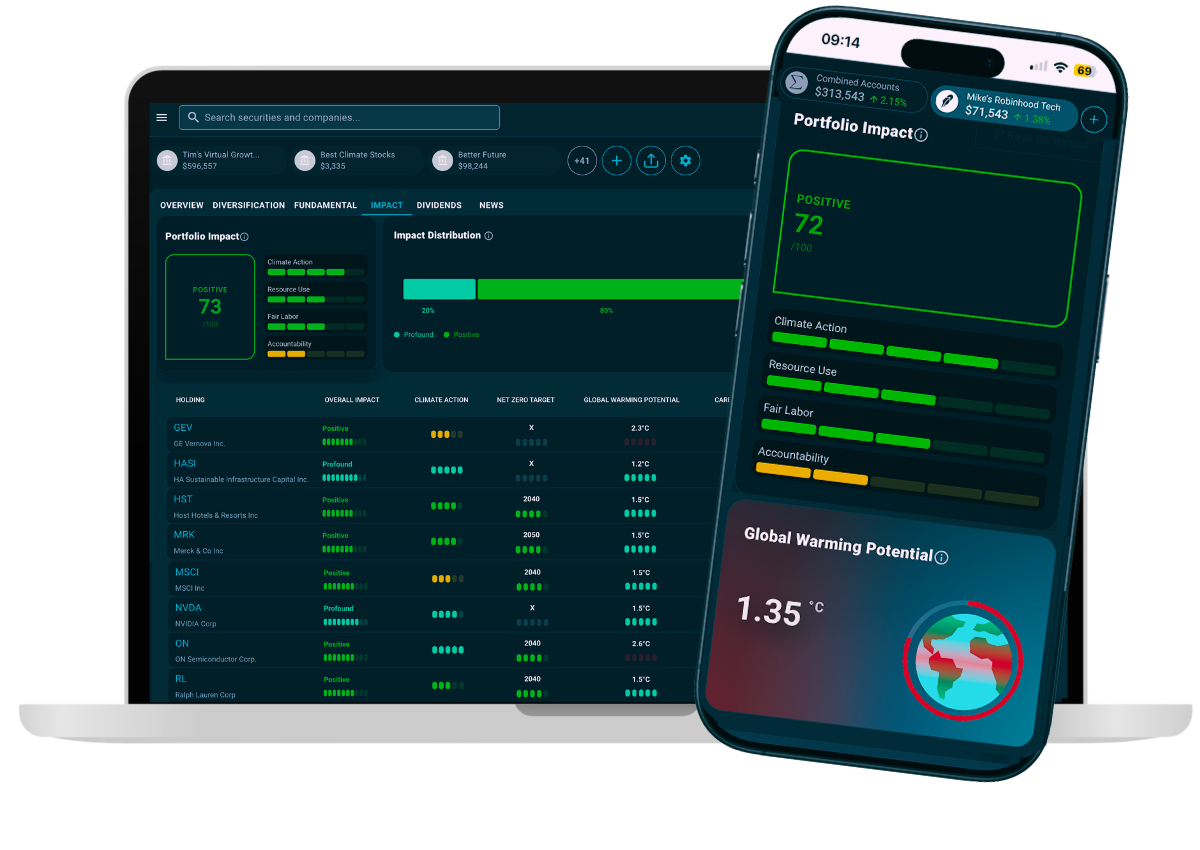
An ESG rating hands you a letter grade and asks you to trust it. Ziggma hands you real-world impact scores, backed by specific numbers and data points — so you can reconcile the score with the data.
Start at the top. The Portfolio Impact score (0–100) breaks into four categories: Climate Action, Resource Use, Fair Labor, and Accountability. They're sourced from ACA Ethos, an independent impact data provider.
Below the headline score, every holding's real-world climate impact is there to check line by line: Climate Action, Net Zero Target Year, Global Warming Potential, Carbon Intensity, Energy From Renewables, Climate Solutions, and Carbon Intensity Change.
Ford's Global Warming Potential is 1.3°C. NVIDIA sources 100% of its energy from renewables. Walmart's carbon intensity rose 15%.
Three steps. First, link your accounts — Ziggma works across brokers via Plaid and Snaptrade, so nothing needs to move. Second, open Portfolio Checkup and look at GWP and carbon intensity for your actual holdings, not a fund-level estimate. Third, compare that number against your MSCI or Sustainalytics rating, if you track one — the gap between the two is exactly what this page has been about.
No. Climate-aligned investing measures a company's climate footprint — GWP, carbon emissions, net-zero dates. Impact investing applies a broader standard: intentionality, measurability, and additionality across any outcome, not just climate. See our impact investing guide for the full framework, or read more on how ESG and impact investing differ.
No. The impact universe spans technology, healthcare, industrials, clean energy, consumer, and utilities — enough breadth to build a diversified portfolio without concentrating in one sector. Climate-aligned holdings show up across most industries, not just renewable energy. For a starting list across sectors, see Ziggma's best climate stocks for 2026.
Global Warming Potential estimates the degree of warming a company's or portfolio's emissions point toward, in °C. Carbon intensity measures emissions relative to revenue, letting you compare companies of different sizes. A company can have a lower GWP than a peer and still carry far higher carbon intensity. See how to reduce the climate impact of your portfolio for how these numbers roll up at the portfolio level.
Yes. Ziggma flags fossil fuel exposure across every linked account, regardless of broker, and lets you screen it out directly. This is narrower than climate-aligned investing as a whole — it targets one exclusion, not a full climate profile. See building a fossil-free portfolio for the full screening process.
Link your brokerage accounts, then open the Portfolio Impact tab. Ziggma works with most major brokers through Plaid and SnapTrade, so nothing needs to move or consolidate. See how to link a brokerage account for the full setup.
Yes. Ziggma uses read-only connections through Plaid and SnapTrade — neither Ziggma nor these partners can move money or place trades. See how secure portfolio tracking works for the full explanation.
No. The Ziggma Score measures fundamental quality — growth, valuation, profitability, financial health — peer-relative across 30+ indicators. The Impact Score measures real-world outcomes instead. A stock can score well on one and poorly on the other. See how Ziggma's stock scores work for the full methodology.
Not necessarily, and not historically. Corporate Knights' Clean200 index has still outperformed the MSCI World cumulatively despite periods of fossil fuel outperformance. Climate-aligned holdings span enough sectors that one commodity cycle doesn't determine the whole portfolio's returns. See Ziggma's best renewable energy stocks for 2026 for sector-specific options.
Ziggma's free plan includes the Portfolio Impact tab, GWP, and carbon intensity for linked accounts. Paid plans add the Portfolio Optimizer and deeper screening tools. See Ziggma's plans for the full breakdown.
Start with a screen rather than a single list. Ziggma's free stock screener lets you filter by GWP, carbon intensity, and net-zero status directly, across thousands of stocks and ETFs. Combine it with fundamental filters so you're not trading quality for climate alignment. Try the free stock screener to build your own.
Free Whitepaper
Your Complete Guide to Impact Investing
How to actually move the needle. Why public markets are where real impact happens, and how to act on it.
No spam. No newsletter — we'll only reach out for major updates.