How to Build a Values-Aligned Portfolio

Values-aligned investing is growing because the problems driving it are growing. Climate change, resource depletion, and widening inequality are no longer future risks. They are present-day existential issues that threaten the livelihoods of billions.

The Intergovernmental Panel on Climate Change (IPCC) projects global warming of 2.7°C by 2100 under current policies — nearly double the Paris Agreement target of 1.5°C. Physical climate risk and carbon transition risk are now embedded in corporate valuations, insurance markets, and regulatory frameworks. Investors who exclude these factors from portfolio analysis are not insulated from them.

In response, interest in sustainable investing has grown massively, especially with  Gen Z and Millennial investors. According to the Morgan Stanley Sustainable Signals Survey, 99% and 97% of GenZ and Millenial investors report interest in shifting capital to sustainable investing. With a $124 trillion intergenerational wealth transfer coming their way, this is a structural demand shift, not a cyclical trend.

Self-directed investors who want to act on these realities face a practical problem. Most screening tools available to retail investors rely on aggregate third-party ESG ratings that bundle unrelated factors into a single score. Ziggma provides a five-step workflow built on granular, company-level impact data to close this gap.

Impact portfolios have outperformed conventional benchmarks

Self-directed investors who want to act on these realities face a practical problem. Most screening tools available to retail investors rely on aggregate third-party ESG ratings that bundle unrelated factors into a single score. Ziggma provides a five-step workflow built on granular, company-level impact data to close this gap.

Study Benchmark / Period Performance advantage
Schroders / Oxford Saïd Business School — impact equity portfolios (257 companies) vs MSCI ACWI IMI (2010–2023) 8/10 portfolios outperformed; top portfolios >9% annualized alpha
Clean200 — As You Sow index vs MSCI World (5 years) +29 ppts
Morgan Stanley — Sustainable funds vs conventional peers (2019–2025) +9% cumulative

Sources: Schroders Research; As You Sow Clean200 Report; Morgan Stanley Institute for Sustainable Investing. Cited in the Ziggma Impact Investing Whitepaper.

"Impact isn't a tax on returns. It's frequently a marker of the operational quality investors should already be paying for."

— Ziggma Impact Investing Whitepaper

The performance evidence clearly counters the long-standing misconception that values-aligned investing entails sacrificing returns. With that notions dismissed, the practical question becomes how to implement values-aligned investing with the precision required to ensure a portfolio reflects actual values — not just labels.

The following five steps show how Ziggma gives self-directed investors the tools to screen, score, optimise, track, and measure impact across every holding.
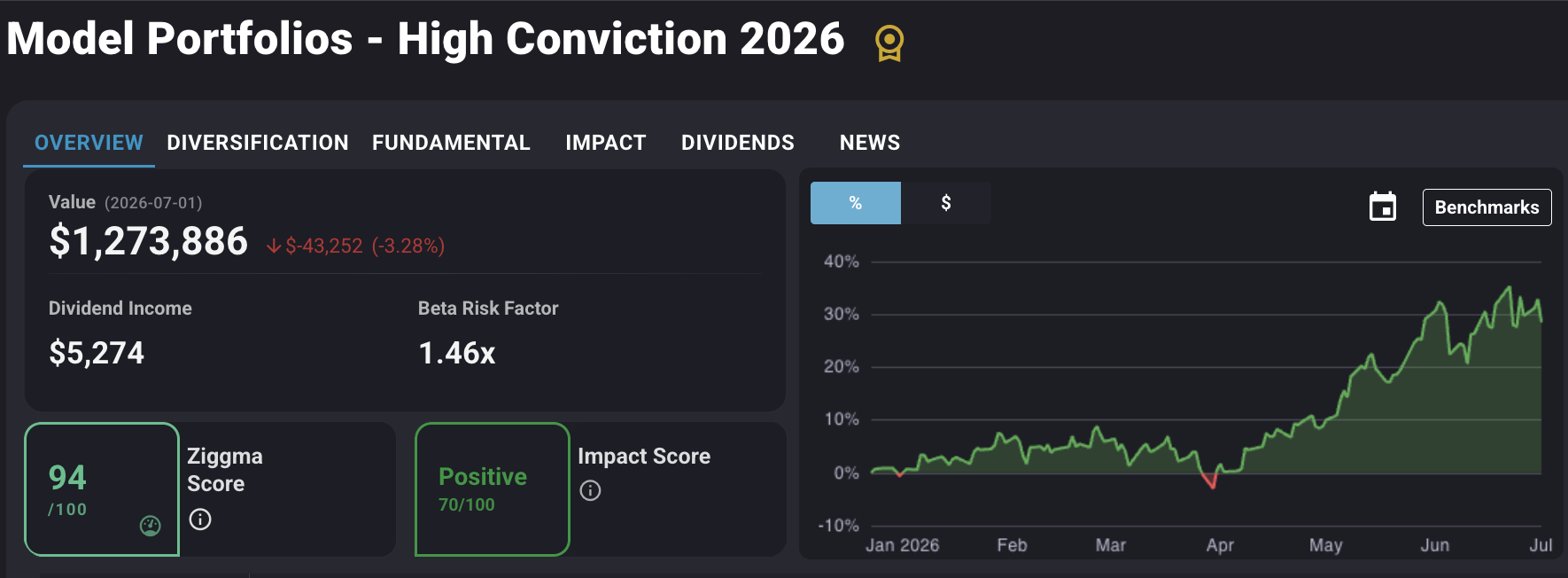
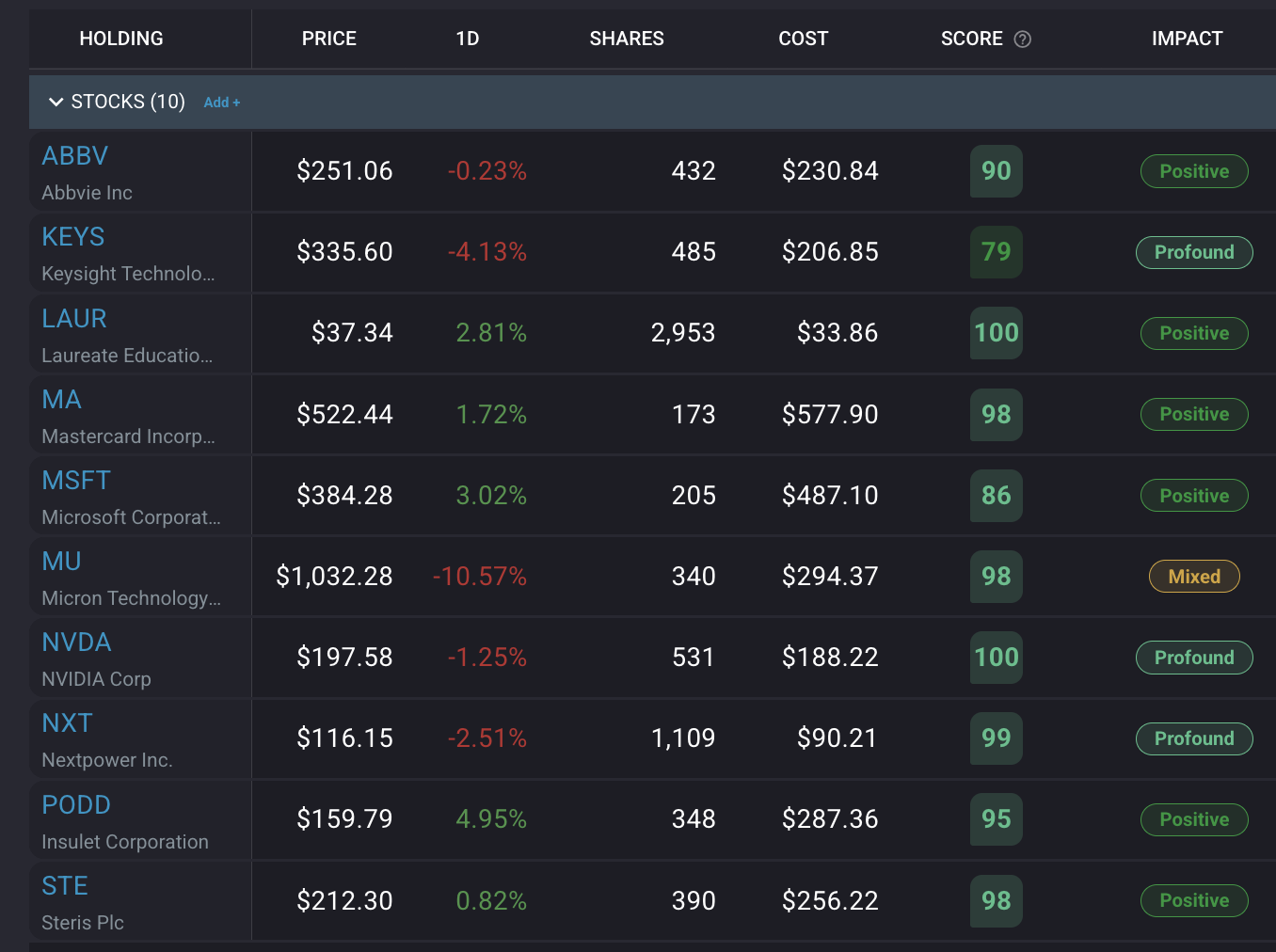
High conviction model portfolio dashboardHigh conviction Ziggma model portfolio holdings

Step 1 — Screen by impact metrics, not aggregate ratings

The Ziggma stock screener filters by specific, measurable impact data. Aggregate ratings from MSCI and Sustainalytics bundle unrelated factors into a single composite score. A tobacco company with strong governance can outscore a clean-energy firm with weak lobbying disclosure. Ziggma filters by individual data points instead: carbon intensity, net-zero target date, Ziggma Fair Labour Score, and Ziggma Controversy Score. Available Ziggma themes include Climate Action, No Vice Stocks, Happy Employees, and Fossil-Fuel-Free. Each theme targets one measurable variable.

Use the Ziggma impact stock screener to build your initial shortlist.

Step 2 — Score every holding on quality and impact

Ziggma scores every holding on two independent dimensions: financial quality and real-world impact. The Ziggma Stock Score processes millions of fundamental data points. The Impact Score rates corporate behaviour across four dimensions: Climate Action, Sustainable Resource Use, Fair Labour Practices, and Accountability. Impact data is provided by ACA Ethos, Ziggma's impact data partner. Both scores appear side by side for every holding on the Ziggma platform.

For example, The Ziggma High Conviction 2026 model portfolio holds a Ziggma Score of 94 out of 100. LAUR (Laureate Education) and NVDA (NVIDIA) each score 100. KEYS (Keysight Technologies) scores 79 — the lowest in the portfolio and still above the quality threshold. The Ziggma Impact Score for the portfolio is 70. KEYS, NVDA, and NXT (Nextracker) achieve Profound Ziggma Impact status. MU (Micron Technology) is the only Mixed-impact holding.

Ziggma Proprietary Metric

Ziggma Stock Score

94 / 100

Ziggma High Conviction 2026 model portfolio

The Ziggma Stock Score reflects a holding's return prospects. It scores millions of fundamental, financial data points on a scale of 0 to 100 across four dimensions: growth, valuation, profitability and financial health. In the Ziggma High Conviction 2026 model portfolio, Laureate Education (LAUR) and NVIDIA (NVDA) each score 100. Keysight Technologies (KEYS) scores 79 — the lowest holding and still above the quality threshold. The Ziggma Portfolio Checkup flags low-scoring holdings for immediate review alongside their Ziggma Impact Score.

Fundamentals Analyst consensus Momentum
→ Score your holdings free

Ziggma Proprietary Metric

Ziggma Impact Score

70 / 100

Ziggma High Conviction 2026 model portfolio

The Ziggma Impact Score reflects a company's real-world impact on a scale of 0 (harmful) to 100 (profound). It aggregates four independently scored dimensions: Climate Action, Sustainable Resource Use, Fair Labour Practices, and Accountability. Data comes from ACA Ethos, Ziggma's impact data partner. The portfolio score is a weighted average of individual holding scores. In the Ziggma High Conviction 2026 model portfolio, Keysight Technologies (KEYS), NVIDIA (NVDA), and Nextracker (NXT) achieve Profound impact status. Micron Technology (MU) is the only Mixed-impact holding. The impact distribution is 30% Profound, 60% Positive, and 10% Mixed.

Climate Action Resource Use Fair Labour Accountability
→ See your Ziggma Impact Score

Step 3 — Optimize for risk, return, and values

The Ziggma Portfolio Optimizer rebalances any portfolio against multiple simultaneous objectives: a Ziggma Score floor, a Ziggma Impact Score floor, and a Ziggma Beta Risk Factor ceiling. This removes the need to screen alternatives manually.

The Ziggma High Conviction 2026 model portfolio carries a Ziggma Beta Risk Factor of 1.50x — above the market baseline of 1.0. The Ziggma Portfolio Checkup flags this automatically. The Ziggma Portfolio Optimizer can surface lower-beta alternatives while maintaining the portfolio's Ziggma Score of 95 and Ziggma Impact Score of 70.

Step 4 — Track performance across all accounts

The Ziggma free portfolio tracker links directly to brokerage accounts — including Robinhood, Fidelity, and Schwab — and syncs holdings automatically. Manual data entry is not required. Ziggma monitors the Ziggma Score, Ziggma Impact Score, and Ziggma Beta Risk Factor in real time. Multiple accounts consolidate into one dashboard.

The Ziggma High Conviction 2026 model portfolio is available as a virtual portfolio that any Ziggma user can save and track. It provides a live benchmark for self-directed investors building values-aligned portfolios. Account linking and virtual portfolios are available during the Ziggma 7-day free trial.

Step 5 — Measure impact with GWP and Portfolio Checkup

The Ziggma Portfolio Checkup delivers a full health assessment on one screen. Ziggma flags concentration risk automatically using the Herfindahl-Hirschman Index (HHI). The Ziggma Global Warming Potential (GWP) gauge shows the implied temperature pathway of a portfolio's holdings under current emissions trajectories. The Ziggma Controversy Score surfaces reputational risk alongside financial metrics.

The Ziggma High Conviction 2026 model portfolio registers a Ziggma GWP of 2.29°C. The Paris Agreement target is 1.5°C. The Ziggma Controversy Score is 39 out of 100, with 328 controversies tracked across the portfolio in the past two years.

Net-zero target dates appear holding-by-holding in the Ziggma Impact tab. Microsoft (MSFT) targets 2030. Keysight Technologies (KEYS) and Mastercard (MA) target 2040. AbbVie (ABBV) and Micron Technology (MU) target 2050. NVIDIA (NVDA), Nextracker (NXT), Laureate Education (LAUR), and Insulet (PODD) have not declared net-zero targets.

Ziggma Tool

Ziggma Portfolio Checkup

The Ziggma Portfolio Checkup delivers a complete health report for any portfolio on one screen. It evaluates diversification, Ziggma Score, Impact Score, Ziggma Beta Risk Factor. It flags the three lowest-scoring holdings in each category. It links directly to the Ziggma Portfolio Optimizer for corrective action. The Ziggma High Conviction 2026 model portfolio shows a Ziggma Score of 95, a Ziggma Impact Score of 70, and a Ziggma Beta Risk Factor of 1.50x.

Ziggma Score Ziggma Impact Score Beta Risk Factor HHI Concentration
→ Run your Ziggma Portfolio Checkup

Ziggma Proprietary Metric

Ziggma Global Warming Potential (GWP)

2.29 °C

Ziggma High Conviction 2026 model portfolio

The Ziggma Global Warming Potential (GWP) tells you the implied temperature pathway of your portfolio in degrees Celsius by 2100. A Ziggma GWP of 2.29°C means the held companies are currently on a trajectory consistent with 2.29°C of global warming. The Paris Agreement target is 1.5°C. In the Ziggma High Conviction 2026 model portfolio, Microsoft (MSFT) targets net-zero by 2030. Keysight Technologies (KEYS) and Mastercard (MA) target 2040. AbbVie (ABBV) and Micron Technology (MU) target 2050. NVIDIA (NVDA) and Nextracker (NXT) have not declared net-zero targets.

Temperature pathway Paris-aligned Holding-level detail
→ Measure your investments' global temperature alignment

Transparency and data quality determine whether values-aligned investing works

Aggregate ESG ratings from MSCI and Sustainalytics are the dominant data source for most impact-labelled investment products. These ratings measure the financial risk to a company from ESG factors — not the company's impact on the world. The distinction matters.

Two companies in the same sector can receive identical composite ratings for entirely different reasons. A fossil fuel company with strong governance and good lobbying disclosure can outscore a renewable energy firm with a weak compliance function. This is not an edge case. It is a structural feature of how composite ratings work.

Greenwashing risk is highest when investors rely on opaque composite scores without access to underlying data. An investor who excludes fossil fuels but holds a high-rated energy company deriving most of its revenue from oil extraction has not achieved their objective. They have held a label.

Ziggma uses ACA Ethos impact data — company-level measurements scored independently across Climate Action, Sustainable Resource Use, Fair Labour Practices, and Accountability. Nothing is bundled into a composite. The Ziggma Impact Score exposes each dimension separately for every holding. Investors can identify the source of any score and respond to it.

A structural shift in capital is underway

The case for values-aligned investing has moved beyond ethics. It is now a capital allocation thesis.

Companies that operate sustainably — reducing emissions, managing resources efficiently, treating employees and suppliers fairly — tend to demonstrate the operational discipline that drives long-term financial performance. The Schroders and Oxford Saïd Business School study found this connection is statistically significant and independent of traditional financial risk factors.

The $124 trillion intergenerational wealth transfer has the potential to redirect a meaningful share of global capital toward companies that meet the environmental and social standards of a new generation of investors. Companies that fail to adapt face simultaneous exposure: capital pressure from shifting investor preferences, regulatory pressure from climate disclosure requirements, and reputational pressure from increasing public transparency.

The aggregate effect of this reallocation stands to reward companies that operate sustainably and penalize those that do not. Self-directed investors who act early gain both the financial performance advantage identified in the research and the portfolio alignment they are seeking.

Ziggma provides the scoring, screening, and tracking infrastructure to make this shift with precision — through granular data-based scoring backed with an extensive set of empiriral data on corporate environmental and social performance.

For a side-by-side look at how Ziggma's impact mechanism compares to Morningstar, As You Sow, and Carbon Collective, see the impact investing tools comparison.

Build your values-aligned portfolio today

Screen by real impact data. Score every holding with the Ziggma Stock Score and Ziggma Impact Score. Track Ziggma Global Warming Potential at the portfolio level. Free to start.

Start free on Ziggma

No credit card required.

Frequently Asked Questions

A values-aligned portfolio holds securities from companies whose operations align with the investor's personal principles. It applies non-financial screening criteria alongside standard financial analysis. Values criteria typically include climate impact, labour practices, corporate governance, and industry exclusions such as tobacco or fossil fuels. The Ziggma impact investing guide covers the full range of values-based strategies available to self-directed investors.

The evidence indicates it does not. A Schroders and Oxford Saïd Business School study of 257 impact companies found 8 out of 10 randomly constructed impact portfolios outperformed the MSCI ACWI IMI from 2010 to 2023. Some generated over 9% annualized alpha. The Clean200 index outperformed the MSCI World by 29 percentage points over five years. Morgan Stanley tracked sustainable funds delivering a 9% cumulative performance advantage from 2019 to 2025. Three independent research institutions and distinct time horizons point to the same conclusion.

ESG ratings measure financial risk to a company from ESG factors. Values-aligned investing measures a company's actual impact on the world. These are not the same thing. MSCI and Sustainalytics bundle dozens of unrelated signals into one composite score. A tobacco company with strong governance can outscore a clean-energy firm with weak lobbying disclosure. Ziggma uses ACA Ethos impact data — individual, measurable dimensions including carbon intensity, net-zero target dates, and Ziggma Controversy Scores — to reflect specific investor principles rather than bundled ratings.

The Ziggma Impact Score tells you whether a company creates real-world positive impact. It rates each company or ETF on four independently scored dimensions: Climate Action, Sustainable Resource Use, Fair Labour Practices, and Accountability. Scores range from 0 to 100. Data comes from ACA Ethos, Ziggma's impact data partner. The portfolio Ziggma Impact Score is a weighted average of individual holding scores. The Ziggma Portfolio Checkup flags the three lowest-scoring holdings for immediate review.

The Ziggma Global Warming Potential (GWP) tells you the implied temperature pathway of your portfolio. It expresses that pathway in degrees Celsius by 2100. A Ziggma GWP of 2.29°C means the held companies are currently on a trajectory consistent with 2.29°C of global warming. The Paris Agreement target is 1.5°C. The Ziggma High Conviction 2026 model portfolio registers 2.29°C. Ziggma GWP appears at portfolio level and holding-by-holding in the Ziggma Impact tab.

Yes. ETFs such as the iShares Global Clean Energy ETF (ICLN) and the State Street SPDR S&P 500 Fossil Fuel Reserves Free ETF (SPYX) provide diversified exposure to impact themes. Ziggma displays Ziggma Impact Scores and Ziggma GWP metrics at the ETF level. Ziggma does not currently look through ETFs to their underlying holdings — ETF scores reflect the fund's reported impact data. The Ziggma stock screener includes a dedicated filter for ETFs with high Ziggma Impact Scores.

The Ziggma Stock Score is a 0-to-100 composite quality rating. It covers three dimensions: fundamental health, analyst consensus, and price momentum. The Ziggma High Conviction 2026 model portfolio holds a portfolio-level Ziggma Score of 95. Laureate Education (LAUR) and NVIDIA (NVDA) each score 100. Keysight Technologies (KEYS) scores 79 — the lowest in the portfolio. Low-scoring holdings are flagged automatically in the Ziggma Portfolio Checkup alongside their Ziggma Impact Score.

The Ziggma stock screener filters by granular, company-level impact data — not aggregate ESG ratings. Available Ziggma themes include Climate Action, No Vice Stocks, Happy Employees, and Fossil-Fuel-Free. Each theme filter targets one measurable variable. You can also filter directly by net-zero target date, carbon intensity, or Ziggma Impact Score floor. A full walkthrough is available at the Ziggma impact stock screener guide.

The Ziggma Portfolio Checkup is a single-screen health report for any connected portfolio. It displays the Ziggma Score, Ziggma Impact Score, Ziggma Beta Risk Factor, and Herfindahl-Hirschman Index (HHI) concentration measure. It flags the three lowest-scoring holdings in each category. It links directly to the Ziggma Portfolio Optimizer for corrective action. Account linking is available during the Ziggma 7-day free trial.

Quarterly review is a reasonable baseline for most self-directed investors. Companies change between reviews. Net-zero commitments are made or abandoned. Controversies emerge. Ziggma Scores shift with earnings releases. The Ziggma Portfolio Checkup surfaces changes immediately after data updates. The Ziggma Portfolio Tracker sends alerts when holdings breach user-defined thresholds, removing the need for constant manual monitoring.

Yes. Values-aligned portfolios can be held in IRAs and 401(k)s, subject to investment options available through the plan provider. The performance evidence covers retirement-relevant time horizons. The Schroders and Oxford Saïd Business School study spans 2010 to 2023. The Clean200 covers five years. Morgan Stanley's analysis runs from 2019 to 2025. Ziggma tracks portfolios across multiple linked accounts simultaneously, including retirement and taxable accounts in one dashboard.

Socially responsible investing (SRI) excludes harmful companies from a portfolio. Impact investing goes further — it targets companies that actively generate measurable positive social or environmental outcomes. The two approaches are compatible and often combined. Ziggma's Ziggma Impact Score covers both: the Ziggma Controversy Score surfaces exclusion signals, while the Climate Action and Fair Labour Practices dimensions measure positive contribution. The Ziggma impact investing guide maps each strategy type to specific Ziggma screening tools.