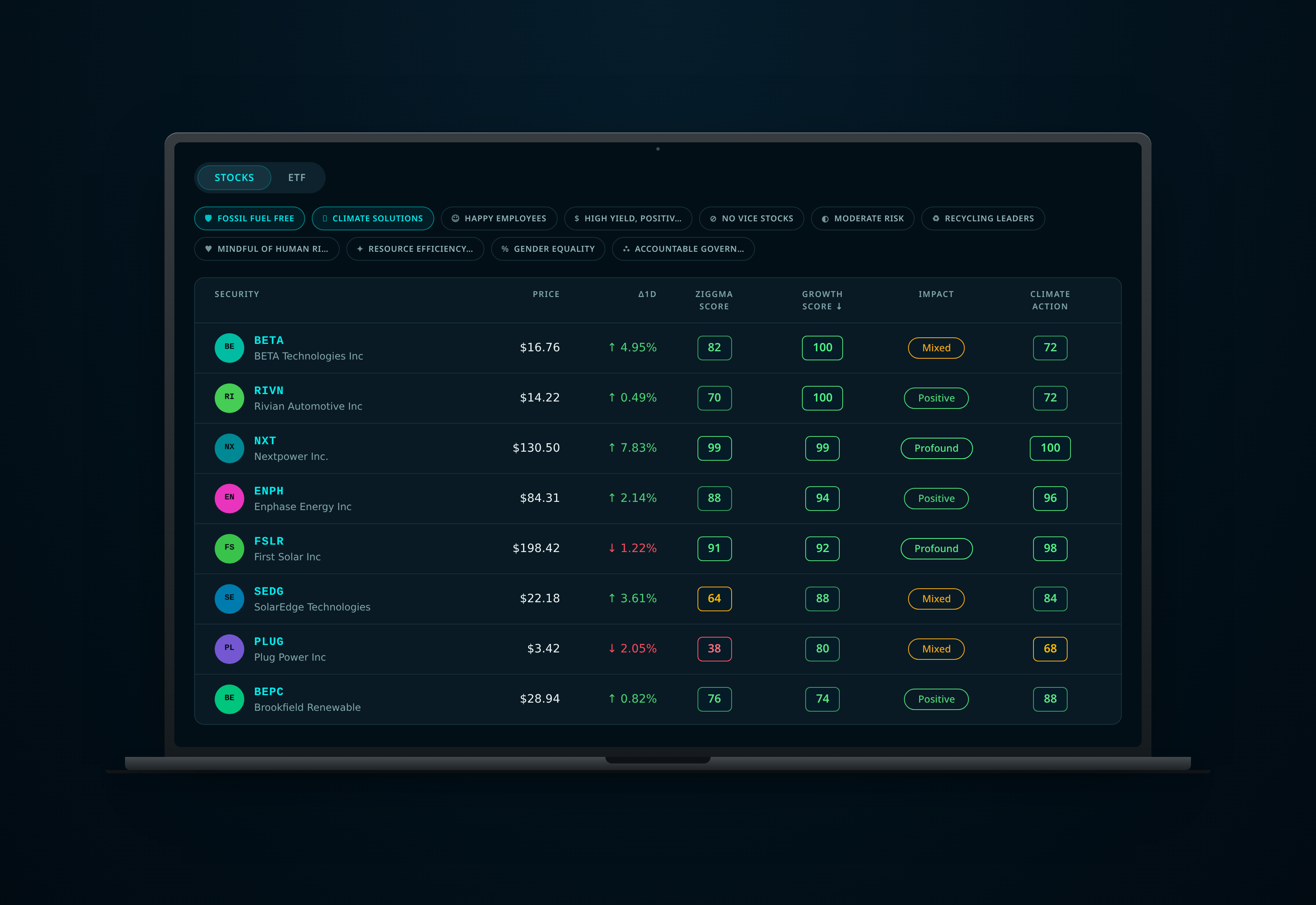
Net-zero screening goes beyond standard ESG ratings. A company earns a net-zero label by committing to a specific emissions-reduction target date — and by showing measurable progress across Scope 1, Scope 2, and Scope 3 emissions. Most general ESG scores bundle dozens of unrelated factors, which can mask poor climate performance. A dedicated net-zero screener isolates the signals that actually matter: ambition, trajectory, and accountability. This guide shows how to use the Ziggma stock screener to find companies with genuine climate commitments — and how to filter out the ones that don't meet your financial standards at the same time.
A net-zero commitment is only as strong as the evidence behind it. Three signals separate genuine net-zero companies from companies that merely claim the label.
The first signal is a target date. A company with no published net-zero target date has made no binding commitment. The ambition level matters too — a 2040 target is more credible than a 2060 one. Ziggma's screener lets you filter by net-zero target date, so you can set a minimum year and exclude companies with no deadline at all.
The second signal is carbon intensity. A target date without emissions data is a press release. Carbon intensity measures a company's greenhouse gas output relative to its revenue — across Scope 1 (direct emissions), Scope 2 (purchased energy), and Scope 3 (supply chain and product use). Ziggma surfaces all three scopes as separate filter sliders, so you can see exactly where a company's emissions sit today.
The third signal is trajectory. A company can have low carbon intensity today simply because it never decarbonized — it may have always been a low-emitter. What matters is whether intensity is falling. Ziggma's carbon intensity change percentage filter captures this directional signal.
All three signals together — target date, current intensity, and trajectory — give you a far more reliable picture than any single ESG label.
Net-zero screening works in two distinct directions. The first removes companies you don't want. The second finds companies actively driving the transition. Used together, they give you a portfolio that avoids harm and pursues opportunity.
Strategy 1: Exclusion screening
Exclusion screening sets a floor. It removes companies whose business model conflicts with a net-zero portfolio — regardless of how their ESG score ranks them overall.
The Ziggma screener includes four preset exclusion themes built for climate-focused investors:
Each preset applies in one click. You can combine multiple exclusions before adding any positive filters.
Strategy 2: Positive selection screening
Positive selection goes beyond exclusion. It actively targets companies contributing to the net-zero transition — through clean energy, resource efficiency, or verified climate action.
The Ziggma screener includes three preset positive-tilt themes:
The two strategies are designed to stack. Start with exclusions to clear the field. Then apply a positive-selection preset to identify the strongest opportunities within the remaining universe.
Ziggma's screener includes analyst-built preset themes that apply multiple filters in one click. Each theme is a starting point — you can add or remove filters after applying it. The four themes most relevant to net-zero screening are:
Net-zero screening works best as a two-step process. Exclusions clear the field — removing fossil fuel producers, deforestation risk, and companies with active controversies.
Positive selection then identifies the strongest opportunities within what remains — companies with published target dates, falling carbon intensity, and core businesses built around climate solutions.
The final step is the quality check: sorting by Ziggma Stock Score ensures the companies that pass your climate filters are also worth owning as investments.
Used together, these three steps give you a screener output built on evidence rather than labels. Open the Ziggma free stock screener to apply any of the preset net-zero themes — or build your own filter combination from scratch using the Impact filter panel.
Ziggma's screener includes analyst-built preset themes that apply multiple filters in one click. Each theme is a starting point — you can add or remove filters after applying it.
To see how net zero targets compare across climate tech companies, the best-climate-tech-stocks ranked by Ziggma Stock Score includes ACA Ethos net zero data for each of the top 10.
For the full breakdown of impact filter dimensions — exclusions, scores, and hard metrics — see the best stock screener for ESG and impact investors.