The mechanism behind public-market impact — why buying a stock is a capital-allocation decision, not just a trade.
Owning public stock creates real impact through two channels: price and control. Price is capital allocation — buying and selling shares moves a company's cost of capital. Rising demand lifts the share price and lowers that cost, so growth gets cheaper to fund; selling pushes the other way. Control is ownership itself — your shares carry votes over how the company is run, from board seats to emissions targets.
The common objection is that trading existing shares changes nothing — the shares already exist, so you are only swapping them with another investor. That belief is where the mechanism is easiest to miss. Share prices are set at the margin by demand, and a company's share price sets its cost of capital. That is where your impact enters: by buying or selling, you help set the price that decides what the company can afford to build next. Cumulative buying and selling by thousands of investors can quickly create massive share price movements.
If you own stocks, you own a piece of real companies — even if you never picked them yourself. A fund, an ETF, or a workplace 401(k) still makes you a part-owner of everything inside it. Owning a piece of a company gives you a say in it, and a say comes with responsibility. Where your money sits is always a choice — one you made, or one a default made for you. So the influence this page describes already belongs to you, and so does the responsibility for how it's used.
The two channels resolve into two things you actually do: allocate capital and vote your shares. Capital allocation sets a company's cost of capital — buying lowers it, selling and divestment raise it.
Voting sets how the company behaves, from board seats to emissions targets. Capital allocation is the primary mechanism; voting reinforces it.
This mechanism runs in both directions. Share prices are set at the margin by demand, and a company's valuation sets its cost of capital — the blended price it pays for equity and debt. Sustained buying lifts the share price, which lowers the cost of new equity directly and, by reducing leverage and credit risk, tends to lower the cost of debt as well. Cheaper capital lets the company clear projects at a lower hurdle rate — the next solar farm, factory, or transmission line.
At the level of the individual investor, a decision to buy or sell will not be felt by the company. However, when hundreds or even thousands of investors start making a move, cost of capital can be affected extensively.
Selling runs the same mechanism in reverse. Withholding demand — or divesting outright — lowers the valuation, which makes new equity dearer and, as leverage and credit risk climb, pushes up the cost of debt too. A higher cost of capital can drop marginal projects below their hurdle rate. At scale, coordinated across universities, pension funds, and sovereign wealth funds, divestment also carries a reputational charge that shapes the norms lenders, regulators, and customers apply. The direct price evidence is mixed, so honest analysis treats divestment as a slow, signal-driven lever rather than an instant one.
The second mechanism is shareholder rights. Every share carries a vote, and U.S. households own roughly 58% of publicly traded U.S. stock — the largest constituency in every proxy vote, ahead of any single institution. Those votes decide board seats and resolutions on climate disclosure, emissions targets, and political spending; 184 ESG shareholder resolutions are filed across U.S. companies in 2026. For directly held shares, you can back filings from As You Sow, Trillium Asset Management, and the Nathan Cummings Foundation. For shares held through funds, pass-through voting is arriving fast: BlackRock, Vanguard, and State Street now let beneficial owners direct their votes, and Tumelo — over £200 billion in assets, extended to retail through its December 2025 BetaNXT partnership — is scaling it to ordinary investors.
What that right actually obliges you to do, and what happens to your shares if you never exercise it: active shareholder investing.
These two mechanisms are the theory. The next section shows the first one — cost of capital — working in a single company. To turn them into specific holdings and screens, see impact investing tools for retail investors and the full Impact Investing Guide.
The mechanism is visible at index level. Corporate Knights and As You Sow rank 200 public companies by clean-economy revenue in the Clean200. From its July 2016 inception to January 2026, that basket returned 282.9%. The MSCI ACWI/Energy Index of fossil fuel companies returned 111.0% over the same period. The broad MSCI ACWI returned 221.3%.
The financing side moves with the valuations. The Oxford Sustainable Finance Group analysed two decades of global energy financing and found coal mining carries the highest cost of capital in the energy sector — 7.9% cost of debt in 2021. Renewables-focused electric utilities finance more cheaply than fossil-focused peers globally, at 6.0% cost of debt against 6.7%. Cheaper capital is not a reward. It is a price that determines which projects clear a hurdle rate and which do not. The pattern is directional rather than universal: the same analysis found low-carbon utilities finance more cheaply in Europe, the reverse in China, and no consistent trend in North America.
That is the loop from earlier on this page. Investor demand raised the valuation. The valuation lowered the cost of capital. The lower cost of capital built more clean energy. Public-market allocation became megawatts on the ground.
Capital repricing cuts both ways. As investors concluded coal faced structural decline, they raised its cost of capital. Among regulated utilities the effect is muted: coal-heavier names carry lower valuation multiples, which is a higher cost of capital expressed quietly. In merchant coal, where regulation offers no shield, the same force ran all the way to its conclusion.
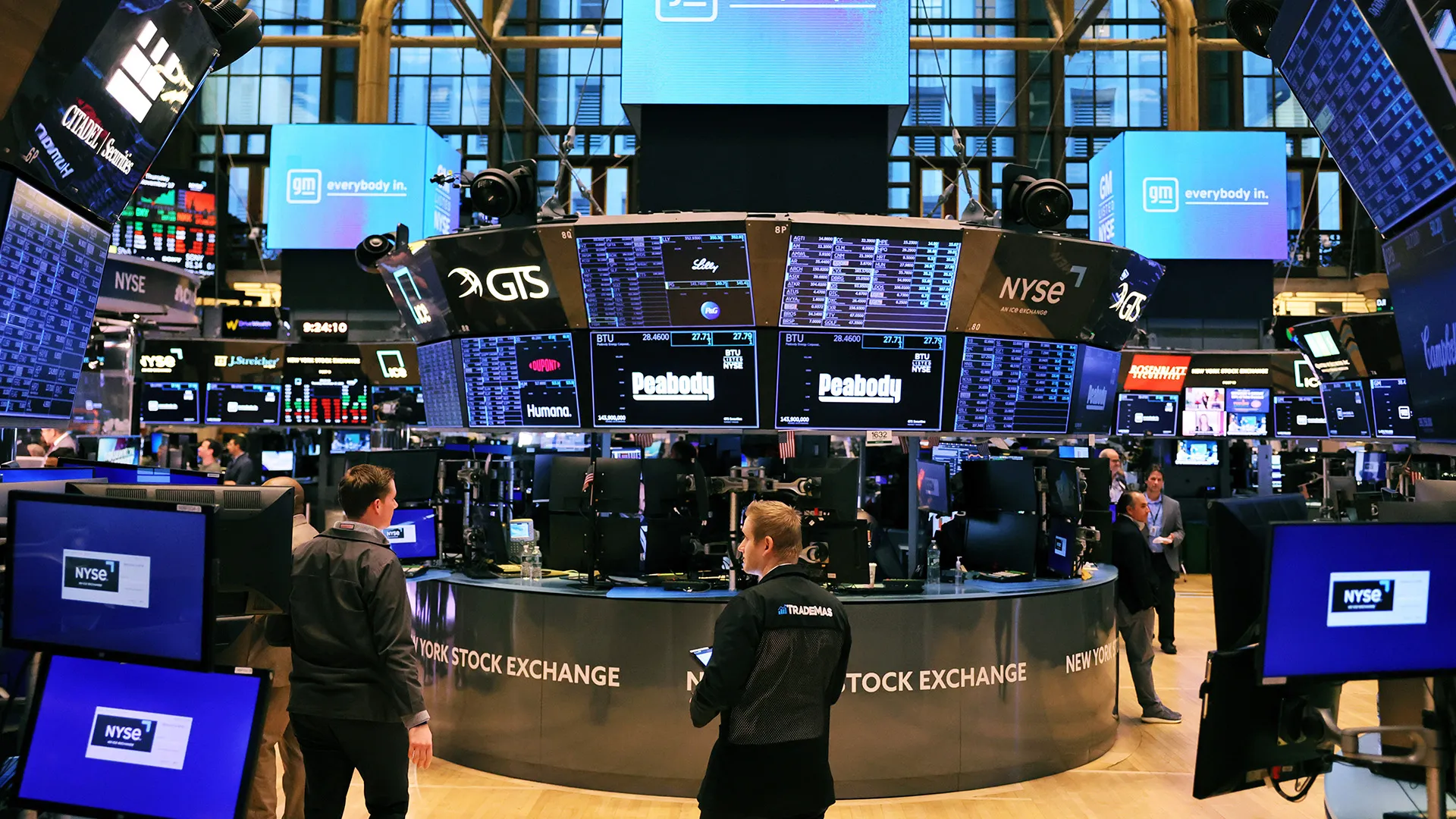
Peabody Energy is the clearest case. In 2011 it was the world's largest listed coal company, worth close to $20 billion. Coal's structural decline — cheap natural gas, tightening climate policy, falling demand — drove investors and lenders out, and Peabody's own debt-funded expansion deepened the hole. It filed for Chapter 11 in April 2016 with roughly 99% of its market value gone. The original common stock was extinguished with no value in April 2017. Cost of capital, pushed high enough, ends the company.
The mechanism operates across $87 trillion in public-market wealth, and U.S. households hold the majority of it. That $87 trillion is the capital base every allocation, vote, and exclusion above draws on. Households own roughly 58% of publicly traded U.S. stock — about 40% directly, the rest through funds, 401(k)s, and pensions. The largest actor pulling these levers is not an institution. It is retail investors, acting collectively.
The one arena the mechanism barely reaches is the private market — and that arena is far smaller than its reputation suggests.
The mechanism runs through public markets because that is where the capital and the access both sit. Private impact investing — climate-tech venture, regenerative-agriculture funds, community solar — is real but structurally capped at 2–5% of a diversified portfolio. Three constraints set the ceiling: liquidity, since capital locks up for 7–10 years; access, since most deals require accreditation and five- or six-figure minimums; and transparency, since private vehicles carry no standardized impact reporting. None of these limits applies to a share of public stock.
The size gap follows from those constraints. The entire pool of private impact investments accessible to non-accredited retail investors totals roughly $2–4 billion. Household public-market wealth is $87 trillion — a lever more than 20,000 times larger.
The full case for public markets over private — and the six strategies for acting on it — is in the Impact Investing Guide.