A trucker in Ohio starts to doze off for two seconds behind the wheel. A camera on the dashboard catches it, beeps a warning, and just like that, a crash that almost happened never does. That tiny save happens thousands of times a day across the trucks and delivery vans running on Samsara's technology, and it's why we think this stock deserves a spot on your radar.
We don't say that lightly. Our High Conviction 2026 portfolio, built on this same kind of research, gained 32.9% so far this year while the overall stock market actually lost ground. That's what can happen when you find companies doing real good in the world and making real money at the same time. Samsara looks like it belongs in that same club.
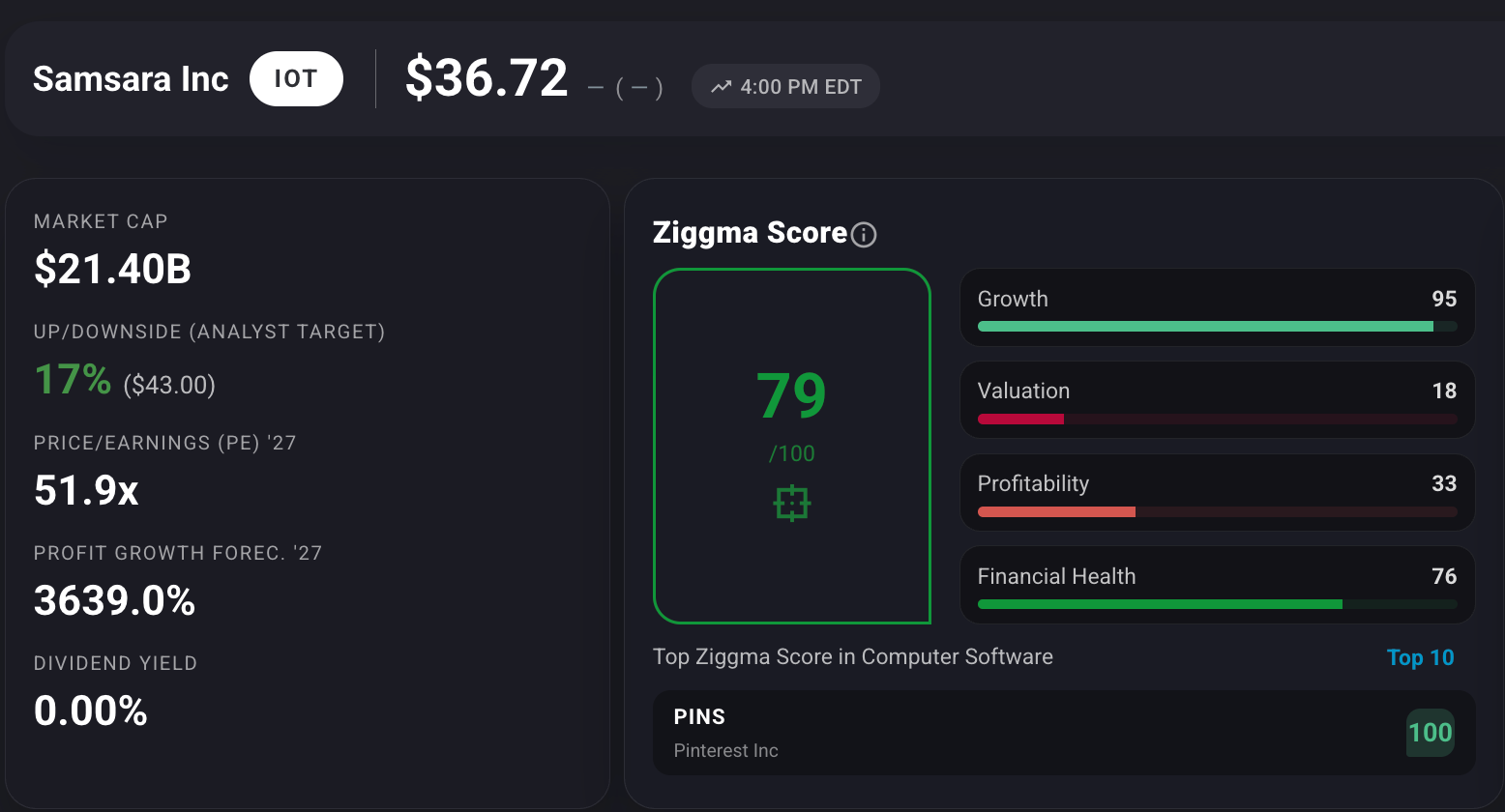
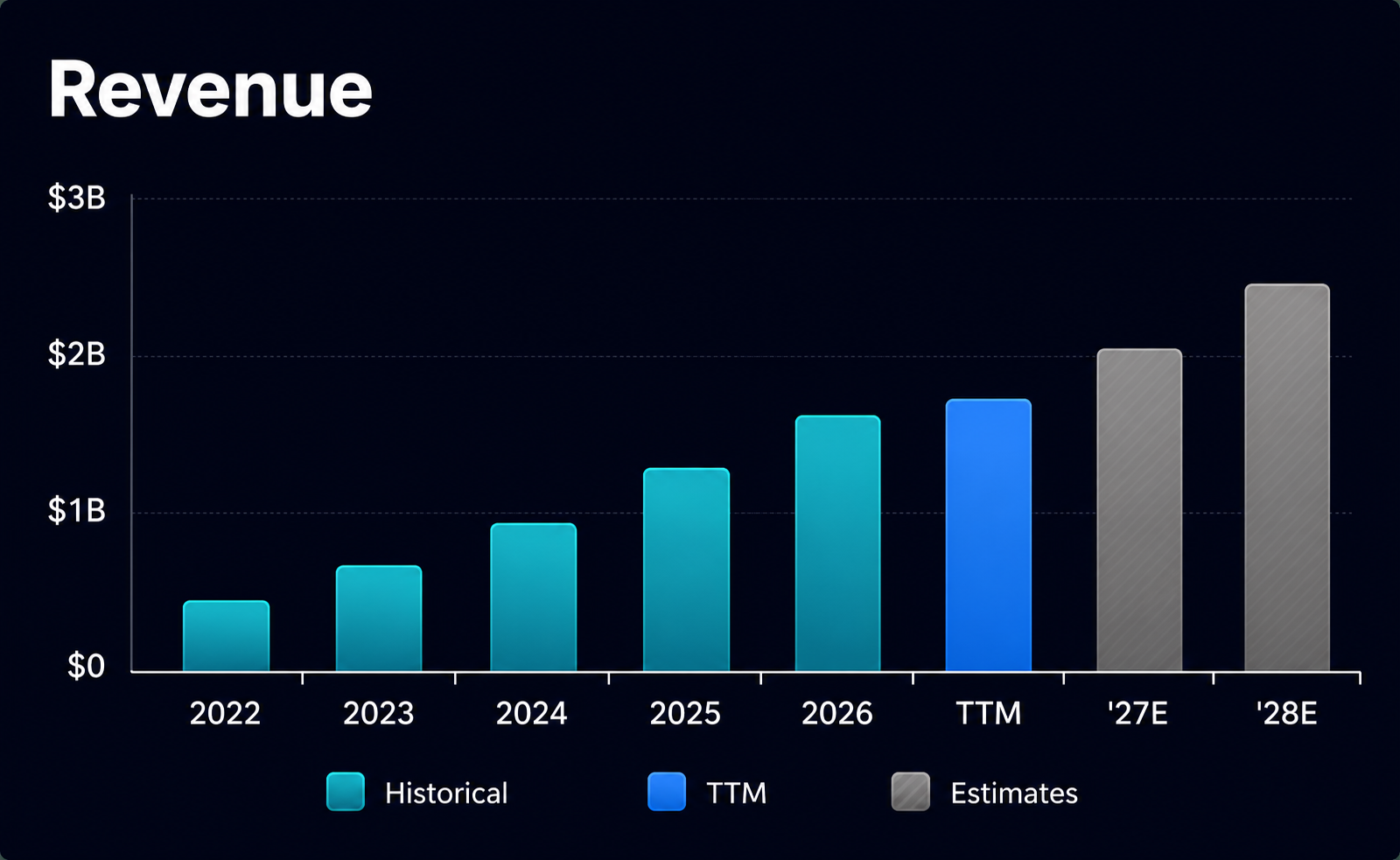
Here's the simple version of what Samsara does: it puts sensors and cameras on trucks, forklifts, and job sites so companies can see what's happening in real time and fix small problems before they turn into big, expensive ones. The company just hit a milestone that a lot of fast-growing tech companies never reach. After years of losing money, it's now actually profitable, and its sales keep growing by about 30% every year. Wall Street analysts think the stock has about 17% more room to climb from where it sits today.
The feel-good part of the story is just as strong as the financial one. Samsara's own numbers show that customers using its tools eliminated over 3 billion pounds of carbon pollution and cut crash rates by 73% in a single year. That's not a marketing slogan, that's just what happens when the product does its job well, which is exactly the kind of company we look for.
Source: Ziggma
Samsara went from losing money on almost every dollar of sales to actually turning a profit, three quarters in a row now. Its earnings per share grew 145.5% in the past year, and it's still bringing in new business fast, with sales up nearly 30%. The stock trades at a meaningful discount to what analysts think it's worth, which is why we like it here.
Samsara's cameras and AI helped customers cut over 3 billion pounds of carbon pollution and reduce crash rates by 73% in a single year, while also saving 261.7 million gallons of fuel. This is real, measurable good, not a side project, it's what happens automatically when the product works.
Think of Samsara as a set of eyes and ears for companies that run trucks, warehouses, and job sites. It puts sensors and cameras on vehicles and equipment so a trucking company or construction crew can see exactly what's happening, everywhere, all the time. If a driver is getting drowsy, if a truck needs maintenance, if fuel is being wasted, Samsara's software catches it and flags it before it becomes a real problem.
Nobody else does this at the same scale, which gives Samsara a nice head start. And because its cameras and sensors are physically installed in a customer's trucks and buildings, switching to a competitor is a real pain, not something a company does on a whim. Every new customer also adds more information to Samsara's system, which makes its AI smarter for everyone using it. That's a strong, lasting advantage, not just a nice story. If you want to see how Samsara stacks up against other companies driving the shift toward a cleaner, smarter economy, our free stock screener lets you build your own watchlist filtered by both quality and impact.
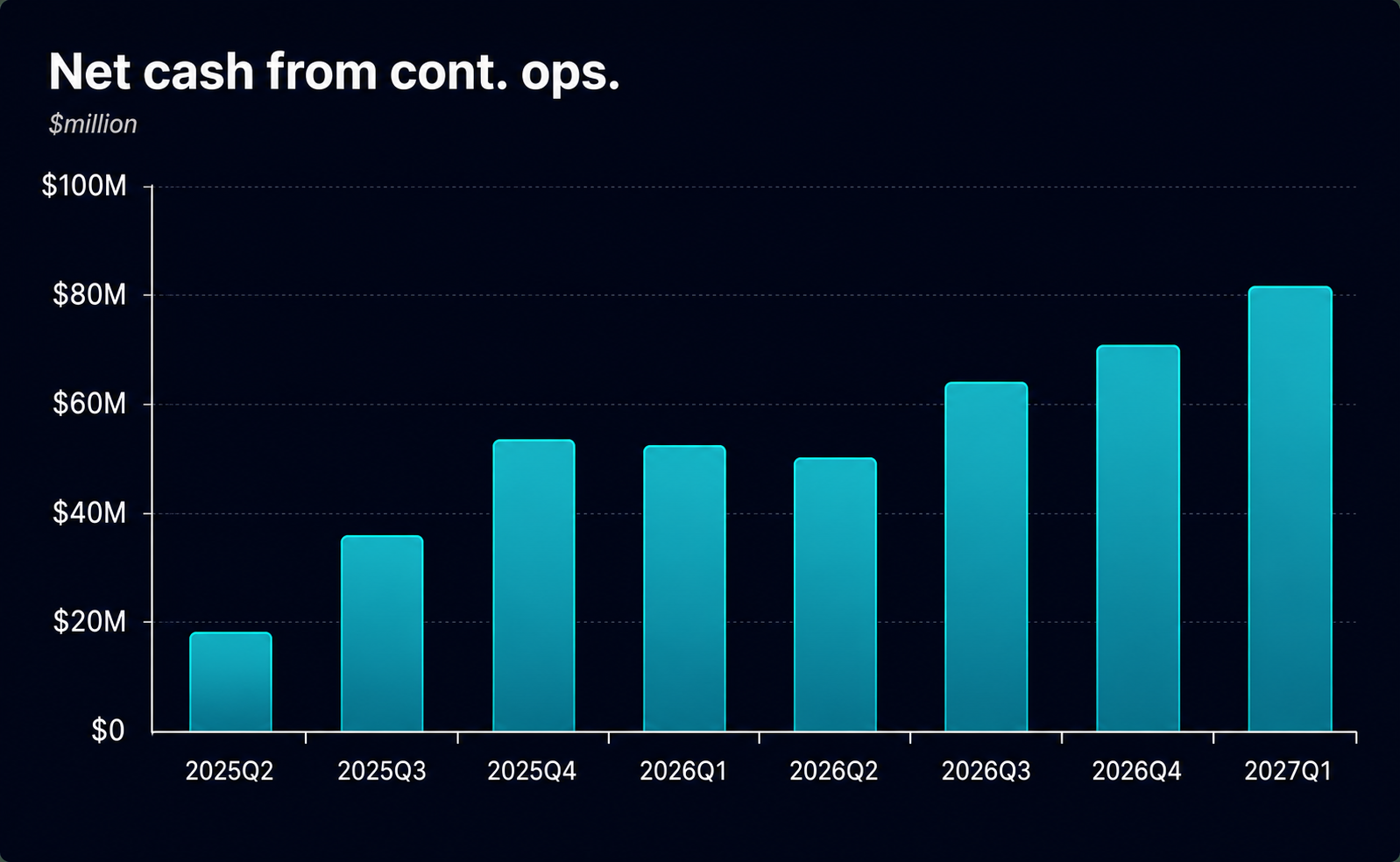
The turnaround here isn't just a headline number, it shows up quarter after quarter, like watching a plant grow if you check on it every few weeks. Two years ago, Samsara was losing $50 million every three months. Then the losses shrank, quarter by quarter, from $38 million to $11 million to $22 million to $17 million. Then something clicked. In the third quarter of last year, the company posted its first profit, a modest $8 million. The next quarter, that profit nearly tripled to $22 million. And in the most recent quarter, it doubled again to $45 million. That's not a one-time fluke, that's a business that found its footing and is now building real momentum.
Sales tell the same steady story, climbing every single quarter without exception, from $300 million two years ago to $479 million most recently. That's the kind of consistent, no-drama growth that's hard to fake.
Source: Ziggma
Here's the catch, and it's an important one. Investors are paying a premium for this stock, more than 50 times next year's expected profit, well above what similar software companies typically trade for. Normally that kind of price tag would make us nervous. But look at the trajectory again: three straight profitable quarters, with the profit roughly doubling each time. If that pace holds even partway, the company could grow into today's price a lot faster than the raw valuation number suggests. That's the bet the market is making, and so far, the last few quarters have backed it up rather than undercut it.
Source: Ziggma
The one wrinkle worth flagging: the path here hasn't been a straight line. Operating income actually dipped in early 2026 before turning the corner, a reminder that even a genuine turnaround can have a bumpy quarter along the way. Ziggma's own scoring system reflects this tension well, Samsara earns an excellent 95 out of 100 for growth and a strong 76 for financial health, but a much lower score for valuation since the stock isn't cheap and the profit streak is still young, only three quarters old. Most Wall Street analysts covering the stock rate it a buy, with price targets mostly between $43 and $49, implying the market broadly agrees the recent trend has room to keep running.
A few risks worth naming plainly. The stock's high price means there's little room for a bad quarter to break the spell. Big companies can take a long time to sign contracts, so sales, while growing steadily so far, could still bounce around in the future. Competition in this space is heating up. And three good quarters, however encouraging, still isn't the same as a proven multi-year track record. Even with those risks, a business that just went from losing $50 million a quarter to earning $45 million a quarter, with each profitable quarter bigger than the last, has earned the benefit of the doubt on upside from here.
Samsara scores especially well on how it treats its own employees, with a strong 81 out of 100 on fair labor practices, backed by a solid 4 out of 5 employee rating and good marks on pay equity. It also has a clean record with zero fines or legal violations. One area with more room to improve is how efficiently it uses resources like water and recycled materials in its own operations, something worth keeping an eye on as the company grows. All of this comes from ACA Ethos's impact data, the same independent source behind every Impact Score in our GoodStocks research.
But the number that matters most is simple: customers using Samsara's driver coaching cut their crash rates by 73% in a single year, and drivers received 11.6 million individual coaching moments along the way. Add in over 3 billion pounds of carbon pollution avoided and hundreds of millions of paper-based tasks replaced with digital ones, and you've got a company whose product does good just by being used the way it's meant to be used.
Samsara is a rare find: a tech company that just proved it can make real money, trades at a discount to where analysts think it's headed, and makes roads safer and the planet cleaner every time a new customer signs up. It fits the same pattern we've seen across our High Conviction 2026 portfolio, up 32.9% this year while the broader market has actually lost ground, proof that doing good and making money don't have to be a tradeoff. The stock isn't cheap, so this one calls for some patience, but for investors who want their money working toward a safer, cleaner future, Samsara tells that story about as clearly as it gets.
____________________________________________________________________________________________________________________________________________________
Disclaimer
This information is provided solely for general information and educational use. It is not intended as, and should not be construed to be, financial, investment, tax, legal, or other professional advice. Data used in the analysis is derived from third-party sources and applicable at the time of publication of the analysis. No representation or warranty is made as to the accuracy or completeness of the information or any analysis herein.
Ziggma is not registered or licensed as a financial advisor, broker-dealer, or tax professional. Readers should perform their own independent research and seek advice from appropriately qualified professionals before making any financial, investment, or legal decisions.
You should presume that, as of the date this report is published or any related communication referencing publicly traded securities or assets, Ziggma team members may hold positions in the securities or assets discussed and could benefit financially from price movements. Positions may be changed without notice.
There is no duty to revise or update the content after publication. Neither Ziggma nor any affiliated parties accept responsibility for market changes, economic developments, or subsequent events that could affect the relevance or accuracy of the information.
Forward-Looking Statements
This report may include forward-looking statements, such as forecasts, projections, estimates, or expectations regarding financial outcomes, market dynamics, or future corporate developments. These statements are based on assumptions that may not hold true, and actual results may vary materially. The author undertakes no obligation to update or revise any forward-looking statements as circumstances change.
Third-Party Data & External Sources
Certain information is sourced from third parties. Nonetheless, the accuracy, completeness, and timeliness of such information cannot be assured. Ziggma disclaims any responsibility for errors or omissions in third-party data and does not endorse, verify, or assume accountability for the methodologies or conclusions of external sources.
AI-Generated Enhancements
AI tools can be used to enhance clarity, structure, and brevity, and to assist with research organization, ideation, and analytical review.
Redistribution
You may share this report for informational purposes. However, reproduction, distribution, republication, or modification of any portion of the content, in whole or in part, without prior written consent is prohibited.
Investment Risk Disclosure
All investing carries risk of loss.. Historical performance does not guarantee future outcomes. References to specific securities, companies, or strategies are for informational purposes only and do not constitute recommendations or endorsements. Any use of, or reliance on, the information in this report is entirely at the reader’s own risk.
Neither Ziggma nor affiliated parties shall be liable for any direct or indirect losses or damages of any kind arising from the use of this report or reliance on its contents. By accessing this report, you agree to indemnify and hold harmless Ziggma and affiliated parties from any claims, liabilities, or damages resulting from your use of the material.
You alone bear responsibility for your decisions. Use this information at your own discretion and risk.