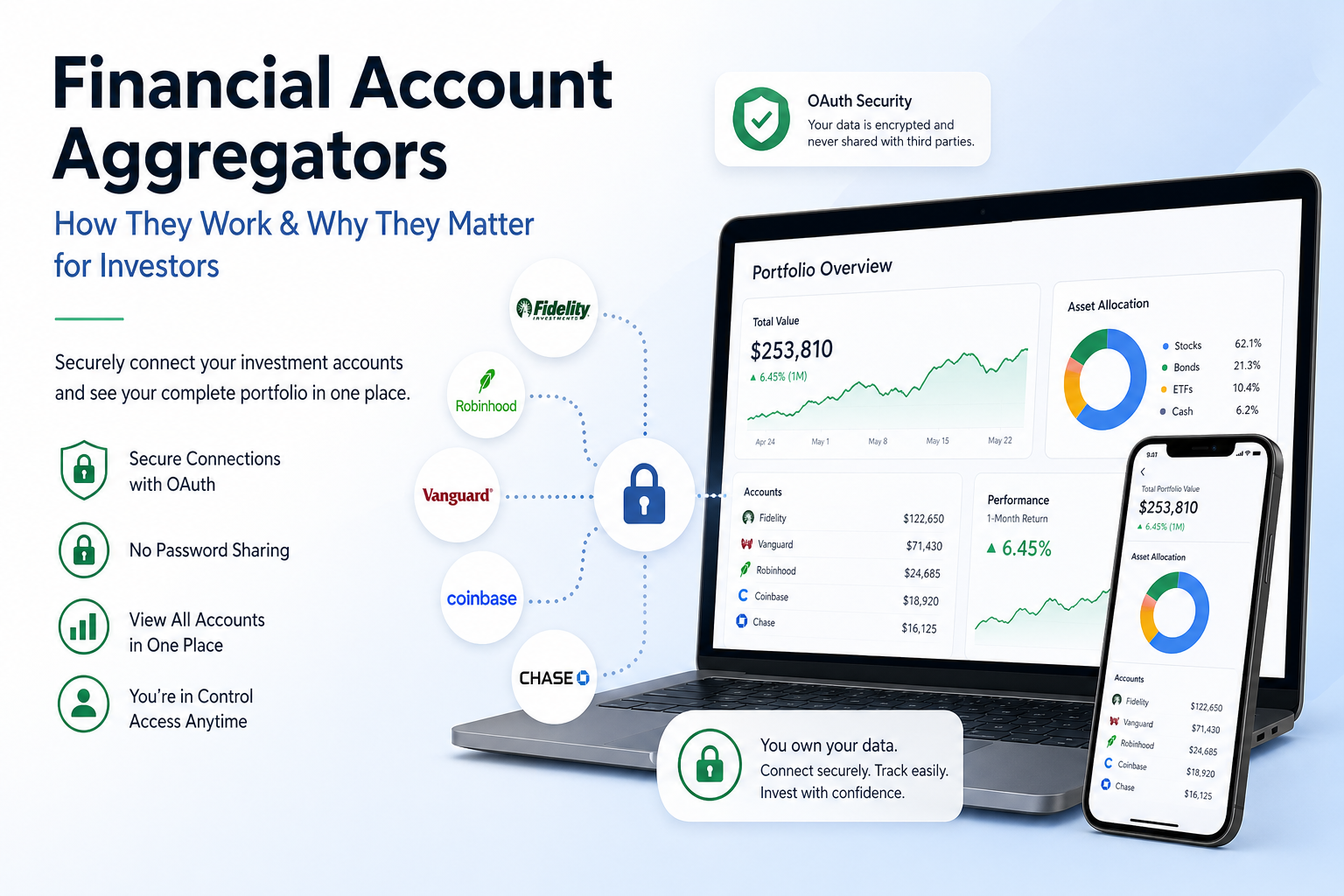
For investors, OAuth represents the biggest improvement in financial data security over the past decade.
Ziggma Portfolio Tracker
See all your accounts in one unified view
Connect your brokers securely via OAuth — no credentials shared.
Try free →
How secure are financial account aggregators?
Reputable financial account aggregators operate at security standards comparable to banks and brokers. They use encryption, permission-based access, and strict compliance frameworks.
No system is entirely risk-free. However, modern API-based connections using OAuth significantly reduce the risks associated with older methods such as screen scraping and credential storage. In practice, aggregation has become both secure and widely adopted by major financial institutions.
Major financial institutions, including Fidelity, Robinhood, and Coinbase, now support OAuth-based connections.
API-based connections vs screen scraping
Not all aggregators connect to your accounts the same way. Understanding the difference
matters for evaluating how secure any portfolio tracking tool actually is.
| Factor |
API / OAuth connection |
Screen scraping |
| How it works |
You authenticate directly with your broker. A limited access token is issued to the aggregator — your credentials never leave the institution. |
You hand over your login credentials. The aggregator logs in on your behalf and copies the data from the screen. |
| Credential exposure |
None — credentials stay at the broker |
High — credentials stored by a third party |
| Data access scope |
Restricted to approved read-only data (balances, holdings, transactions) |
Full account access — the same as if you logged in yourself |
| Revocability |
Revoke access at any time from your broker's connected apps page |
Must change your password to remove access |
| Reliability |
Stable — direct API feeds from the institution |
Fragile — breaks when the broker updates its UI |
| Broker support |
Fidelity, Schwab, Robinhood, Coinbase, and most major US brokers |
Older or smaller institutions without public APIs |
| Industry direction |
Standard — mandated by open banking regs in EU; expanding in US |
Declining — actively discouraged by regulators and major institutions |
Ziggma connects via API-based OAuth connections using Snaptrade and Plaid —
no credentials are ever stored.
See how Ziggma handles your data →
Why this matters for portfolio analysis
Aggregation is not just about convenience. It is what makes meaningful portfolio analysis possible.
This is exactly why modern portfolio trackers like Ziggma rely on financial account aggregators to provide a complete, unbiased view of your investments.
Best financial account aggregators for investment tracking
Several providers power today’s portfolio tracking ecosystem. Each takes a slightly different approach.
Plaid is the most widely used aggregator in the US, known for its broad coverage and long track record. It connects thousands of institutions across banking and investments, though its generalist approach means it is not always optimized for investment-specific data.
Envestnet Yodlee is one of the pioneers of financial data aggregation, offering extensive global coverage and deep institutional experience. Its strength lies in scale, although its technology stack can feel less modern.
Snaptrade focuses specifically on investment account aggregation. This specialization allows it to offer strong OAuth coverage across major brokers, making it particularly relevant for portfolio tracking applications.
Akoya, backed by major banks, emphasizes secure API-based connections and data reliability. Its approach prioritizes security, though its coverage expansion can be slower.
Finicity, owned by Mastercard, focuses on data privacy and compliance. It is widely used in lending applications, although its reliability and investment-specific coverage can be more limited.
Which financial account aggregator should you choose?
Plaid and Yodlee are well suited for broad financial coverage across banking and investments. Snaptrade is more specialized for investment account aggregation and is often preferred in portfolio tracking contexts. Akoya and Finicity place a stronger emphasis on data security and compliance.
For investors, the most important factor is whether the aggregator supports secure, OAuth-based connections with your brokerage accounts.
The bottom line
Financial account aggregators are a foundational layer of
modern investing tools. They allow investors to move beyond fragmented views and see their portfolio clearly, across accounts and institutions.
Combined with broker-agnostic portfolio trackers, they enable better decisions, clearer insights, and greater independence. And with OAuth now widely adopted, they do so with a level of security that was not possible just a few years ago.
Final step