In this update
HP Inc (HPQ) grew fourth-quarter sales 9% to $16.0B and beat forecasts. But its PC business kept just 3.0% of sales as operating profit, down from 5.8% a year ago, because memory chips got much more expensive. The stock jumped 11.5% the day after. It's up 27% since our first report in November 2025, against 7% for the S&P 500. One reason for owning it in that report, AI PCs, got much stronger. Two broke: PC margins and handing all free cash flow back to shareholders.
HP is a GoodStock because it's a sustainability leader: EcoVadis has put it in the top 1% of the more than 100,000 companies it rates for 16 years running. Customers mail empty ink and toner cartridges back for free through HP Planet Partners, more than one billion so far. HP shreds the plastic, mixes in bottles gathered in Haiti before they reach the sea, and molds new cartridges. It runs on 66% renewable electricity, 100% in the US, and if every company emitted like HP, global warming would stop at 1.5°C. That earns an Impact Score of 67, in the Positive band, and Ziggma tracks it with every update.
+27%
S&P 500: +7%
$30.00
−4% downside (Wall Street consensus)
82
−12 from 94 in our first report
67
Positive band
Best, base, downside case
Each case multiplies about $2.55 of official profit per share for the year to October 2027, our estimate from HP's own outlook, by a price to earnings multiple: 13x for the best case, 12x (about today's) for the base case and 9x for the downside case. See what each case assumes
Estimates, not promises. The price can end up outside this range, including below the downside case, and you can lose money. This is research, not personal financial advice.
Data as of 25 Nov 2026 close; scores as of 26 Nov 2026
Revenue for the three months to 31 Oct rose 9% to $16.0B, ahead of the $15.47B analysts expected. Adjusted earnings per share, profit per share before one-off items such as restructuring costs, fell 11% to $0.83 but beat the $0.75 forecast. Refunds of tariffs HP had paid added $0.15 of that. Official earnings per share, the figure under standard accounting rules, were flat at $0.84.
Quarter to 31 Oct, this year against last
Analysts expected $15.47B
Analysts expected $0.75. Includes $0.15 of tariff refunds
Personal Systems, profit from operations as a share of sales
The PC business grew revenue 14% while shipping 29% fewer units, so the growth came from higher prices and pricier machines. Business PCs rose 23%; consumer PCs fell 7%. Printing slipped 1% but kept a healthier 19.7% of sales as profit. Free cash flow, the cash left after running the business, was $3.3B for the year, according to the earnings release.
For the year to October 2027, HP expects adjusted earnings of $3.15–3.45 a share and $2.9–3.1B of free cash flow. It will no longer count stock-based pay as a cost in that adjusted figure, which flatters the comparison with this year.
What HP expects next
Quarter to 31 Jan 2027. HP's new definition leaves out stock-based pay
Our estimate from HP's outlook, less the $0.75 HP excludes
Year to 31 Oct 2027
Our first report on 17 Nov 2025 made five arguments. Here's how each fared:
The growth story got stronger. The profit story got weaker.

Since our first report: 17 Nov 2025
$31.15 from $24.53
82 from 94
67 from 73
11.9x from 9.3x
The Ziggma Stock Score fell 12 points while the stock rose 27%, and that's the score doing its job. Most of the drop is HP getting pricier and less profitable. Each pillar ranks HP against its peers:
One caveat on Growth. Ziggma's data doesn't include the full fiscal year yet, and its 22% profit growth forecast mixes adjusted forecasts with official history. Official earnings per share actually slipped 1%, so the Growth score flatters HP a little. We've flagged it to our data team.
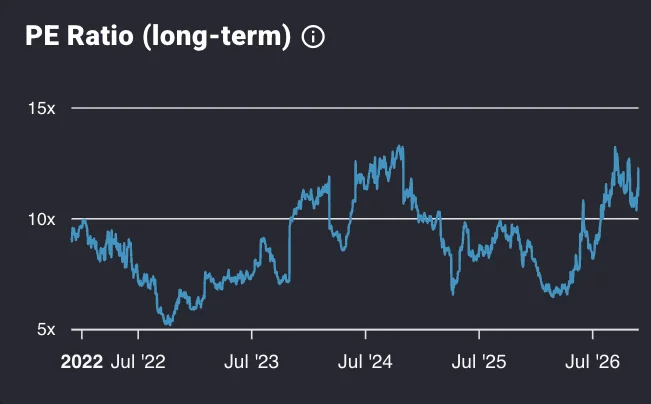
The price to earnings ratio, what investors pay for each $1 of yearly profit, is 11.9x trailing official earnings, against a five-year average of 6.9x. Other measures look calmer. Price to sales is 0.46x, close to its 0.5x five-year average, and HP's $28.09B market value is about 8.5x the $3.3B of free cash flow it made this year.
The fear is simple. AI data centers are buying up memory chips, and PCs need them too. When HP reported in February, memory prices had doubled in a quarter and HP steered toward the low end of its profit outlook. The stock hit its low of the year, $18.20, that day, and Morgan Stanley said the next morning that HP's guidance was too optimistic on memory costs.
This quarter shows the damage and the defence. Memory and storage now make up close to 40% of what goes into a PC, HP said on its 24 Nov call, and the PC operating margin fell to 3.0%. Yet PC revenue rose 14%. Morgan Stanley stayed at Underweight with a $21 target, arguing the new outlook looks less impressive once tariff refunds and the change in how HP counts stock-based pay are stripped out. Citi went the other way and raised its target to $29.
HP's answer is price and mix. It's raising prices, selling more business machines (up 23%) and fewer cheap consumer ones (down 7%), and pushing AI PCs, which carry more memory and sell for more. AI PCs reached nearly 60% of shipments. HP expects PC margins to improve every quarter of fiscal 2027 from here, and a new chief executive, Emma Walmsley, takes over on 4 Jan 2027.
We think the strategy works for profit but costs HP its scale. Shipping 29% fewer PCs and making more on each one keeps revenue up, but it shrinks the base that sells printers, services and the next upgrade. The main risk is that memory stays expensive through 2027 while volumes keep falling, which would leave margins stuck near 3% and test a new CEO in her first year. The number to watch is the Personal Systems operating margin. Back above 5% would mean the price strategy is working.
All three value HP on its official profit, the figure under standard accounting rules and the same basis as its price history in the Ziggma app. HP expects $3.15–3.45 of adjusted profit a share for the year to October 2027 and leaves out about $0.75 of costs; adding them back gives about $2.40–2.70, $2.55 at the middle. That's our estimate from HP's own outlook, not an analyst forecast. We don't use the five-year average of 6.9x: it includes fiscal 2021, when official profit topped $5 a share, and it would put the stock near $18, far below every analyst target.
Downside case
$22.95 −26%
Investors cut what they pay to 9x, a 26% markdown from today's 12x, because memory costs keep PC margins near 3% through 2027.
Base case
$30.60 −2%
Investors keep paying about today's 12x, and PC margins recover slowly as HP expects.
Best case
$33.15 +6%
Investors pay 13x, about where HP peaked in 2024 and again in September 2026, as memory costs ease.
HP pays a dividend. It raised the quarterly payment to $0.31 from $0.30, paid on 6 Jan 2027, which is about 4.0% a year at today's price and comes on top of each case. Wall Street's view, not ours: the average analyst target in the Ziggma app is $30.00 (−4%).

By HP's count, more than half of the non-HP ink and toner cartridges sold end up in landfill. HP built a loop to bring its own back: 82% of Original HP ink cartridges now contain 45–70% recycled plastic, from returned cartridges and from bottles collected near Haiti's coasts and rivers. That loop is behind Climate Action at 79 and Resource Use at 76. HP holds its own plants to the same standard: they kept 91% of their non-hazardous waste out of landfill in 2025, and the carbon HP emits for each dollar of sales fell 18%.
Inside the company, the picture is less tidy. The CEO earned 278 times what the median worker did, which holds Fair Labor to 50 even though staff rate HP 4.0 out of 5. Accountability is the weakest pillar at 38, with low marks for privacy and for peace and justice. HP also pushed its goal of 100% renewable power worldwide back to 2040, from 2025, citing a lack of clean power where it operates.
The score comes from what HP does with waste, in its products and its plants. Pay, governance and the delayed power goal are where it can improve.
On watch, no discernible upside. HP's AI PC story got stronger, but its PC profits halved and the stock now trades above most analyst targets. Watch the Personal Systems operating margin: a climb back toward 5% would put the thesis back on track.
Data as of 25 Nov 2026 close. Scores and valuation from Ziggma, 26 Nov 2026.
See the Ziggma Stock Score and Impact Score for every stock you own, and how your portfolio's warming potential compares with the S&P 500.
Create a free accountOr find more stocks like HP in the impact stock screener