Airbnb doesn’t own a single room. In 2025 it still turned $4.6 billion into free cash flow and returned $3.8 billion of it to shareholders through buybacks.
GoodStocks are companies that create value for shareholders and leave the world better off. The evidence says they tend to outperform.
Airbnb takes Marriott’s successful formula, collecting fees on rooms other people own, one step further.
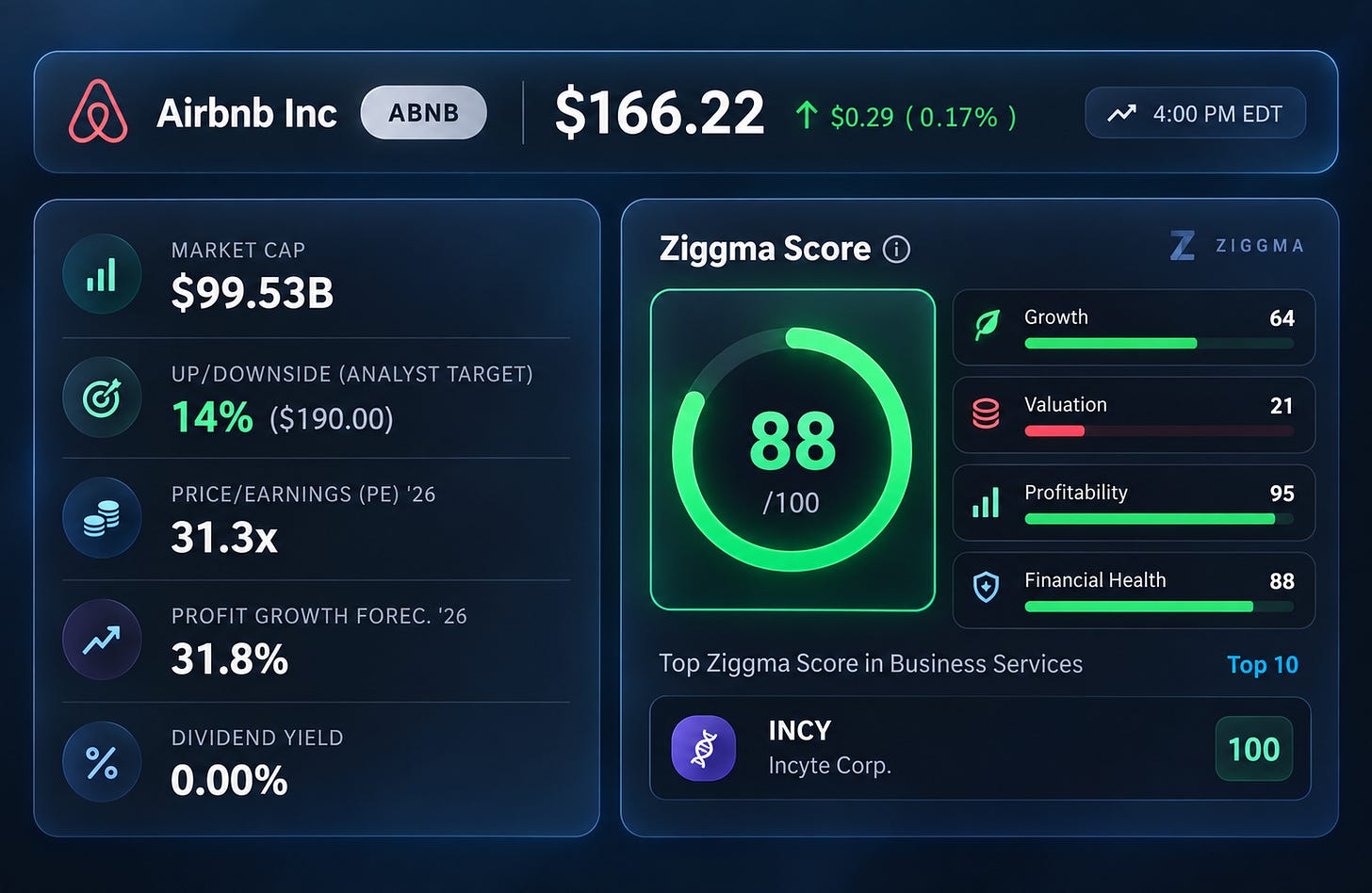
Analysts’ average price target of $190 implies 14% upside, and at about 21 times free cash flow we think 10–15% annual returns are realistic over the long run.
Airbnb’s individual impact metrics are strong. Its emissions path fits the 1.5°C climate goal, its CEO takes a $1 salary and employees rate it 4.2 out of 5. The overall Impact Score reads Mixed at 59, largely because of the controversies any home-sharing platform attracts.
Source Ziggma
Marriott showed how much money there is in earning fees on hotels someone else owns. Airbnb runs the same capital-light model with even less capital: Marriott still runs many hotels for their owners, while Airbnb leaves the running to hosts, so nearly all of its operating cash is free to hand back to shareholders. That came to $4.6 billion in 2025, 38 cents of every revenue dollar, and bookings are speeding up again.
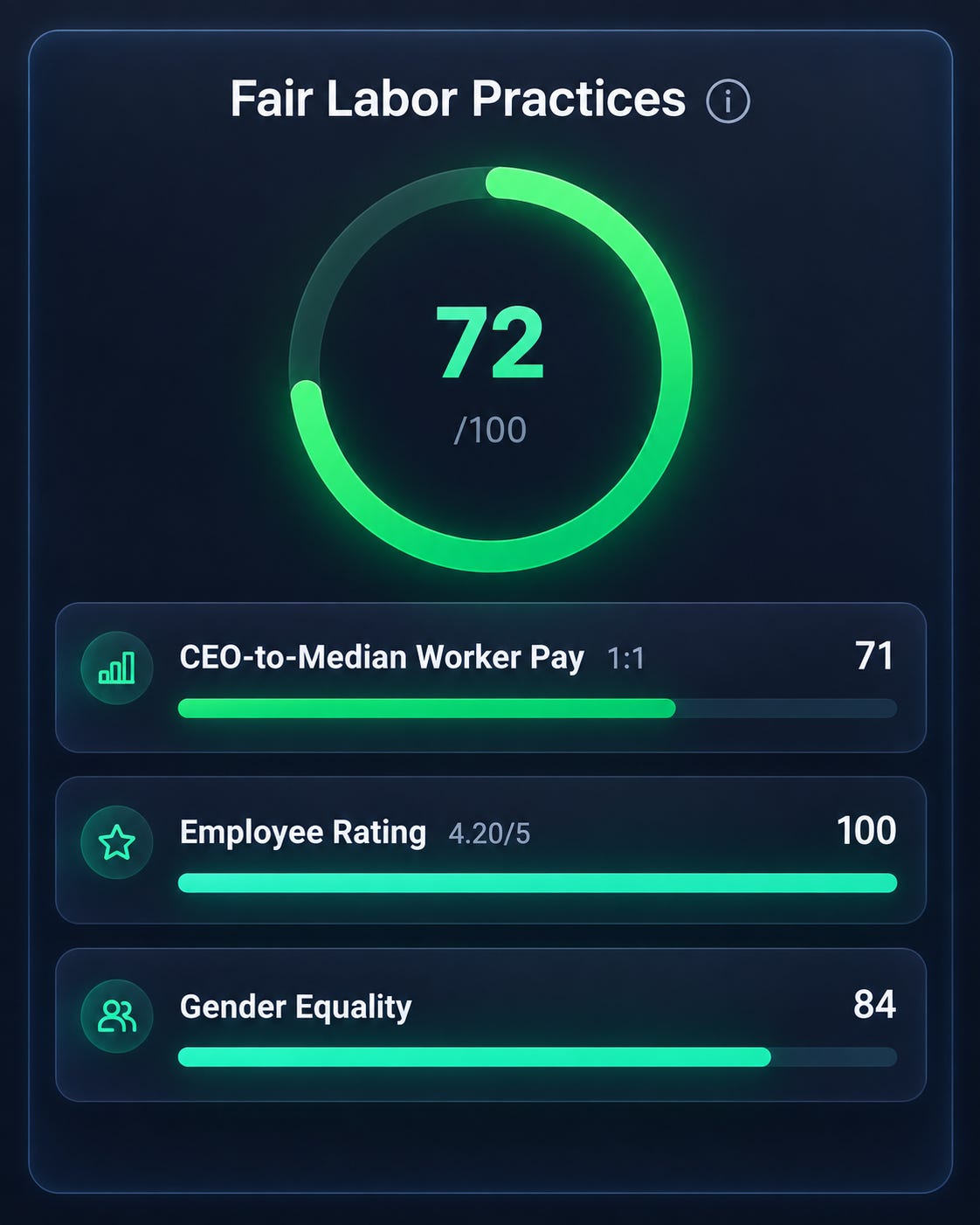
Airbnb scores a perfect 100 on Ziggma’s global warming potential measure, meaning its emissions path lines up with the Paris Agreement’s 1.5°C goal. Its CEO earns less than the median employee, while large hotel and travel companies report CEO pay above 500 times the typical worker’s.
Airbnb runs a marketplace. Hosts list apartments, spare rooms and cabins, guests book them, and Airbnb keeps a fee on each stay. Guests booked 533 million nights and experiences in 2025 across more than 9 million listings.
Marriott owns very few of its hotels. It collects franchise and management fees while other investors carry the buildings and the debt. Airbnb goes further: hosts buy the furniture, pay the cleaners and carry the risk of an empty night.
The moat is the network. More hosts draw more guests, which draws more hosts. Skift Research estimates Airbnb took about 44% of global short-term rental revenue in 2024, up from 28% in 2019. The weak spot is that hosts can list the same home on Booking.com and Vrbo.
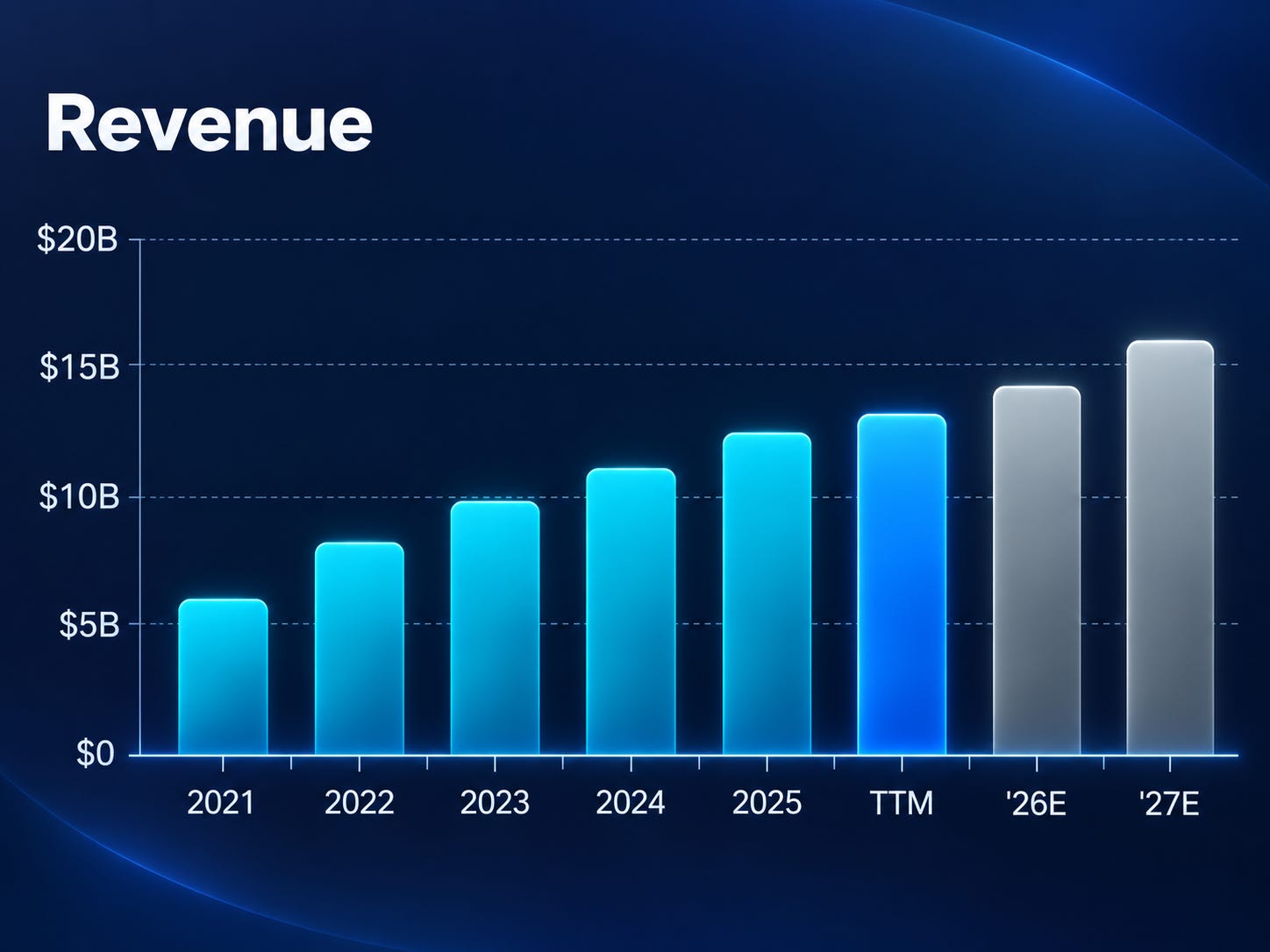
Revenue doubled between 2021 and 2025 to $12.2 billion, and 83% of it is left after direct costs. Operating profit was flat in 2025 because marketing jumped 20%, twice as fast as revenue. About $200 million went into launching services such as private chefs, and the bill also covers Olympic and World Cup sponsorships. Airbnb isn’t pulling back. Marketing grew 27% in the second quarter of 2026, but revenue is growing fast enough that management raised its full-year margin target.
Source: Ziggma
It seems to be working. In the second quarter of 2026, nights booked rose 10% and first-time guests grew 11%, the fastest in four years. Management now expects revenue growth of at least mid-teens this year, and analysts see earnings per share up 31.8%.
At 31.3 times 2026 earnings, Airbnb costs far more than Booking Holdings at roughly 16–18 times. Cash tells a different story: $4.6 billion of free cash flow against a $99.5 billion market value is a 4.7% yield. One caveat: that figure adds back stock-based pay, a real cost to shareholders. Buybacks have more than offset it, shrinking the share count from 680 million in 2022 to 623 million.
The Ziggma Score is 88 out of 100, with Profitability at 95 and Financial Health at 88, both among the best in the industry. Valuation is the only drag.
Cities keep tightening short-term rental rules, and New York’s 2023 law wiped out most short stays in one of Airbnb’s biggest markets. In 2027 Airbnb has to beat a year boosted by the World Cup. And if AI assistants become the front door for trip planning, Airbnb may have to pay more to be found.
Beyond the 14% analyst upside, simple math helps: a 4.7% cash yield plus low-teens growth points to 10–15% a year, without the stock needing a higher valuation.
Global warming potential of 1.5°C earns 100 out of 100, and carbon intensity fell 25%. Fair Labor scores 72. What pulls the overall score down to Mixed is Accountability, at 27. A platform active in more than 100,000 cities runs into a steady stream of disputes with neighbors and city halls, and controversy measures pick up every one.
Brian Chesky’s salary is $1. His reported 2024 pay was $186,326, below the median employee’s $271,657. His real payday is a 12 million share award that vests only if the stock clears price hurdles, the next one at $245. Chesky has committed to donate the net proceeds of that award. In 2016 he and his two co-founders signed the Giving Pledge, started by Bill Gates and Warren Buffett, promising to give away most of their wealth. Employees rate Airbnb 4.2 out of 5, which earns a perfect 100 from Ziggma.
Source: Ziggma
A study by Kyle Barron, Edward Kung and Davide Proserpio in Marketing Science found that a 1% rise in Airbnb listings lifts rents by 0.018% in a typical US zip code. The effect is limited because private homes and rooms still make up as much as 68% of Airbnb rentals, so most listings are places people live in, not units taken off the rental market.
By Airbnb’s own count, travel on the platform generated $93 billion of US economic activity in 2025. 63% of US census tracts have Airbnb listings but no hotels, and hosts there earned $9.9 billion. Our read: the housing cost is real but concentrated in tight city markets, while the income spreads widely, including into rural towns.
Airbnb is a Marriott-style fee machine, growing faster and priced at about 21 times the cash it produces. Its impact rating carries the controversies that come with the business. But a company that pays its founder only when shareholders win, and sends tourism money into towns hotels skip, earns its place in the GoodStocks universe.
______________________________________________________________________________________________________________________________
Disclaimer
This information is provided solely for general information and educational use. It is not intended as, and should not be construed to be, financial, investment, tax, legal, or other professional advice. Data used in the analysis is derived from third-party sources and applicable at the time of publication of the analysis. No representation or warranty is made as to the accuracy or completeness of the information or any analysis herein.
Ziggma is not registered or licensed as a financial advisor, broker-dealer, or tax professional. Readers should perform their own independent research and seek advice from appropriately qualified professionals before making any financial, investment, or legal decisions.
You should presume that, as of the date this report is published or any related communication referencing publicly traded securities or assets, Ziggma team members may hold positions in the securities or assets discussed and could benefit financially from price movements. Positions may be changed without notice.
There is no duty to revise or update the content after publication. Neither Ziggma nor any affiliated parties accept responsibility for market changes, economic developments, or subsequent events that could affect the relevance or accuracy of the information.
Forward-Looking Statements
This report may include forward-looking statements, such as forecasts, projections, estimates, or expectations regarding financial outcomes, market dynamics, or future corporate developments. These statements are based on assumptions that may not hold true, and actual results may vary materially. The author undertakes no obligation to update or revise any forward-looking statements as circumstances change.
Third-Party Data & External Sources
Certain information is sourced from third parties. Nonetheless, the accuracy, completeness, and timeliness of such information cannot be assured. Ziggma disclaims any responsibility for errors or omissions in third-party data and does not endorse, verify, or assume accountability for the methodologies or conclusions of external sources.
AI-Generated Enhancements
AI tools can be used to enhance clarity, structure, and brevity, and to assist with research organization, ideation, and analytical review.
Redistribution
You may share this report for informational purposes. However, reproduction, distribution, republication, or modification of any portion of the content, in whole or in part, without prior written consent is prohibited.
Investment Risk Disclosure
All investing carries risk of loss.. Historical performance does not guarantee future outcomes. References to specific securities, companies, or strategies are for informational purposes only and do not constitute recommendations or endorsements. Any use of, or reliance on, the information in this report is entirely at the reader’s own risk.
Neither Ziggma nor affiliated parties shall be liable for any direct or indirect losses or damages of any kind arising from the use of this report or reliance on its contents. By accessing this report, you agree to indemnify and hold harmless Ziggma and affiliated parties from any claims, liabilities, or damages resulting from your use of the material.
You alone bear responsibility for your decisions. Use this information at your own discretion and risk.