Ziggma continuously looks for companies that build real wealth for shareholders while doing measurable good for people or the planet, and the evidence keeps saying those goals reinforce each other. AbbVie (ABBV 🔎) tests that idea, because it does both and has also, in its past, done one thing badly.
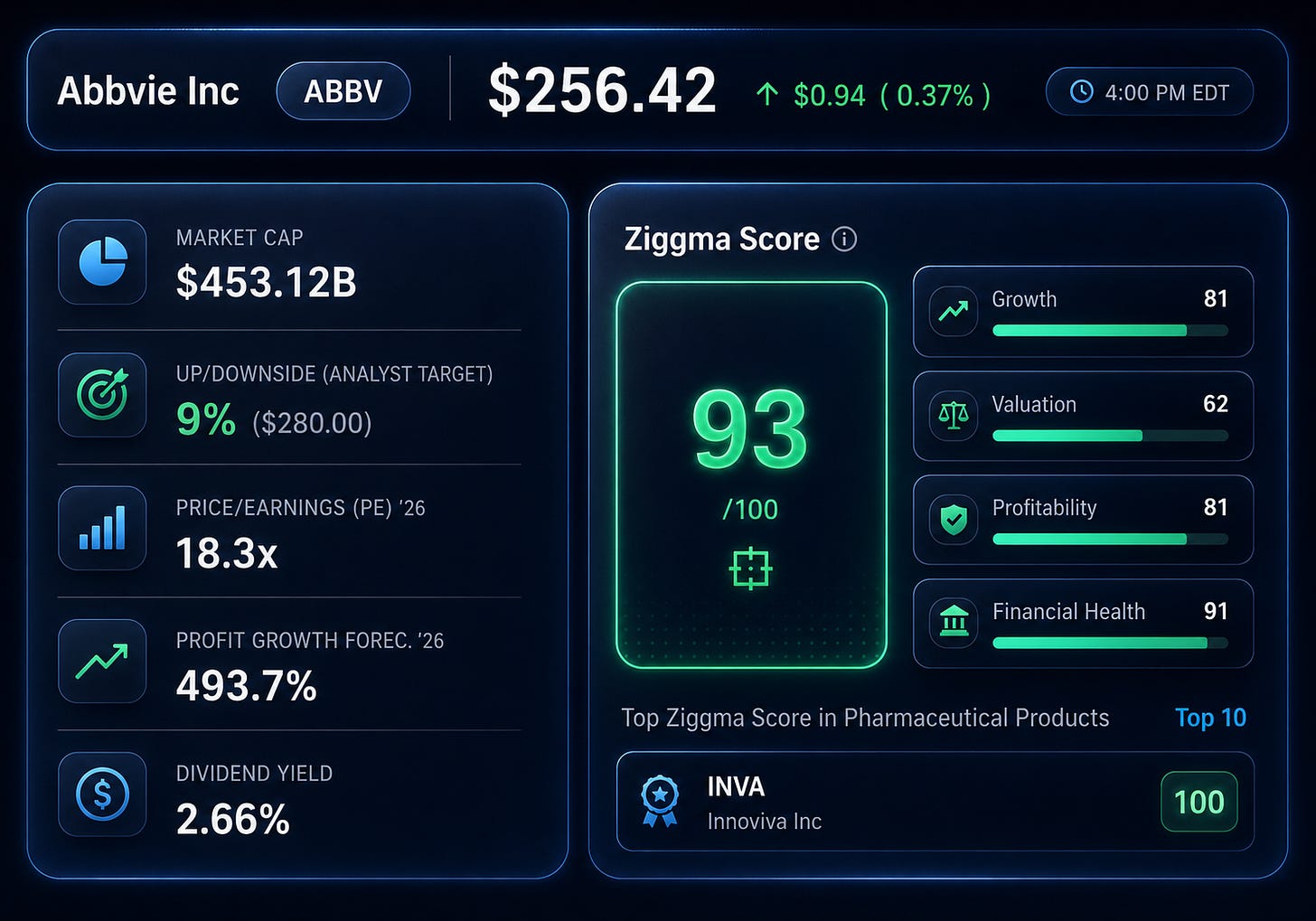
ABBV stock trades near all-time highs. Yet it changes hands at just 18x next year’s earnings. The Ziggma Stock Score is high at 93 out of 100, and the average analyst target of $280 implies close to 12% total return over a year. We believe upward revisions are in the cards.
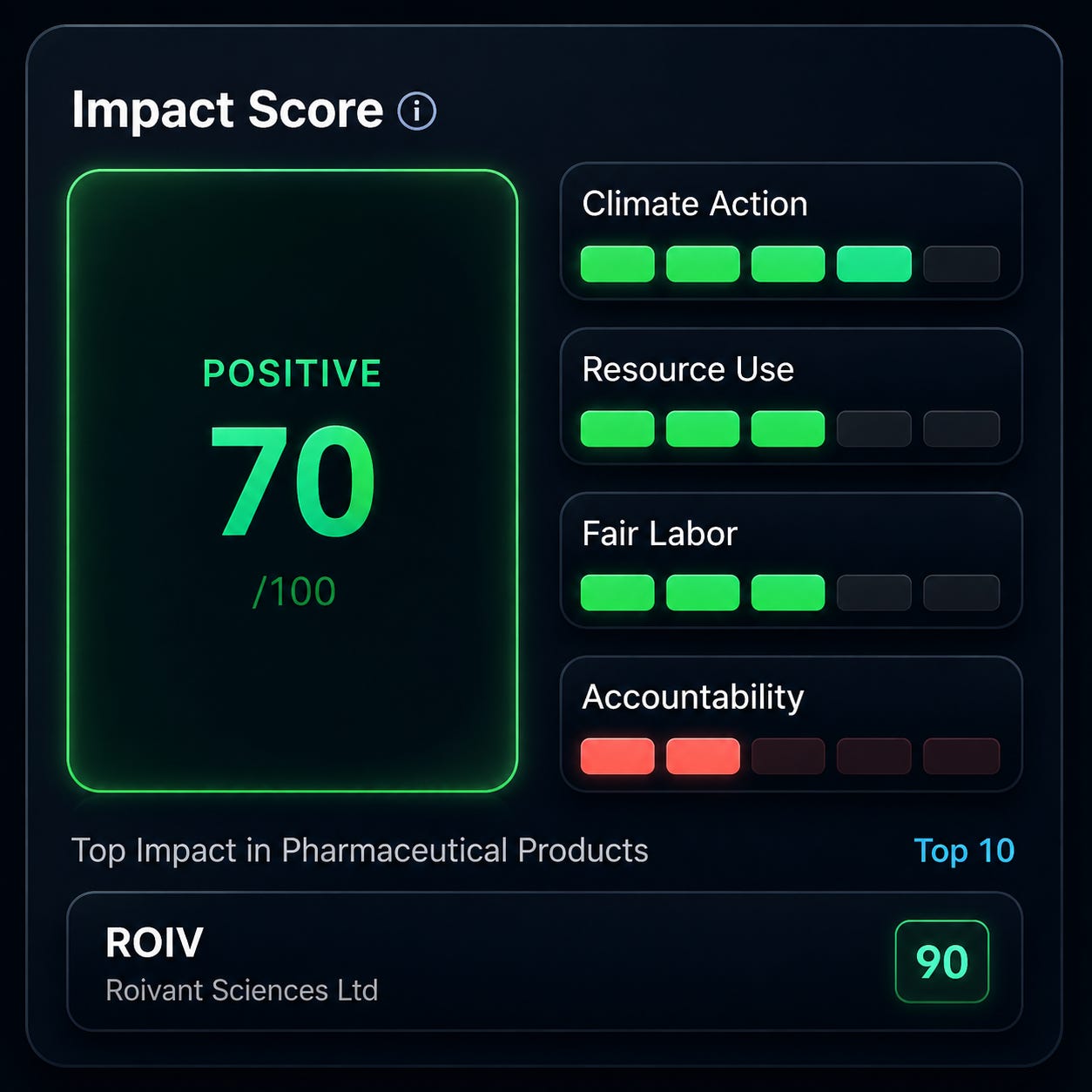
The Impact Score is 70 out of 100 and rated Positive. Driving it: medicines that treat conditions which quietly dismantle lives, from Crohn’s disease and psoriasis to rheumatoid arthritis, Parkinson’s, blood cancers and migraine, plus the free medicine shipped last year to more than 210,000 Americans who could not afford it. Holding it back is a governance record we are not burying in a footnote.
Source: Ziggma
AbbVie has pulled off the hardest transition in large pharma: replacing a $20 billion drug that lost patent protection. Skyrizi and Rinvoq each grew about 24% last quarter and together out-earn Humira at its peak, yet the stock trades below the market multiple.
More than 210,000 people received AbbVie medicines free of charge in the US last year, and Climate Action scores 83 out of 100 on the back of an emissions path rated consistent with 1.5°C. The core product measurably reduces suffering, the highest tier of impact we look for.
AbbVie is one of the biggest drugmakers on earth, worth about $453 billion and run out of North Chicago. It does not sell anything you would spot in a pharmacy aisle. Its business is prescription treatments for serious long-term conditions, prescribed by doctors and reimbursed by insurers, plus the Allergan aesthetics range it bought in 2020.
It spun out of Abbott in 2013 with one enormous asset, Humira, and the certainty it would lose exclusivity. It answered by building two successors in house. Skyrizi treats psoriasis and inflammatory bowel disease, Rinvoq treats rheumatoid arthritis and a widening list of conditions, and around them sits a business spanning Botox, migraine and Parkinson’s.
The moat is unusual. Biologics are grown in living cell systems rather than mixed from a recipe, so copies arrive slowly and expensively and Skyrizi stays defended for a decade. Roughly one in ten people worldwide lives with an autoimmune condition, so demand keeps building.
Management guides 2026 earnings to about $14 a share, roughly 10% growth on a like-for-like basis and in line with revenue. That is the number to anchor on. Last year’s reported $2.36 looks alarming beside it, but the gap is an artifact of $2.76 a share in upfront payments for research programs AbbVie bought, which the 2026 guidance excludes. That was real cash buying future medicines, not weakness, and cash flow margin held at 31.1%.
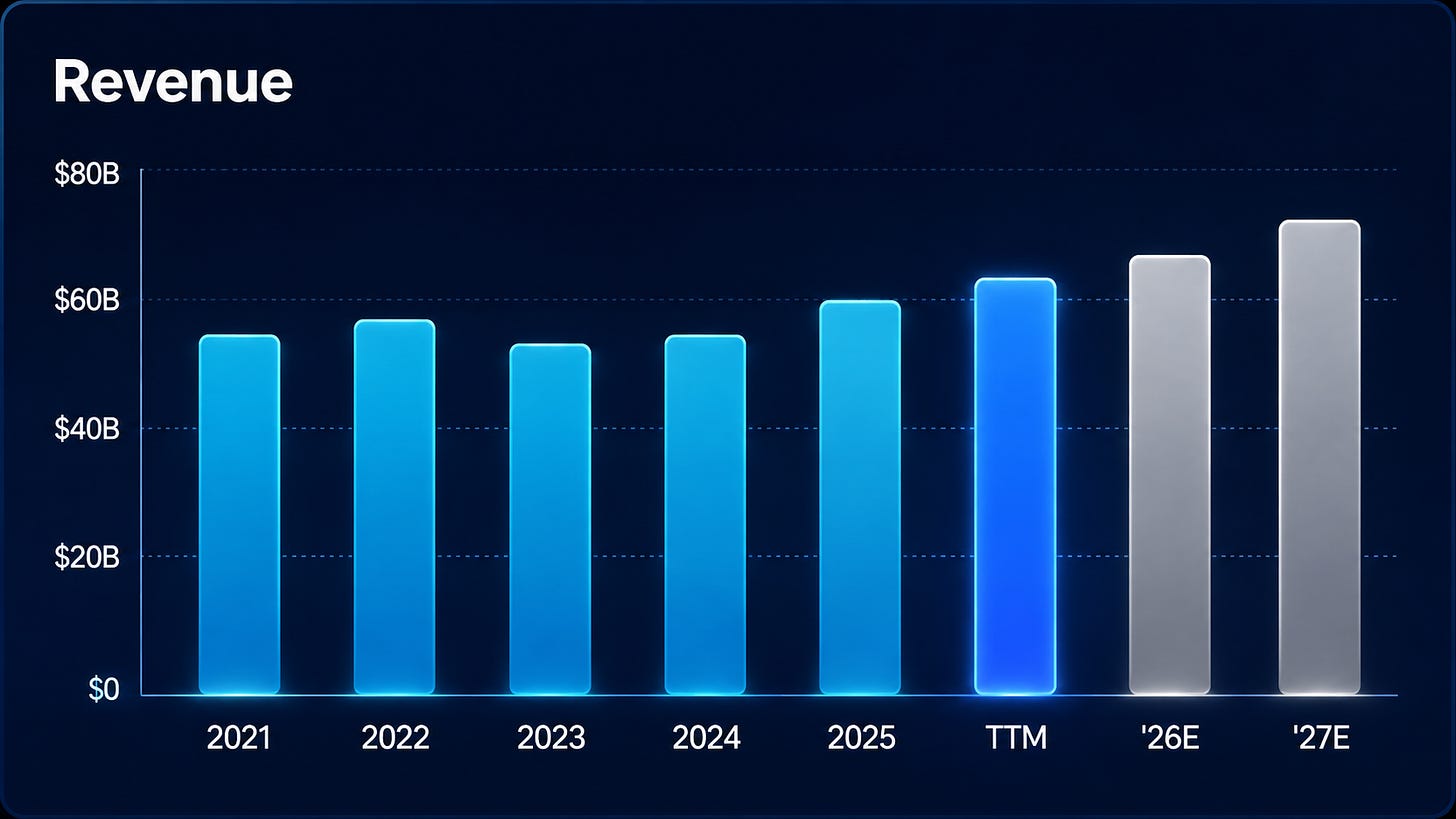
AbbVie bottomed at $190.75 in late April on drug pricing fears, then ran 34% into summer. What began as a bounce has turned into something firmer. Revenue grew 12.4% and 10.2% in the last two quarters against 1.7% a year through the Humira era, and management has beaten expectations four quarters running, raised guidance twice, and guides high single-digit growth through 2029.
Source: Ziggma
At 18x next year’s earnings AbbVie costs less than the S&P 500 while growing faster than its biggest peers. Revenue is guided up around 10% this year against 6.6% at Johnson & Johnson and 5% at Merck, while Pfizer and Bristol Myers Squibb guide theirs lower. What you are really paying for is visibility. AbbVie has put numbers years out: Skyrizi at $21.7 billion this year, Rinvoq at $10.2 billion, more than $31 billion combined by 2027 and high single-digit growth through 2029. Merck, by contrast, trades above 50x forward earnings heading into a patent cliff of its own. Underneath it all sits a dividend raised for more than 50 consecutive years.
About half of 2026 revenue comes from two drugs, so a safety signal or trial failure in either would hurt badly. Drug pricing policy is the other live threat, with Medicare negotiation and a voluntary Medicaid pricing agreement already narrowing margins. Even so, high single-digit earnings growth at a stable multiple, plus the dividend, supports low double-digit annual returns over three to five years.
The good here comes from what the company sells. Ulcerative colitis in remission is the difference between holding a job and losing one. A Parkinson’s patient on Vyalev gets back hours of controlled movement a day. Add the 210,000 who got free medicine last year and the access story is real. It is the same test we applied to Insulet and to Alnylam: does the product itself do the good, or does the company just behave well while selling something ordinary?
Climate Action scores 83, AbbVie’s best impact sub-score, and one metric carries it: the emissions path is rated consistent with holding warming to 1.5°C, a perfect 100. Targets validated by the Science Based Targets initiative call for a 42% cut by 2030, and emissions fell 10% last year to 380,850 metric tons. There are real gaps, though. Only 10% of energy comes from renewables and 40% of waste is recycled, both scoring in the 30s.
Source: Ziggma
AbbVie built a wall of patents around Humira: 247 applications and more than 130 US patents, most filed after the drug was already on sale. The core patent expired in 2016, yet cheaper copies did not reach American patients until 2023. Those six extra years of monopoly pricing cost patients and insurers tens of billions, and they are why Accountability scores 39 and the overall impact number is 70 rather than 90.
The conduct has changed. Growth now comes from molecules AbbVie invented rather than legal walls, and in January it agreed to cut Medicaid prices and sell Humira direct to patients at lower cost. Read that with one eye open, though. The same deal won AbbVie a three-year exemption from tariffs and future price mandates, and regulators had already made patent thickets far less profitable.
AbbVie spent years defending an old drug badly, quietly built two better ones, and now trades at 18 times earnings while growing 10% and paying 2.66% to hold it. The medicines give people back their days, the climate work is audited and on track, and the governance record is a real mark against it that no longer pays. For investors who want returns and impact without pretending the trade-offs away, Abbvie is worth a closer look to align capital with values.
______________________________________________________________________________
Disclaimer
This information is provided solely for general information and educational use. It is not intended as, and should not be construed to be, financial, investment, tax, legal, or other professional advice. Data used in the analysis is derived from third-party sources and applicable at the time of publication of the analysis. No representation or warranty is made as to the accuracy or completeness of the information or any analysis herein.
Ziggma is not registered or licensed as a financial advisor, broker-dealer, or tax professional. Readers should perform their own independent research and seek advice from appropriately qualified professionals before making any financial, investment, or legal decisions.
You should presume that, as of the date this report is published or any related communication referencing publicly traded securities or assets, Ziggma team members may hold positions in the securities or assets discussed and could benefit financially from price movements. Positions may be changed without notice.
There is no duty to revise or update the content after publication. Neither Ziggma nor any affiliated parties accept responsibility for market changes, economic developments, or subsequent events that could affect the relevance or accuracy of the information.
Forward-Looking Statements
This report may include forward-looking statements, such as forecasts, projections, estimates, or expectations regarding financial outcomes, market dynamics, or future corporate developments. These statements are based on assumptions that may not hold true, and actual results may vary materially. The author undertakes no obligation to update or revise any forward-looking statements as circumstances change.
Third-Party Data & External Sources
Certain information is sourced from third parties. Nonetheless, the accuracy, completeness, and timeliness of such information cannot be assured. Ziggma disclaims any responsibility for errors or omissions in third-party data and does not endorse, verify, or assume accountability for the methodologies or conclusions of external sources.
AI-Generated Enhancements
AI tools can be used to enhance clarity, structure, and brevity, and to assist with research organization, ideation, and analytical review.
Redistribution
You may share this report for informational purposes. However, reproduction, distribution, republication, or modification of any portion of the content, in whole or in part, without prior written consent is prohibited.
Investment Risk Disclosure
All investing carries risk of loss.. Historical performance does not guarantee future outcomes. References to specific securities, companies, or strategies are for informational purposes only and do not constitute recommendations or endorsements. Any use of, or reliance on, the information in this report is entirely at the reader’s own risk.
Neither Ziggma nor affiliated parties shall be liable for any direct or indirect losses or damages of any kind arising from the use of this report or reliance on its contents. By accessing this report, you agree to indemnify and hold harmless Ziggma and affiliated parties from any claims, liabilities, or damages resulting from your use of the material.
You alone bear responsibility for your decisions. Use this information at your own discretion and risk.