Ziggma’s GoodStocks research covers companies where strong shareholder returns and real-world positive impact converge, and the evidence keeps stacking up that this combination beats the market over time. Adobe (ADBE 🔎) is one of the odder names to land in that category, because right now the market is telling you it has no future at all.
The stock has lost roughly 60% from its 2024 high. It traded at $190 in June. The story behind the collapse is easy to follow: if anyone can produce a professional-looking image by typing a sentence, why would they keep paying for Photoshop? We made the same argument about Salesforce in June.
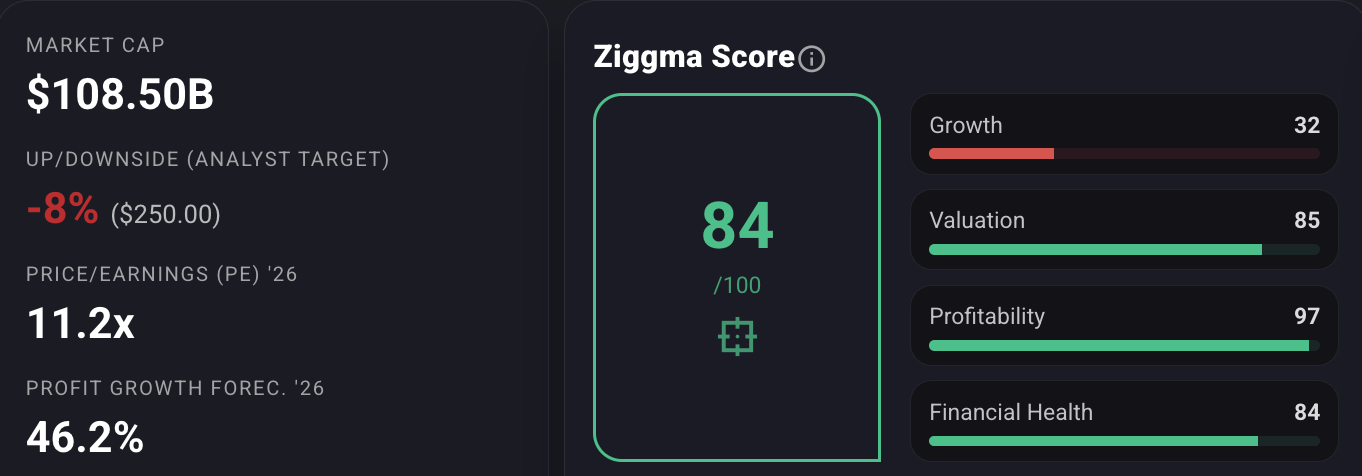
Here is what that story leaves out. Adobe’s revenue hit a record $6.6 billion last quarter, up 13% from a year earlier. It generated $2.96 billion of operating cash flow in a single quarter earlier this year. And at around $264 a share, it changes hands at roughly 11 times the profit management itself expects to earn this year, against a five-year average closer to 41 times. You are being asked to pay a going-out-of-business price for a business that is still growing.
The impact side is unusual too. Adobe founded and funds the effort behind Content Credentials, the cryptographic labelling system that lets anyone check where an image came from and whether a machine made it. It is now an international standard. Real infrastructure against a real problem, built by the company everyone assumes AI is about to erase.
Source: Ziggma
Key takeaways
Adobe scores 97 out of 100 on Ziggma’s profitability measure, with return on equity of 63% and 42% of every sales dollar converting into cash flow. That quality is available at roughly 11 times forward earnings, a price that assumes the growth has already stopped. It has not.
Adobe built the provenance standard now used by the BBC, Reuters, the Associated Press and more than 200 member organizations to prove whether an image is authentic. At a moment when anyone can fabricate a convincing photograph in seconds, that is a direct and measurable contribution to an information environment people can actually trust.
Adobe makes the tools that most professional visual work passes through. Photoshop, Illustrator and Premiere Pro for images and video. Acrobat and the PDF, which the company invented, for documents. A third arm sells marketing and content software to large enterprises, recently strengthened by the acquisition of Semrush. Around 850 million people touch an Adobe product each month.
The moat is habit and file formats. Design schools teach Photoshop. Agencies staff for it. Every printer, publisher and legal department in the world can open a PDF. Switching costs are not written into a contract, they are written into how an entire profession works. The broader software market Adobe sits in is forecast to grow around 13% a year.
Adobe has traded at an average of about 42x earnings over the past five years. Today it sits near 15 times trailing earnings and roughly 11 times what management guided for this year. Measured against sales, the stock is at 4.2 times versus a five-year average of 11.7x. A company does not get three quarters cheaper because of a bad quarter. It gets there because investors decided the future changed.
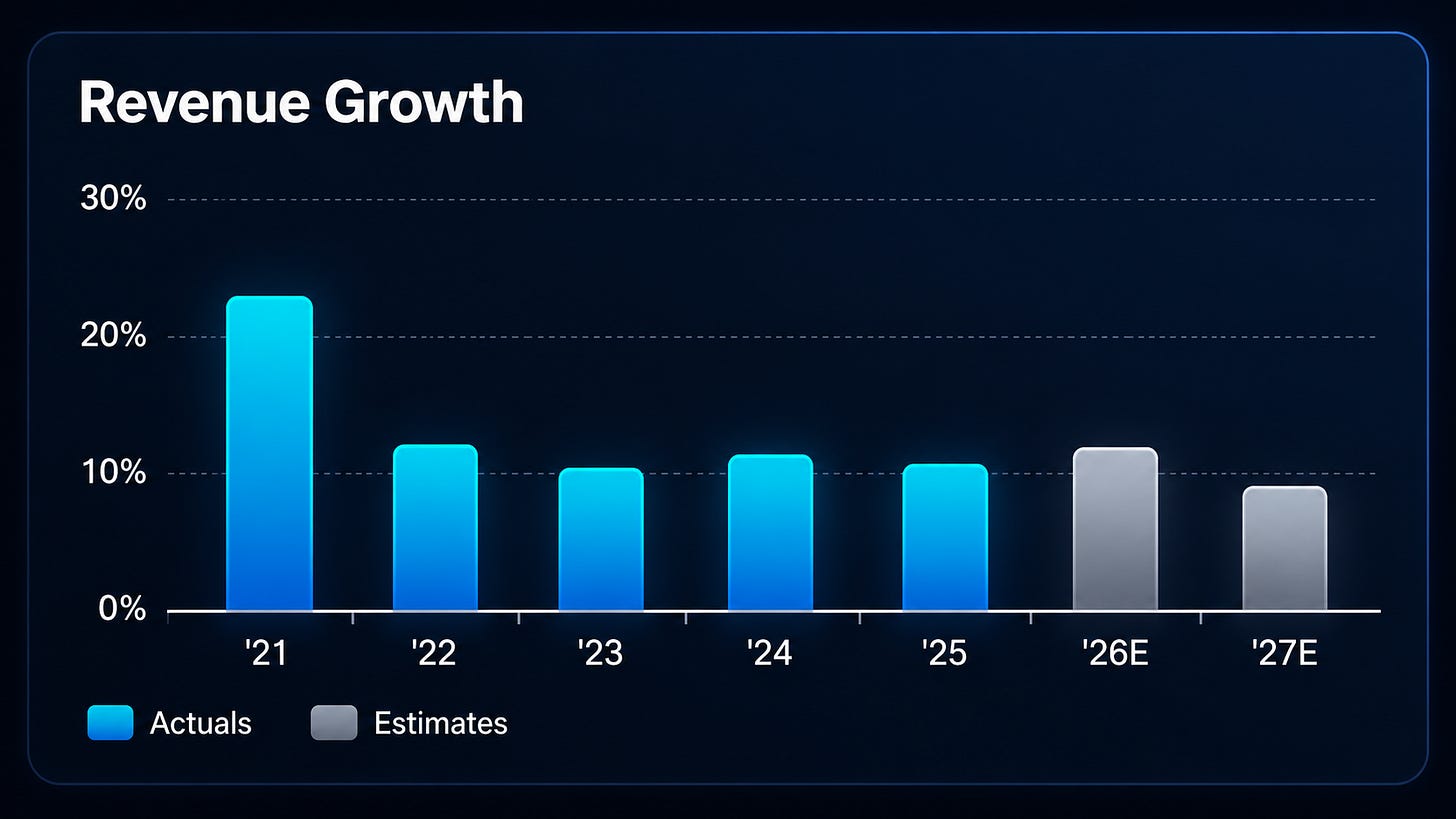
Revenue rose 11.5% over the past year, but the five-year compound rate is 8.5%, and Ziggma’s growth score of 32 out of 100 reflects that deceleration honestly. Management guided its organic recurring revenue growth down to 8.3% for this year, partly because it is giving away AI features free to build usage first. The counter-evidence is real: AI-first recurring revenue tripled in a year to more than $500 million, and contracted future revenue rose 13.1%.
Source: Ziggma
The board authorized $25 billion of buybacks through 2030, against a company worth around $109 billion. Share count is already down roughly 10% over three years, and every dollar spent now retires far more stock than it did at 2024 prices. There is no dividend. In June, one Adobe director bought 10,000 shares of his own money on the open market at $194.51, near the low.
The average analyst target sits at $250, slightly below where the stock already trades. Those same targets were far higher before the fall, so the professionals followed the price down rather than calling it. The spread matters more than the average anyway. Morgan Stanley cut Adobe to underweight in July with a $240 target, down from $365. CLSA opened coverage the day before with an outperform rating and a $300 target. Same company, same numbers, opposite conclusions, one day apart, and today’s share price sits right between the two. Disagreement this wide is what a price set by story rather than arithmetic looks like, and it is where contrarian returns tend to hide. Just do not expect analysts to hand you a catalyst on the way up.
Start with the cash. Adobe collected about $10.3 billion over the past year after every salary, bill and equipment cost was paid. That is roughly $25 for each share in existence, and it grew almost 9%.
At $264 you are paying about 10 times a single year’s cash. Before the AI panic, Adobe routinely fetched more than 25 times.
Our base case is a return to 15 times, still well below anything this company traded at in the past decade. That puts the shares near $375, about 42% above today’s price. If sentiment swings harder and buyers pay 20 times, you are looking at $500, roughly 89% higher. We would not underwrite that second number. The first one only requires the cash to keep growing at the rate it already is.
Narayen announced in March that he would step aside after eighteen years, and a successor has not yet been named. The chief financial officer is moving on as well. Narayen stays on as chairman and Adobe has acted to retain the leadership beneath him, so this reads as a managed transition rather than a scramble. Even so, the next strategic chapter will be set by someone who has not been hired yet, which argues for a measured position size.
AI substitution is genuine at the low end, where casual users may never need a subscription again. A generation of designers learning on AI-native tools may never form the Photoshop habit the whole moat rests on. Recurring revenue growth is slowing, and if the free-features bet fails to convert into paying customers, the cash flow that underpins every number above stops growing with it.
Put it together and the setup is asymmetric. At 11 times earnings with a quarter of the company being bought back, Adobe does not need to win the AI war. It only needs to find a role in an AI world.
Adobe created the Content Authenticity Initiative and drove the technical standard behind it into international recognition. Content Credentials attach a tamper-evident record to an image showing where it originated and what was done to it. Photoshop, Lightroom, Premiere Pro and Adobe’s own AI tools all read and write these credentials, and major newsrooms now sign their photography with them. This is the rare corporate impact claim with a clear causal chain: Adobe built the thing, and the thing addresses one of the defining problems of the decade.
Source: Ziggma
Adobe trained its Firefly AI models only on licensed and public domain content, specifically so customers are not exposed to someone else’s copyright and so creators are not harvested without consent. In an industry that mostly did the opposite, that choice cost money and mattered.
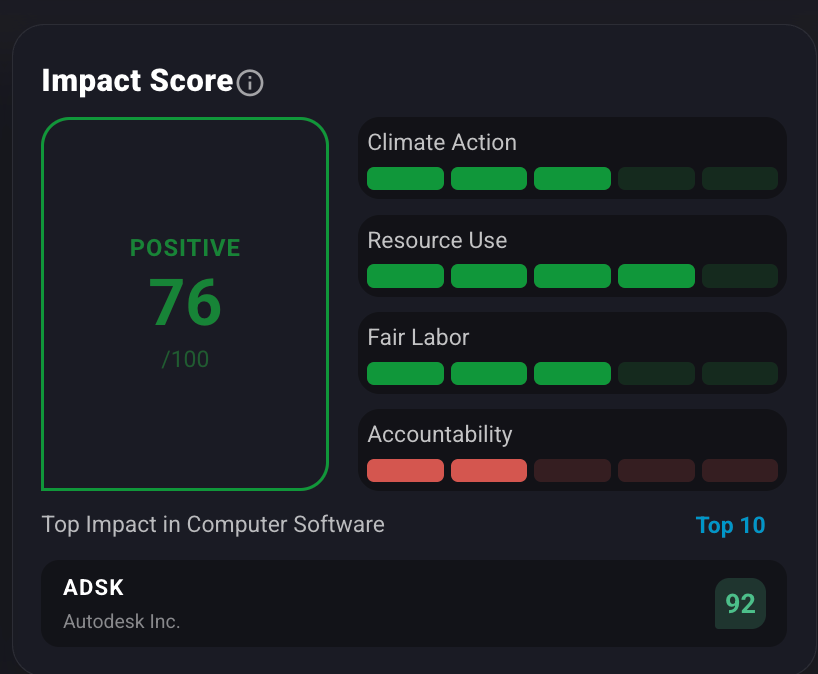
The company scores 32 out of 100 on accountability, and it earned that. Adobe paid $150 million in 2026 to settle government claims that it buried early termination fees in fine print and made subscriptions deliberately hard to cancel. Its privacy score of 36 reflects a 2024 episode in which vague new terms convinced creators their work would be fed to AI, a fear Adobe eventually addressed by rewriting the terms and committing not to train on customer content. Executive pay runs 250 times the median employee. On the other side of the ledger, employees rate the company 4.80 out of 5, among the best figures we see anywhere, and the climate program carries validated science-based targets. This is a company that treats the people inside the building well and has a history of mishandling trust with the people outside it.
Adobe is not a 100% clean positive impact story. While the Content Authenticity Initiative represents extensive positive impact, the accountability record is the weakest we have covered in this series.
What it is, at 11 times forward earnings, is a highly profitable business still growing double digits, returning close to a quarter of its market value to shareholders, priced as though generative AI already finished it off. In reality the pivot is already under way. Revenue from Adobe’s AI-first products tripled over the past year to more than $500 million, and the company is deliberately trading near-term subscription growth for adoption of those tools.
And the company the market believes AI will destroy is the same one building the system that lets the rest of us tell what is real. That is worth owning a piece of at this price, with your eyes open about the rest.
____________________________________________________________________________________________________________________________________________________
Disclaimer
This information is provided solely for general information and educational use. It is not intended as, and should not be construed to be, financial, investment, tax, legal, or other professional advice. Data used in the analysis is derived from third-party sources and applicable at the time of publication of the analysis. No representation or warranty is made as to the accuracy or completeness of the information or any analysis herein.
Ziggma is not registered or licensed as a financial advisor, broker-dealer, or tax professional. Readers should perform their own independent research and seek advice from appropriately qualified professionals before making any financial, investment, or legal decisions.
You should presume that, as of the date this report is published or any related communication referencing publicly traded securities or assets, Ziggma team members may hold positions in the securities or assets discussed and could benefit financially from price movements. Positions may be changed without notice.
There is no duty to revise or update the content after publication. Neither Ziggma nor any affiliated parties accept responsibility for market changes, economic developments, or subsequent events that could affect the relevance or accuracy of the information.
Forward-Looking Statements
This report may include forward-looking statements, such as forecasts, projections, estimates, or expectations regarding financial outcomes, market dynamics, or future corporate developments. These statements are based on assumptions that may not hold true, and actual results may vary materially. The author undertakes no obligation to update or revise any forward-looking statements as circumstances change.
Third-Party Data & External Sources
Certain information is sourced from third parties. Nonetheless, the accuracy, completeness, and timeliness of such information cannot be assured. Ziggma disclaims any responsibility for errors or omissions in third-party data and does not endorse, verify, or assume accountability for the methodologies or conclusions of external sources.
AI-Generated Enhancements
AI tools can be used to enhance clarity, structure, and brevity, and to assist with research organization, ideation, and analytical review.
Redistribution
You may share this report for informational purposes. However, reproduction, distribution, republication, or modification of any portion of the content, in whole or in part, without prior written consent is prohibited.
Investment Risk Disclosure
All investing carries risk of loss.. Historical performance does not guarantee future outcomes. References to specific securities, companies, or strategies are for informational purposes only and do not constitute recommendations or endorsements. Any use of, or reliance on, the information in this report is entirely at the reader’s own risk.
Neither Ziggma nor affiliated parties shall be liable for any direct or indirect losses or damages of any kind arising from the use of this report or reliance on its contents. By accessing this report, you agree to indemnify and hold harmless Ziggma and affiliated parties from any claims, liabilities, or damages resulting from your use of the material.
You alone bear responsibility for your decisions. Use this information at your own discretion and risk.