Ziggma’s GoodStocks research covers a specific kind of company: one that can compound shareholder wealth while doing measurable good, a pairing that a growing body of evidence links to market-beating returns. Back in February we made exactly that case for Amalgamated Financial. Since then the stock has gained more than 50% and now trades around $49, close to its all-time high. So the question for anyone looking at it today is simple. Is the easy money gone, or is there still road ahead?
The short answer: the cheap-valuation part of the thesis has largely played out, but the earnings engine has not. Amalgamated still earns a mid-teens return on equity, is expected to grow profit around 17.6% in 2026, and trades below the multiples of slower regional peers. Longer-term valuation models built on future cash flow point toward $65 to $70 a share. On the impact side, it remains the only publicly listed US bank that is also a certified B Corp, with a climate score of 90 out of 100 and operations running entirely on renewable electricity. That keeps it firmly in the GoodStocks universe.
Source: Ziggma
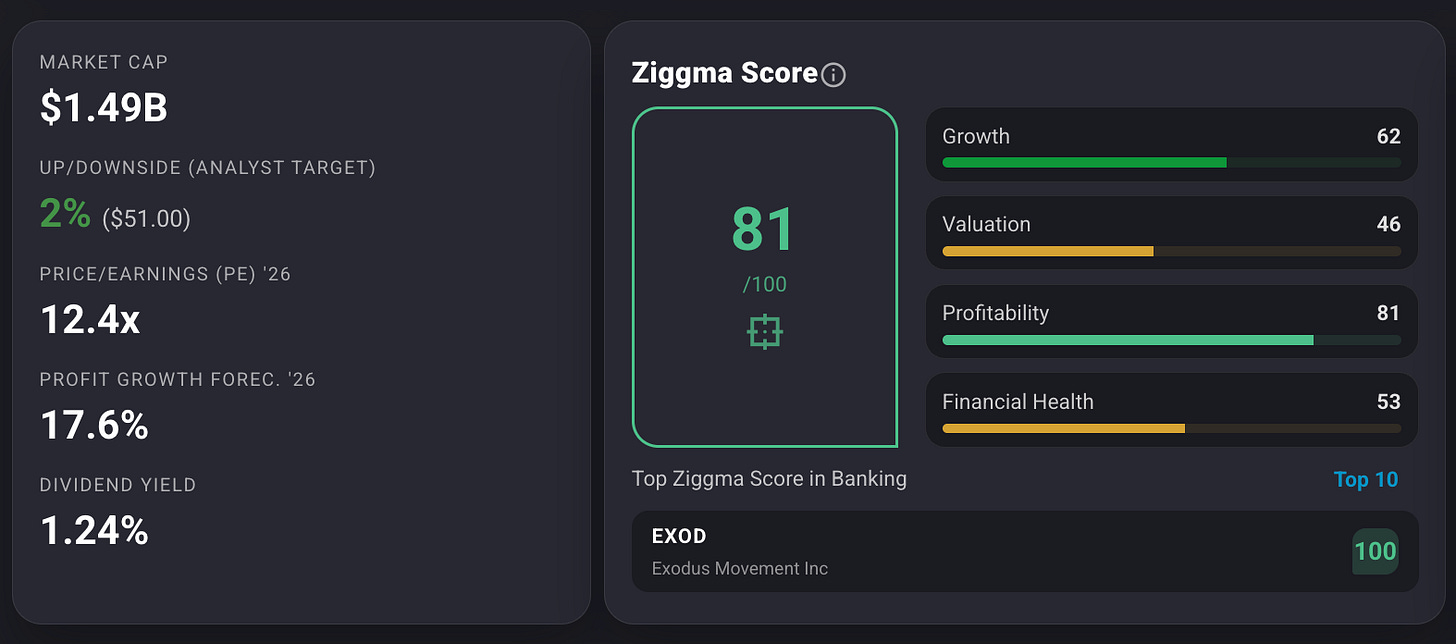
Amalgamated earns a mid-teens return on equity yet trades around 12 times next year’s expected earnings, a discount to most regional banks growing far more slowly. If management delivers the roughly 17.6% profit growth analysts expect for 2026, today’s price looks more like a pause than a peak.
AMAL’s climate score of 90 out of 100 ranks among the highest in US banking, and it runs on 100% renewable electricity. Its lending flows toward clean energy and community projects, so the impact is built into the business rather than bolted on.
Amalgamated Financial is the holding company behind Amalgamated Bank, a New York commercial bank with a national reach and roughly $1.5 billion in market value. It banks labor unions, nonprofits, climate funds, clean energy developers and mission-driven organizations. The everyday products are ordinary: deposits, loans, treasury services. What sets the bank apart is who it serves and where the money goes.
That focus is also its moat. Customers pick Amalgamated because it shares their values, which makes their deposits stickier and cheaper than the industry norm. In banking, a loyal, low-cost deposit base is one of the most durable advantages there is, and it is hard for a conventional rival to copy credibly. As more institutions and city governments want their cash managed in line with their principles, that niche widens rather than shrinks.
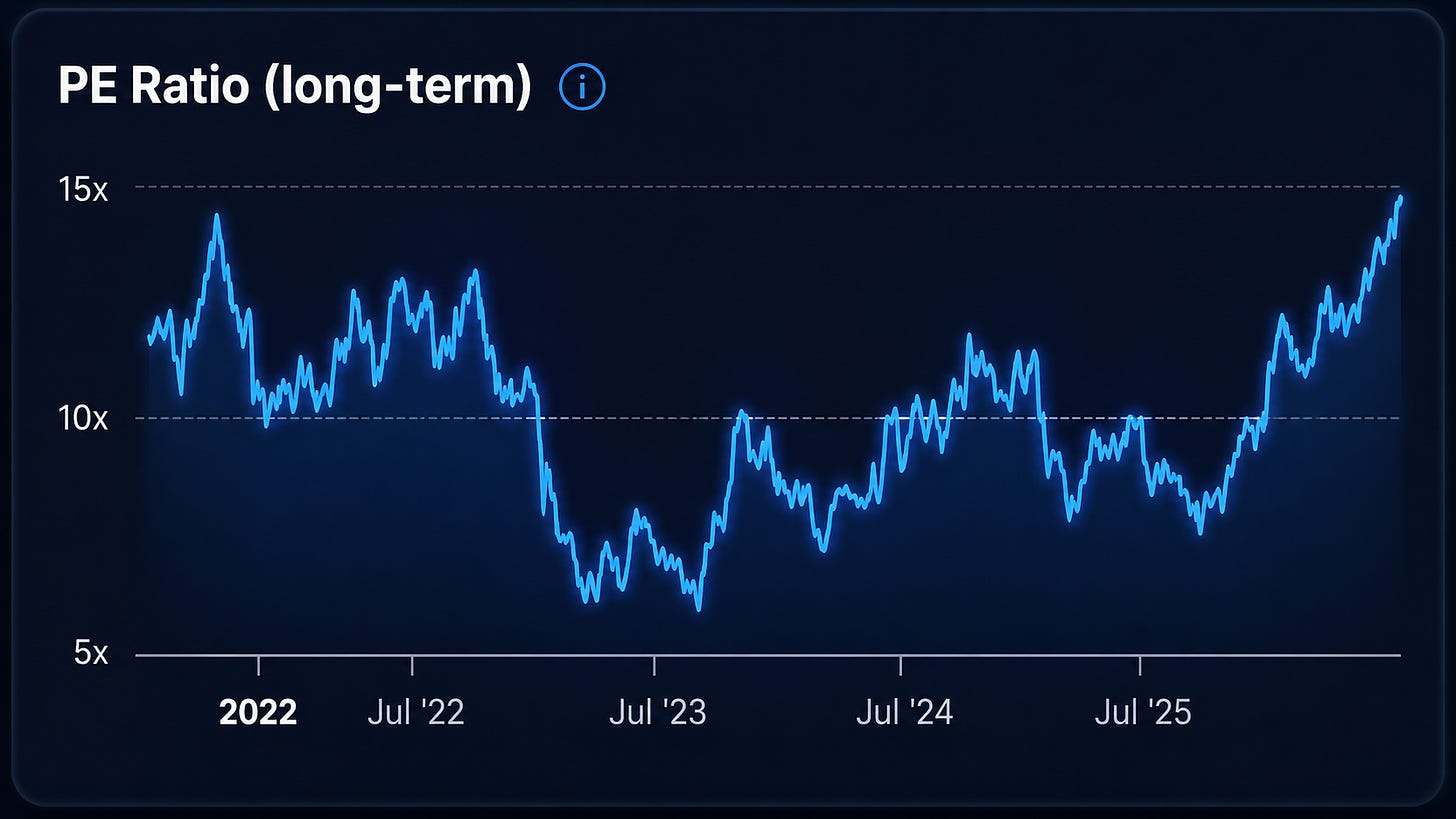
A year ago the conclusion was simple. AMAL was a fast grower trading like a sleepy bank. After a 50% run, that discount has narrowed. The stock now changes hands at about 11 times trailing earnings and 12 times next year’s, up from a five-year average near 9 times. Ziggma’s valuation sub-score of 46 out of 100 confirms it: the stock is no longer a standout bargain.
Source: Ziggma
The multi-year record is strong but uneven. Revenue has compounded at about 10% a year over five years, and earnings per share at roughly 15%. Yet 2025 was a soft patch, with per-share earnings dipping slightly and revenue growth cooling to about 4%. The most recent twelve months show a recovery, with revenue up close to 10% again, and analysts expect profit growth to reaccelerate to around 17.6% in 2026. Loans sit at just 0.6 times deposits, leaving plenty of headroom to lend more, and the average yield on those loans has climbed to roughly 8.6%.
This is where AMAL shines. Return on equity has run in the mid-teens for years and stands near 13.6% today, while return on assets of 1.2% is healthy for a bank its size. The cost-to-income ratio has fallen from 65% in 2021 to about 51%, meaning more of every revenue dollar reaches the bottom line. That efficiency earns AMAL a Ziggma profitability sub-score of 81 out of 100 and an overall Ziggma Score of 81, strong for the banking sector.
Here is the sobering part. The average analyst price target is $50.50, barely 3% above today’s price, so the market currently treats AMAL as fairly valued. Longer-term valuation models based on future cash flow tell a more generous story, sketching a path toward $65 to $70 if the bank sustains mid-teens returns and keeps expanding its loan book. The gap between those two views is the whole debate.
The near-term risks are real. Net interest margins could compress in the second half of the year before recovering, capping earnings momentum. A weaker economy would slow loan demand and could lift credit losses, though provisions remain low at about 0.3% of loans. With the valuation already re-rated, the stock needs earnings, not multiple expansion, to move higher from here.
On balance, the upside case no longer rests on cheapness. It rests on execution. If AMAL delivers the growth analysts expect, the current price is a floor to build on rather than a ceiling.
Plenty of banks talk about sustainability. Few can point to numbers like these.

Source: Ziggma
Amalgamated’s climate score is 90 out of 100, among the best in banking. Its footprint aligns with a 1.4 degree warming pathway, its own electricity is 100% renewable, and its carbon intensity has fallen 13% over the past year. This is not offset accounting. The bank actively finances solar, clean infrastructure and energy efficiency, so shareholder capital is doing real climate work.
Beyond climate, AMAL lends to affordable housing, community facilities and nonprofits serving underserved neighborhoods. It has paid zero regulatory fines, and its gender equality score is a near-perfect 97. As a certified B Corp, it is legally bound to weigh people and planet alongside profit.
AMAL’s resource-use score of 52 is its weakest impact area, dragged down by waste recycling of just 47%. A values-led bank should treat its own footprint as carefully as its clients’ projects. This is a gap to watch, not a dealbreaker, but it keeps AMAL from a spotless impact record.
The first half of the AMAL story, a cheap bank getting recognized, has largely played out in the share price. The next chapter is different. This is now a fairly valued, high-quality bank that has to earn its gains through growth, and the numbers suggest it can. With mid-teens returns, improving efficiency, forecast profit growth near 17.6% and a longer-term valuation case reaching toward $65 to $70, the upside is still there for patient investors.
What makes AMAL rare is that none of this asks for a trade-off. You get a disciplined, growing bank and a genuine climate and community mission in the same stock. AMAL also features in Ziggma’s Better Future model portfolio, which pairs high Ziggma Scores with high impact. For investors who want their money working toward a lower-carbon, fairer economy without giving up returns, Amalgamated remains one of the few true GoodStocks in US banking.
____________________________________________________________________________________________________________________________________________________
Disclaimer
This information is provided solely for general information and educational use. It is not intended as, and should not be construed to be, financial, investment, tax, legal, or other professional advice. Data used in the analysis is derived from third-party sources and applicable at the time of publication of the analysis. No representation or warranty is made as to the accuracy or completeness of the information or any analysis herein.
Ziggma is not registered or licensed as a financial advisor, broker-dealer, or tax professional. Readers should perform their own independent research and seek advice from appropriately qualified professionals before making any financial, investment, or legal decisions.
You should presume that, as of the date this report is published or any related communication referencing publicly traded securities or assets, Ziggma team members may hold positions in the securities or assets discussed and could benefit financially from price movements. Positions may be changed without notice.
There is no duty to revise or update the content after publication. Neither Ziggma nor any affiliated parties accept responsibility for market changes, economic developments, or subsequent events that could affect the relevance or accuracy of the information.
Forward-Looking Statements
This report may include forward-looking statements, such as forecasts, projections, estimates, or expectations regarding financial outcomes, market dynamics, or future corporate developments. These statements are based on assumptions that may not hold true, and actual results may vary materially. The author undertakes no obligation to update or revise any forward-looking statements as circumstances change.
Third-Party Data & External Sources
Certain information is sourced from third parties. Nonetheless, the accuracy, completeness, and timeliness of such information cannot be assured. Ziggma disclaims any responsibility for errors or omissions in third-party data and does not endorse, verify, or assume accountability for the methodologies or conclusions of external sources.
AI-Generated Enhancements
AI tools can be used to enhance clarity, structure, and brevity, and to assist with research organization, ideation, and analytical review.
Redistribution
You may share this report for informational purposes. However, reproduction, distribution, republication, or modification of any portion of the content, in whole or in part, without prior written consent is prohibited.
Investment Risk Disclosure
All investing carries risk of loss.. Historical performance does not guarantee future outcomes. References to specific securities, companies, or strategies are for informational purposes only and do not constitute recommendations or endorsements. Any use of, or reliance on, the information in this report is entirely at the reader’s own risk.
Neither Ziggma nor affiliated parties shall be liable for any direct or indirect losses or damages of any kind arising from the use of this report or reliance on its contents. By accessing this report, you agree to indemnify and hold harmless Ziggma and affiliated parties from any claims, liabilities, or damages resulting from your use of the material.
You alone bear responsibility for your decisions. Use this information at your own discretion and risk.