GoodStocks looks for companies where shareholder returns and real world impact reinforce each other. Genpact (G 🔎) qualifies on both counts. The shares are priced for a decline that is not happening, a gap worth roughly 33% if the market changes its mind.
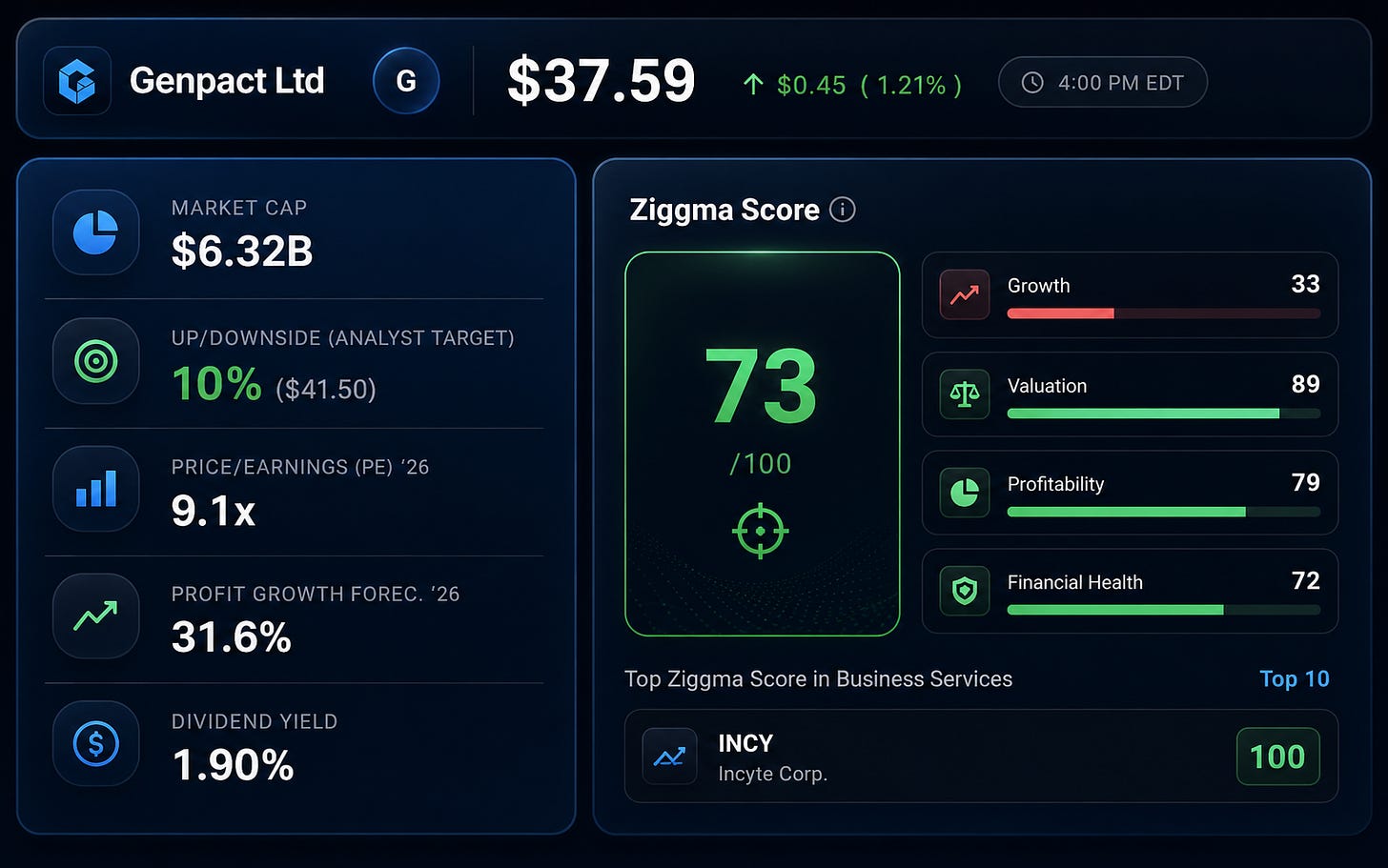
The stock changes hands at 9 times next year’s expected profit, barely half its own five year average. The market has decided artificial intelligence will gut the business of running other companies’ back offices. Genpact reached that conclusion before the market did and started building the machines.
Source: Ziggma
Genpact is guided to grow adjusted profit per share at least 12% this year, more than double what analysts expect from Accenture, Cognizant, Infosys and the rest of its peer group, yet it trades at 9 times earnings while they command far more. A Valuation sub-score of 89 next to a Profitability sub-score of 79 describes a quality business priced like a dying one. If the market stops treating it as a casualty of AI, the re-rating alone is worth more than several years of earnings growth.
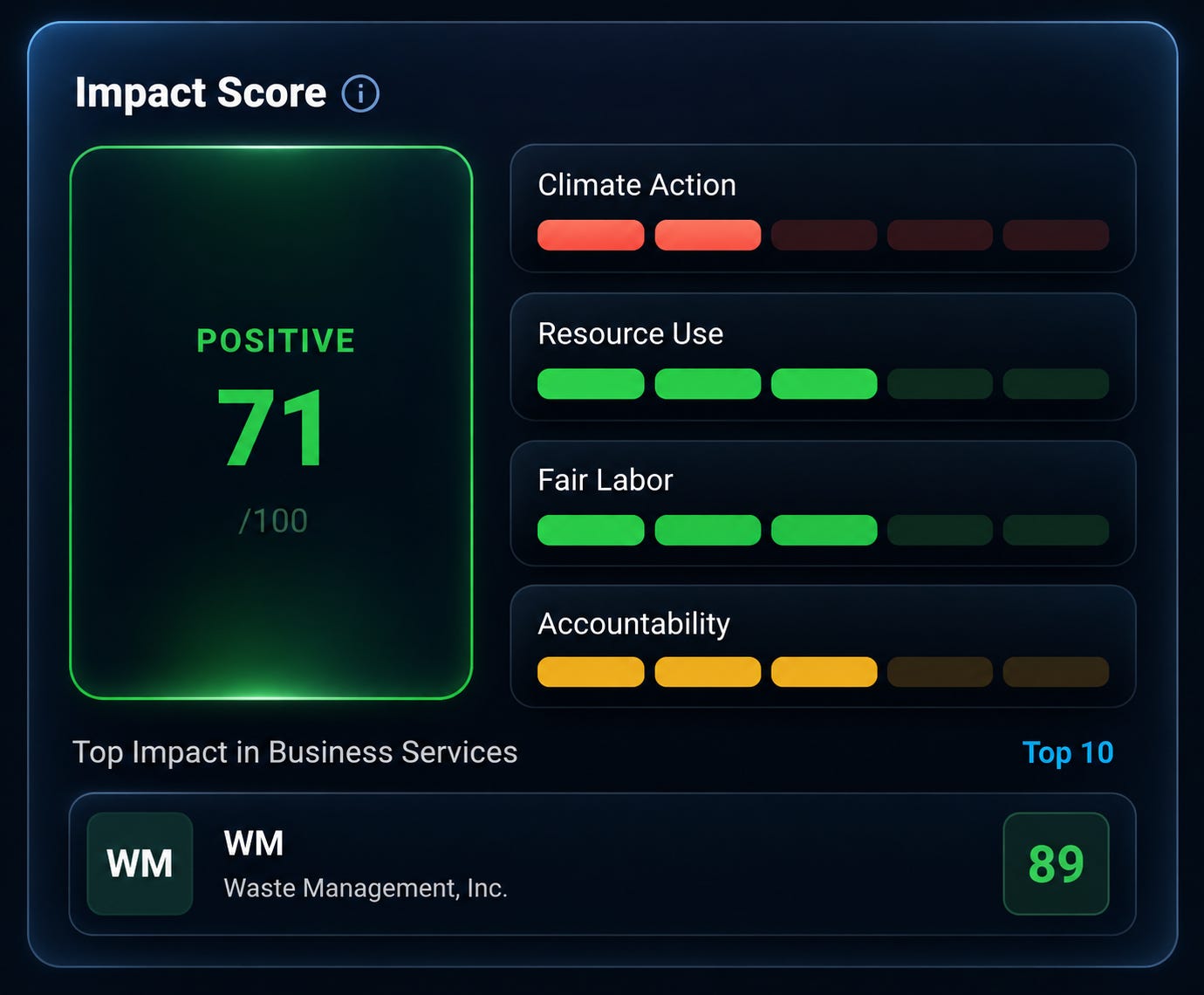
Genpact’s positive impact is not something you can hold in your hand. It is 145,000 mostly Indian workers being trained into better roles rather than made redundant, backed by 12.5 million hours of learning logged in 2025, 40% of it on AI and technology. Its Ziggma Impact Score is 71 out of 100, with gender equality at 88, water stewardship at 94 and validated targets on the way to net zero by 2050.
When you file a claim or chase a refund, a Genpact employee may well sit somewhere in that chain. Spun out of General Electric in 2005, it runs finance, procurement, supply chain and customer operations for large enterprises in banking, insurance, healthcare and manufacturing.
The business reports in two pieces. Core Business Services, the traditional operations work, brought in $980 million last quarter and grew 1.9%. Advanced Technology Solutions, the data and AI side, brought in $363 million and grew 24.1%. That second bucket is now 27% of revenue.
The moat is unglamorous and real. Once Genpact runs your accounts payable across 40 countries, switching means unpicking years of process knowledge and compliance sign-offs.
Profit-based valuation cut in half
In 2021, investors paid 26 times earnings for Genpact. By last year they paid 15 times. Today it is 9 times next year’s adjusted estimate, and less than one times revenue against a five year average of nearly twice that. Measured on reported earnings rather than adjusted, the multiple is closer to 11 times, since the company adds back the stock it pays employees. Either way, nothing in the operating numbers explains a haircut that severe.
The comparison Genpact itself draws is more awkward for the market. Set against Accenture, Cognizant, Infosys, Tata and the rest of the group, Genpact expects revenue growth of at least 7% this year while analysts have peers at 5.4%, and adjusted profit per share growth of at least 12% against 5.5%. It has expanded gross margin for 13 quarters running while the peer group has been flat. The faster grower is the cheaper stock.
Either way, nothing in the operating numbers explains a haircut that severe. We made much the same argument about Adobe in August, for much the same reason.
Growth is slow overall and fast where it counts
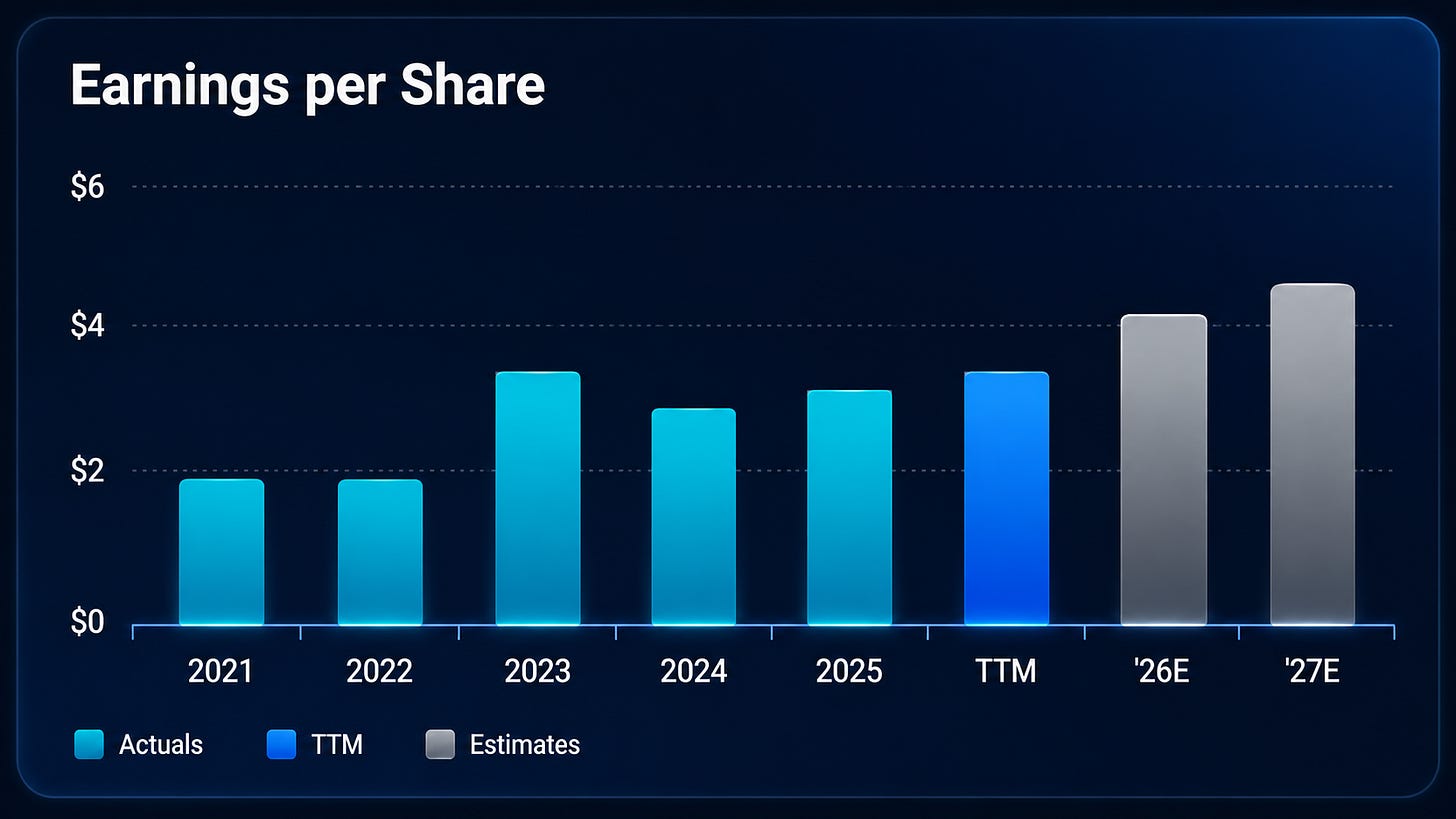
Revenue has compounded at 4.8% over five years, pulling down the Ziggma Growth sub-score to a modest 33. Underneath, profit per share has compounded at 10.4% and dividends at 44.6%. Bookings and backlog both hit records last quarter, and the company expects to book over $1B of agentic contract value this year, five times the 2025 level.
Source: Ziggma
Three raises in fourteen months
In June 2025, Genpact told investors its technology segment would grow in the mid-teens during 2026. In February it said high-teens. In May it said at least 20%. In August it said at least 25%. Three upgrades in fourteen months is the kind of evidence that survives a skeptical reading, because it shows a business outrunning its own management’s forecasts rather than a single hopeful projection.
The new revenue is better revenue
Faster growth alone would not justify a re-rating. The mix does. Every employee in the technology segment generates more than twice the revenue of the company average. Around 70% of that revenue recurs year after year, and a similar share is priced on output rather than on how many people are assigned to the account. Clients who have already moved across carry gross margins more than 300 basis points higher than before. Genpact is swapping a lower quality of revenue for a higher one, and that is what a multiple of 9 times ignores.
The cash flow line deserves a hard look
Operating cash flow has climbed steadily, from $444 million in 2022 to $813 million last year, a jump of 32% in 2025 alone. Then it stalled. Genpact burned $24 million in the first quarter of 2026 and generated $72 million in the second, $48 million for the half against $217 million a year earlier. Cash tends to arrive late in Genpact’s year, so the second half will settle whether this is timing or something worse. Across the last twelve months the company still collected $643 million, roughly level with the twelve before it. If the pattern does not correct, the buyback that has retired close to 39% of shares since 2015 gets harder to fund.
Risks and what analysts see
The consensus target is $41.50, about 10% above today, which tells you analysts have not decided whether the pivot works. Clients could pull this work in-house. Exiting non-strategic contracts costs nearly two points of growth in 2026. Cash conversion may not recover quickly.
Upside
At 12 times 2026 profit, still below its own history, the shares would trade near $50 against $37.59 today, roughly 33% higher, before the 1.93% dividend and continued buybacks.
Genpact's positive impact is not something you can hold in your hand, the way you can hold an MSA Safety breathing apparatus.
The reskilling bet
Most companies automating this aggressively would simply cut. Genpact aims to turn every employee into an AI practitioner within three years, with managers delivering the training. In a country where this work has been a ladder into the middle class for millions of families, that choice matters. Ziggma scores Fair Labor at 64, helped by an employee rating of 3.80 out of 5 and gender equality at 88, with roughly 41% women across the workforce and about 40% in leadership.
Source: Ziggma
A clean record
Accountability scores 55. Fines and violations sit at $0 for a perfect 100, and privacy and data management scores 81, which matters for a company handling sensitive financial and medical records at scale.
Where it falls short
Climate Action scores 37 and we are not going to dress that up. Energy from renewables sits at 27% and waste recycling at 59%, the two reported metrics holding the score down. Genpact holds a top climate disclosure rating and a validated 2050 net zero target, and its own 2025 reporting claims renewables reached 40%. Disclosure is good. Performance has further to travel. Chief executive pay at 279 times the median worker scores a poor 17, which sits awkwardly beside the labor story above.
Genpact does not make solar panels or heart valves. Its case rests on being an unusually decent operator in an industry with plenty of indecent ones, and on handling the most disruptive workforce transition in its history without discarding the people who built it. On the numbers, you are paying 9 times forward earnings for a business growing profit at double digits and rebuilding itself around the technology everyone assumes will destroy it. Chances are that market pessimism is setting Genpact stock up for a major turnaround opportunity.
______________________________________________________________________________
Disclaimer
This information is provided solely for general information and educational use. It is not intended as, and should not be construed to be, financial, investment, tax, legal, or other professional advice. Data used in the analysis is derived from third-party sources and applicable at the time of publication of the analysis. No representation or warranty is made as to the accuracy or completeness of the information or any analysis herein.
Ziggma is not registered or licensed as a financial advisor, broker-dealer, or tax professional. Readers should perform their own independent research and seek advice from appropriately qualified professionals before making any financial, investment, or legal decisions.
You should presume that, as of the date this report is published or any related communication referencing publicly traded securities or assets, Ziggma team members may hold positions in the securities or assets discussed and could benefit financially from price movements. Positions may be changed without notice.
There is no duty to revise or update the content after publication. Neither Ziggma nor any affiliated parties accept responsibility for market changes, economic developments, or subsequent events that could affect the relevance or accuracy of the information.
Forward-Looking Statements
This report may include forward-looking statements, such as forecasts, projections, estimates, or expectations regarding financial outcomes, market dynamics, or future corporate developments. These statements are based on assumptions that may not hold true, and actual results may vary materially. The author undertakes no obligation to update or revise any forward-looking statements as circumstances change.
Third-Party Data & External Sources
Certain information is sourced from third parties. Nonetheless, the accuracy, completeness, and timeliness of such information cannot be assured. Ziggma disclaims any responsibility for errors or omissions in third-party data and does not endorse, verify, or assume accountability for the methodologies or conclusions of external sources.
AI-Generated Enhancements
AI tools can be used to enhance clarity, structure, and brevity, and to assist with research organization, ideation, and analytical review.
Redistribution
You may share this report for informational purposes. However, reproduction, distribution, republication, or modification of any portion of the content, in whole or in part, without prior written consent is prohibited.
Investment Risk Disclosure
All investing carries risk of loss.. Historical performance does not guarantee future outcomes. References to specific securities, companies, or strategies are for informational purposes only and do not constitute recommendations or endorsements. Any use of, or reliance on, the information in this report is entirely at the reader’s own risk.
Neither Ziggma nor affiliated parties shall be liable for any direct or indirect losses or damages of any kind arising from the use of this report or reliance on its contents. By accessing this report, you agree to indemnify and hold harmless Ziggma and affiliated parties from any claims, liabilities, or damages resulting from your use of the material.
You alone bear responsibility for your decisions. Use this information at your own discretion and risk.